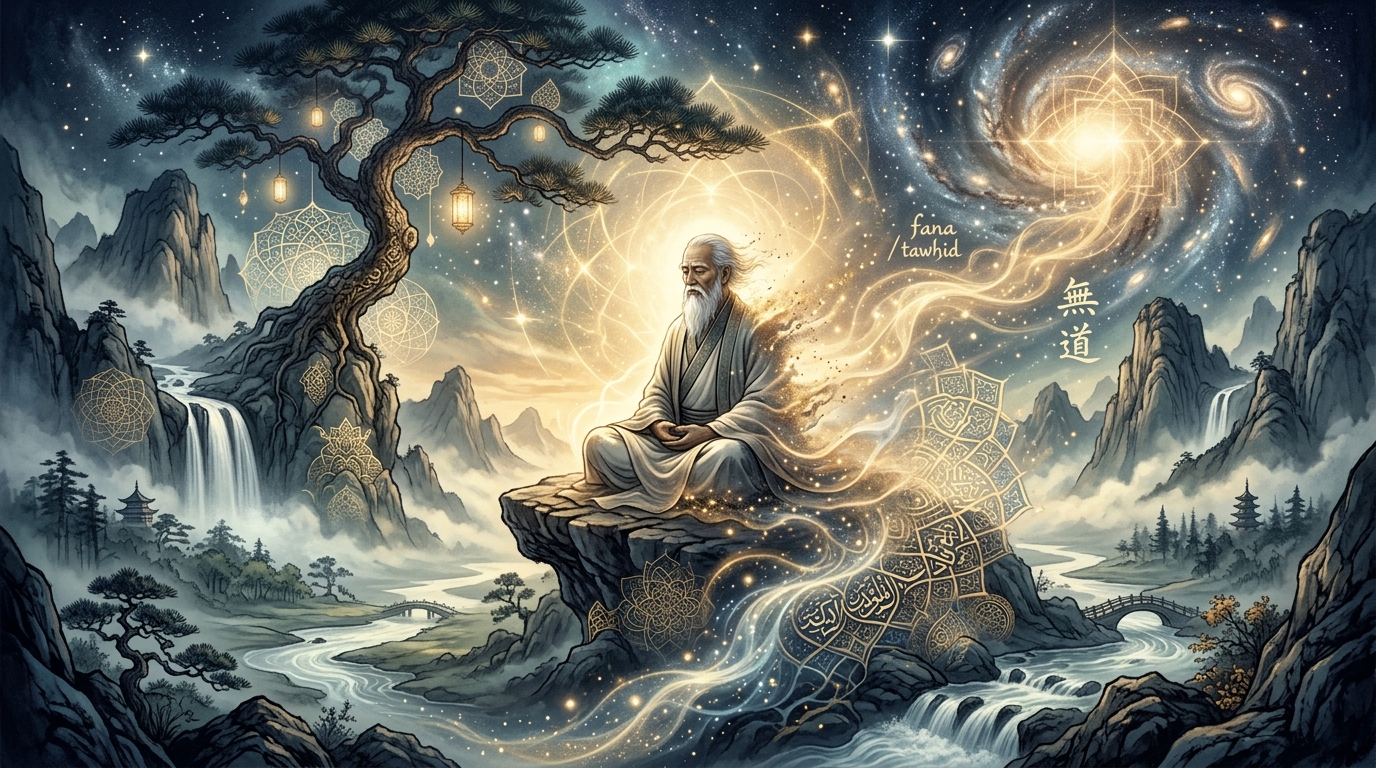
 【Overview】 The Supreme Nexus of Two Deep Philosophies: Radiant Emergence of Extraordinary Being Born from Ego Annihilation
*Note: While sharing foundational themes with the previous dialogue "Deep Philosophy of Being, Non-Being, and Awakening," this text focuses specifically on Toshihiko Izutsu's masterpiece "Sufism and Taoism: A Comparative Study of Key Philosophical Concepts," offering an exhaustive, multi-dimensional inquiry into the structural correspondences between Islamic Sufism (Ibn 'Arabī) and ancient Taoism (Lao-tzu & Chuang-tzu).
Why did two traditions separated by centuries and continents converge miraculously upon two pivotal axes ("The Absolute" and "The Perfect Man"), radical anti-essentialism, and existence as dynamic effusion ("The Cosmic Wind" / t'ien lai)? From the reversal of centrifugal ego-craving (tso-ch'ih) through "Fasting of the Heart" (hsin-chai), to the three sequential stages of de-articulation (putting outside the world, things, and life itself), and the joyful return to everyday multiplicity as transparent cosmic play (Baqā', Miao Yu, and Yú)—this dialogue unveils the complete anatomy of awakening.
Could you provide a comprehensive summary and analysis of Toshihiko Izutsu’s representative English masterwork, Sufism and Taoism: A Comparative Study of Key Philosophical Concepts—specifically examining its overall architecture, core metaphysical themes, and rigorous comparative methodology that transcends mere historical influence?
Dialogue 1: Architecture of "Sufism and Taoism" and the Milestone of Synchronic Comparative Metaphysics
Toshihiko Izutsu’s (1914–1993) landmark English work, Sufism and Taoism: A Comparative Study of Key Philosophical Concepts, stands as an unexcelled summit of comparative philosophy and metaphysics. It builds a rigorous conceptual bridge between the metaphysical architectures of Ibn 'Arabī (1165–1240), the supreme theoretician of Islamic mysticism (Sufism), and Lao-tzu and Chuang-tzu, the seminal masters of ancient Chinese Taoism.
1. Overall Architecture and Rigorous Methodology
To prevent arbitrary parallels or superficial comparisons between two spiritual traditions that possessed no historical or geographical contact, Izutsu instituted a strict tripartite structure:
- Part I: Ibn 'Arabi's Ontology: A rigorous primary-text analysis of Ibn 'Arabī’s magnum opus, Fuṣūṣ al-Ḥikam ("The Ringstones of Wisdom"), independently determining the precise meanings of Pure Existence (wujūd), Divine Self-Manifestation (tajallī), Permanent Archetypes (a'yān thābitah), and the Divine Names (asmā').
- Part II: Lao-Tzu and Chuang-Tzu's Taoist Metaphysics: An independent philological and conceptual analysis of the Tao Te Ching and the Inner Chapters of the Chuang-Tzu, elucidating linguistic de-articulation, anti-essentialism, the self-unfolding of the Way (Tao), Primordial Chaos (hun tun), Sitting-in-Forgetfulness (tso-wang), and the Transmutation of Things (wu hua).
- Part III: Comparative Analysis: Bringing together the two independently extracted conceptual fields into a "meta-historical dialogue," comprehensively articulating their shared ontological ground and rigorous one-to-one correspondences.
2. Two Pivotal Axes Driving the Worldview: "The Absolute" and "The Perfect Man"
Izutsu demonstrated that both systems revolve around two fundamental poles, generating a profound metaphysical tension:
| Pivotal Axis | Sufism (Ibn 'Arabī) | Taoism (Lao-tzu & Chuang-tzu) | Shared Metaphysical Essence |
|---|---|---|---|
| The Absolute | The Real (Ḥaqq), Pure Existence (Wujūd), Unknowable Essence (Dhāt al-wujūd / Ghayb al-ghuyūb) | The Way (Tao), The Nameless, Non-Being (Wu), Mystery of Mysteries (Hsüan chih yu hsüan) | An unarticulated, transcendent realm completely beyond the reach of human language and conceptual discrimination. |
| The Perfect Man | al-Insān al-Kāmil | The Sage (shēng-jên), The True Man (chên-jên), The Perfect Man (chih-jên) | The awakened human being who annihilates the private ego (fanā' / tso-wang) to act as a polished cosmic mirror, reflecting the Absolute’s self-manifestation. |
3. Multistratified Self-Manifestation and the Paradox of "The One and the Many"
The Absolute is not an inert silence; it radiates (tajallī / shēng) hierarchically into the phenomenal multiplicity of the cosmos:
- Sufi Hierarchy: Unknowable Essence (Dhāt) → Absolute Unity (Aḥadīyah) → Unity-in-Multiplicity (Wāḥidīyah / Archetypes a'yān thābitah) → Imaginal World (‘Alam al-mithāl) → Phenomenal Entities (Mawjūdāt).
- Taoist Hierarchy: Mystery (Hsüan) → Non-Being (Wu) → The One (I) → Being (Yu) → The Ten Thousand Things (Wan-wu).
Phenomenal things possess no independent self-subsistent essence; they are merely temporary differentiations of the singular Absolute. Reality is thus intuited as a dynamic field of the coincidentia oppositorum ("one in many, many in one").
✦ Significance of Izutsu's Comparative Breakthrough
By establishing the Arabic concept of Existence (wujūd) as an interpretive axis, Izutsu proved that seemingly disparate Eastern spiritual traditions could be unified into an organic semantic field. He elevated comparative philosophy from a post-hoc historical trace to a forward-looking dialogue on universal human consciousness.
What are the "Seven Structural Commonalities" that Toshihiko Izutsu identified between Ibn 'Arabi's Islamic Sufism and ancient Taoism? How do they function as shared metaphysical patterns?
Dialogue 2: Seven Deep Structural Correspondences Bridging Sufism and Taoism
Izutsu demonstrated that beneath radical linguistic, geographical, and cultural divides, Sufism and Taoism share a profound metaphysical isomorphism across seven fundamental dimensions:
1. Two Pivotal Axes ("The Absolute" and "The Perfect Man")
Both systems structure their entire ontology between the ineffable transcendent Ground (Ḥaqq / Tao) and the awakened human being (al-Insān al-Kāmil / Chên-jên) who, by emptying the private ego, becomes the living microcosm and mirror of the cosmos.
2. Multistratified Self-Manifestation (Tajallī)
Both reject the idea that reality jumps directly from nothingness to physical matter. Instead, reality unfolds through precise hierarchical gradations: from dark unarticulated mystery to pristine oneness, to the archetypal realm of forms, and finally down to concrete phenomenal things.

3. Anti-Essentialism and the Primacy of Existence (Wujūd)
Both critique naive realism, which assumes that objects possess fixed, independent essences (māhīyah) inherent in themselves. Fixed objects are mental abstractions carved out by language; pure dynamic Existence-as-Act (wujūd / Tao) is the sole authentic reality, and entities are merely its modal expressions (tajallī / wu hua).
4. Dynamic Flow of Existence ("The Cosmic Wind" and "Effusion of Being")
Existence is not static matter; it is an ongoing vibration. Chuang-tzu’s evocative metaphor of the "Cosmic Wind" (t'ien lai) sounding through all hollows of the world corresponds perfectly with Ibn 'Arabī’s "Effusion of Being" (sarayān al-wujūd) and the "Breath of the Merciful" (nafas al-raḥmānī). The universe is recreated anew at every single instant (khalq jadīd).
5. Process of Subjective Annihilation (Fanā' and Tso-wang)
Direct realization of this truth demands an existential deconstruction of dualistic consciousness. Sufi Fanā' (Ego Annihilation) and Taoist Tso-wang (Sitting-in-Forgetfulness) / Hsin-chai (Fasting of the Heart) share the exact same function: extinguishing the discursive intellect to achieve pure luminous void (hsü).
6. Return to Multiplicity and Absolute Freedom (Baqā' and Yú)
Ego annihilation is not the final resting point. In the stage of return (Baqā' in Sufism, Yú / Free Wandering in Taoism), the awakened person re-enters ordinary daily life, experiencing everyday multiplicity as the vibrant, transparent self-revelation of the One.
7. Ontological Indiscriminateness (Mercy / Raḥmah and Non-Benevolence / Pu-jen)
Ibn 'Arabī defines God's bestowal of existence upon all things as "Unconditioned Mercy" (raḥmah). Lao-tzu proclaims that "Heaven and Earth are non-benevolent (pu-jen); they treat the ten thousand things as straw dogs." Izutsu showed that both represent the impartial, non-sentimental universality of the Absolute, which showers existence upon all entities without moral favoritism.
Please explore the internal mechanics of ego annihilation in both Sufi Fanā' and Taoist Tso-wang. How does the deconstruction of the subject lead directly to the collapse of objective essentialist boundaries?
Dialogue 3: Annihilation of the Ego ―― Simultaneous Collapse of Subject and Object
Corresponding to Sanskrit Nirvāṇa and Zen Shin-jin-datsu-raku (Casting off Body and Mind), Sufi Fanā' and Taoist Tso-wang represent master models of ontological de-articulation.
1. Deep Dive into Sufi Fanā'
- Shattering the Ego-Shell: The everyday surface ego (nafs) is an opaque shell that isolates individual awareness from the cosmic sea of Being. Through intensive remembrance (dhikr) and unified concentration (tawḥīd), this rigid shell dissolves, reuniting the drop with the ocean of Existence (wujūd).
- Simultaneous Collapse of Subject and Object: When the subjective "I" vanishes, the rigid boundaries isolating external objects (māhīyah) simultaneously disintegrate. Things cease to be separate entities and melt into the unarticulated totality (Jam').
- "Annihilation of Annihilation" (Fanā'-ye Fanā'): Emphasizing Jāmī’s insight, Izutsu notes that genuine Fanā' requires that the reflexive consciousness of "I have achieved annihilation" must also perish. As long as any self-awareness remains, dualism persists.
- Three Ascending Stations:
- Takhalluq (Annihilation of Human Traits): Earthly frailties are extinguished; Divine attributes take their place.
- Tahaqquq (Annihilation of Personal Essence): The individual essence dissolves into the Absolute Essence.
- Ta'alluq (Firm Abiding): Sanctity (walāyah) is firmly stabilized.
2. Deep Dive into Taoist Tso-wang
In Chuang-tzu, Sitting-in-Forgetfulness (tso-wang) is a radical corrective to the compulsive outward craving known as "Sitting-Galloping" (tso-ch'ih).
- From "Sitting-Galloping" to "Fasting of the Heart" (Hsin-chai): Even when the body sits still, the mind races out into the world. To reverse this, sensory and conceptual gates are sealed. Moving from listening with ears (senses) to listening with mind (concepts) to listening with vital breath (ch'i / pure void hsü), awareness sinks centripetally into the primal source.
- Withered Tree and Cold Ashes: Chuang-tzu defines tso-wang as "sloughing off limbs, banishing intelligence, discarding bodily form, and identifying with the Great Pervader (Tao)." Externally, the meditator appears "with form like a withered tree and mind like cold ashes."
- Dissolution into Primordial Chaos: When the axis of ego vanishes, external objects lose their conceptual fences, dissolving into the Boundless Void (Ta-hsü) or Primordial Chaos (Hun-tun).
✦ Not Unconsciousness, But Supra-Consciousness
Ego annihilation is not a swoon, trance, or mental extinction. It is the unveiling of an ever-lucid, unconditioned Supra-Consciousness (Ever-lucid Awareness / 常知)—clearing the inner space so that the Absolute's creative impulse flows without resistance.
Following the annihilation of the ego, what occurs during the "Return to Phenomenal Reality (Baqā' / Miao Yu / Free Wandering)"? How is everyday world-perception fundamentally transformed across Sufism, Zen, and Taoism?
Dialogue 4: Return to the Phenomenal World ―― Baqā', Miao Yu, and the Joy of Free Wandering
In Eastern metaphysics, dissolution into Emptiness is never the final destination. The true consummation of enlightenment is the return to the everyday world through transformed eyes, re-affirming ordinary life with absolute lucidity.
1. Dialectical Architecture of the Return
Izutsu formulated this epistemological transformation through the Zen dialectic of Master Qingyuan and the Logic of Soku-Hi:
- Stage 1 (Naive Realism): Dualistic consciousness. 《\(A \text{ is } A\)》 — "Mountains are mountains; waters are waters." Things are perceived as opaque, separate objects.
- Stage 2 (Emptiness & Ego Annihilation): Plunge into the Void (Fanā' / Tso-wang). 《\(A \text{ is non-}A\)》 — "Mountains are not mountains; waters are not waters." All boundaries dissolve into inarticulate nothingness.
- Stage 3 (Extraordinary Being / Return): Return to phenomenal multiplicity (Baqā' / Miao Yu / Yú). 《\(A \text{ is (again) } A\)》 — "Mountains are once again mountains; waters are once again waters."
The "mountain" that re-emerges in Stage 3 is not a mundane concept. It is the entire, unarticulated energy of the Absolute condensed and exposing itself in that exact place and moment as transparent, radiant Being (Miao Yu).
2. Concrete Modalities of Return Across Traditions
Sufi Baqā' (Subsistence in God)
The individual returns as a "Cosmic Self," established within the very Being of the Real. Phenomena are no longer solid, blocking obstacles; they become translucent mirrors reflecting Divine Names. Actions are experienced not as "my actions," but as God’s action flowing directly through the human form.
Zen Miao Yu and the Coincidentia Oppositorum
As illustrated in Master Dongshan’s verse ("Snow piled in a silver bowl, a white heron hidden in moonlight"), multiplicity and unity interpenetrate without mutual obstruction. White on white, yet silver bowl and snow preserve their distinct places in absolute harmony.
Taoist Wu-hua (Transmutation) and Yú (Free Wandering)
As in Chuang-tzu’s Butterfly Dream, the boundaries between self and other, life and death, success and failure dissolve into the continuous self-transformation of the Way (wu-hua). The ordinary physical environment becomes the pristine "Land of Nothingness" (Wu-ho-yu-chih-hsiang), and every simple daily step becomes a celestial journey (逍遥遊 / Yú).
✦ Three Core Transformations of World-Perception
- Ontological Transparency: External objects cease to be opaque walls; they become luminous windows opening onto the Infinite.
- Dynamic Field of Pure Awareness (SEE): Subject and object merge into an active, self-arising field of consciousness ("A person becomes bamboo, bamboo becomes a person").
- Absolute Affirmation of the Ordinary: The ultimate truth is not elsewhere. Eating when hungry, sleeping when tired, and feeling rain on one's face are celebrated as the complete manifestation of the Absolute.
Could you delve deeper into the structural mechanics of the surface ego’s outward craving ("centrifugal motion" / tso-ch'ih) versus the meditative "centripetal reversal" that leads to liberation?
Dialogue 5: From Centrifugal Dissipation to Centripetal Inwardness ―― Mechanics of the Ego and Awakening
How does the human mind imprison itself within concepts, and how does it break free? Izutsu analyzed the mechanics of consciousness dynamically in terms of directional vectors: centrifugal dissipation versus centripetal concentration.
1. The Surface Ego's Centrifugal Rush (Tso-ch'ih) and the "Preconditioned Mind"
- Ego as the Axis of Division: In daylight consciousness, the surface ego (chi / nafs) functions as the false center around which external reality is chopped into rigid categories (māhīyah).
- Centrifugal Addiction (Tso-ch'ih): Driven by sensory cravings, fear, and intellectual restlessness, the ego constantly rushes outward toward external stimuli. Chuang-tzu calls this "Sitting-Galloping" (tso-ch'ih)—sitting still in posture while the mind gallops madly through the world.
- Tyranny of the "Preconditioned Mind" (Ch'éng-hsin): When centrifugal habits solidify, they become rigid biases (ch'éng-hsin), forcing dualistic judgments ("good vs. evil," "self vs. other") upon experience and completely blinding humanity to primordial Unity.
2. Centripetal Reversal and "Fasting of the Heart"
Awakening requires reversing this vector 180 degrees inward—a "Centripetal Movement."
By sealing sensory apertures and refusing to latch onto mental images, the practitioner enters "Fasting of the Heart" (Hsin-chai). Consciousness vertically descends from the daylight noise of the surface (A-stratum) to the silent depths of the linguistic storehouse consciousness (B-stratum).
3. From Casting Off Body and Mind to the Cosmic Self
At the apex of centripetal focus, both observer and observed collapse simultaneously—"Casting off Body and Mind" (shin jin datsu raku). When the illusory self dies in this abyss of Being, it resurrects as "Cast-off Body and Mind" (datsu raku shin jin): the true, unconfined Cosmic Self (Baqā'), effortlessly dancing amidst phenomenal reality.
What are the specific stages, required durations, and successive spiritual illuminations of "Sitting-in-Forgetfulness" (Tso-wang) as taught by the sage Nü Yü in Chuang-tzu (The Great Ancestral Teacher)?
Dialogue 6: The Three Stages of Tso-wang ―― Nü Yü's Doctrine of Sequential Detachment and Illumination
One of the most profound textual passages analyzed in Sufism and Taoism is the dialogue in Chuang-tzu (Chapter 6: "The Great Ancestral Teacher") where the sage Nü Yü instructs Pu Liang I in the precise, graduated stages of Tso-wang (putting outside / externalizing):
1. The Three Sequential Stages of Detachment
| Stage | Practical Step | Duration | Object and Mechanism of Detachment |
|---|---|---|---|
| Stage 1 | Wai-t'ien-hsia (Putting Outside the World) |
3 Days | Forgetting the Macrocosmic World: Detaching from the external social order, human politics, and the world at large. Because the macro-world is relatively distant from the ego’s core, it is the easiest to externalize and forget first. |
| Stage 2 | Wai-wu (Putting Outside Things) |
7 More Days (10th Day Total) |
Forgetting Immediate Environmental Objects: Eradicating attachment to daily tools, possessions, and physical surroundings. Because daily objects directly serve physical survival, they are harder to forget than abstract "society," requiring deeper internal sinking. |
| Stage 3 | Wai-sheng (Putting Outside Ego-Life) |
9 More Days (19th Day Total) |
Forgetting Personal Existence and Life: Discarding the innermost core of the ego—one’s own physical life, mental self-identity, and bodily attachment. With this, all conceptual barriers between subject and object completely vanish. |
2. Sequential Illumination Following "Wai-sheng"
The instant one puts outside life itself (wai-sheng), consciousness is completely unchained from dualistic structures, triggering an instantaneous cascade of spiritual awakenings:
- Ch'ao-ch'e (Morning Clarity): Transparent spiritual vision (ming) suddenly bursts open like the rising sun penetrating mist.
- Chien-tu (Seeing the Solitary / Absolute): Direct, unmediated contemplation of the unique Absolute (Tao), beyond all relative opposites.
- Wu-ku-chin (Transcendence of Past and Present): The temporal distinctions between past, present, and future dissolve completely.
- Entering into No-Death and No-Life: Complete identification with the primordial, unarticulated realm of the Way, transcending physical birth and death.
How does Nü Yü’s three-stage Tso-wang correlate point-by-point with the three stages of Fanā' (Annihilation of Actions, Attributes, and Essence) in Islamic Sufism? What is the ultimate ontological conclusion Izutsu draws from this correspondence?
Dialogue 7: The Universal Matrix of Consciousness-Sinking ―― Structural Correspondence between Tso-wang and Three-Stage Fanā'
The crowning achievement of Izutsu’s comparative metaphysics is the demonstration that Taoist Tso-wang and Islamic Fanā' map onto a singular, universal paradigm of the de-articulation of human consciousness.
1. Three-Stage Structural Correspondence Matrix
Because the dissolution of subjective consciousness and the dissolution of objective quiddity (māhīyah) are simultaneous, the stages correspond with mathematical precision:
| Depth of Detachment | Taoism (Chuang-tzu / Nü Yü) | Sufism (Ibn 'Arabī / Jāmī) | Ontological Deconstruction |
|---|---|---|---|
| Stage 1 (Severing External Agency) |
Wai-t'ien-hsia (Putting Outside the World) |
Annihilation of Actions (Fanā' al-af'āl) |
The delusion of autonomous individual action and causal agency vanishes. All events in the macrocosm are recognized as the single dynamic activity of the Real (Haqq). |
| Stage 2 (Dissolving Specific Attributes) |
Wai-wu (Putting Outside Things) |
Annihilation of Attributes (Fanā' al-ṣifāt) |
The finite attributes (color, shape, solidity) of individual entities are negated. Objects have no intrinsic quiddity, becoming transparent reflections in the Imaginal World (‘Alam al-mithāl). |
| Stage 3 (Extinction of Personal Essence) |
Wai-sheng (Putting Outside Life/Ego) |
Annihilation of Essence (Fanā' al-dhāt / Annihilation of Annihilation) |
The relative individual essence dissolves into the dark abyss of the Absolute Essence. Even the thought "I am experiencing annihilation" perishes, completing pristine Union. |
| Subsequent Illumination (Consummation of Awakening) |
Morning Clarity, Seeing the Absolute, Entering No-Death No-Life | Unveiling (Kashf), True Unification (Tawḥīd), Transcendence of Time (Waqt) | The veil of phenomena drops away; the solitary Absolute (Tao / Wujūd) is directly intuited, and eternity is condensed into the living Now. |
2. Ontological Conclusions of Comparative Metaphysics
Why must human consciousness undergo such radical deconstruction? Izutsu articulates two fundamental answers:
- Dismantling the Opaque Prison of Language:
In everyday daylight consciousness, human beings are prisoners of essentialist illusions created by linguistic names (asmā' / ming). Tso-wang and Fanā' serve as an indispensable "metaphysical reduction" to shatter this conceptual mesh and return to raw, unarticulated reality. - The Indispensable Stepping Stone to Baqā' and Free Wandering:
By passing through the zero-point of the ego, human consciousness is reborn into the world. Everyday reality is no longer an arena of suffering and limitation, but a shimmering playground of the Absolute (Miao Yu / Yú), where every encounter is a direct revelation of the divine.
✦ Concluding Insight: From the Edge of Words to Transcendent Play
Izutsu's exploration in Sufism and Taoism transcends academic comparison. It provides a living metaphysical cartography for breaking the prison of words and stepping into absolute freedom. For the person who has cast off the ego, every mundane breath becomes a conscious participation in the infinite self-manifestation of Being.
Key Sources and References
- Sufism and Taoism: A Comparative Study of Key Philosophical Concepts (Toshihiko Izutsu, University of California Press): The masterwork establishing the synchronic structuration of Ibn 'Arabī and Lao-Chuang.
- The Concept and Reality of Existence (Toshihiko Izutsu, Keio Institute of Cultural and Linguistic Studies): Seminal monograph on the primacy of existence (aṣālat al-wujūd).
- The Structure of Oriental Philosophy (Toshihiko Izutsu, Keio University Press): Eranos lectures on multi-layered consciousness, mandala theory, and subjective-objective correspondences.
- Chuang-Tzu (Inner Chapters): Primary source for Nü Yü's doctrine, Tso-wang, Hsin-chai, and Wu-hua.
- Fuṣūṣ al-Ḥikam (Ibn 'Arabī): The foundational classic of Sufi ontology.