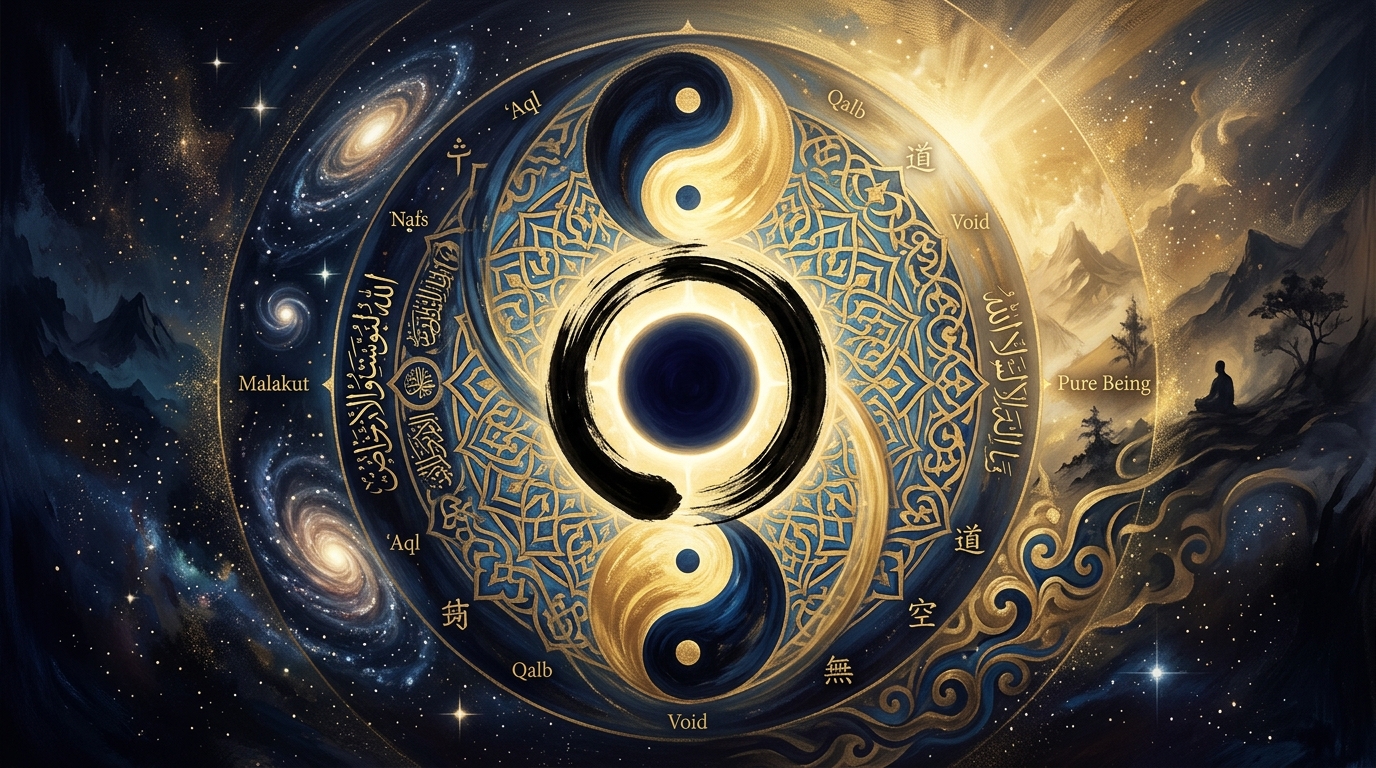
 【Overview】 Shattering the Prison of Language and Re-originating the Miracle of "Extraordinary Being"
Toshihiko Izutsu (1914–1993) was one of the intellectual titans of the 20th century. Synthesizing Islamic mysticism (the Unity of Existence of Ibn 'Arabi), ancient Chinese Taoism (Lao-tzu and Chuang-tzu), Mahayana Buddhism (Yogācāra, Mādhyamaka, Hua-yen, Zen, and Esoteric Buddhism), ancient Indian Advaita Vedānta, Western metaphysics, and depth psychology through his rigorous method of "synchronical structuralization," Izutsu's metaphysics shakes the very foundations of what we naively accept as "objective reality" and the "self."
This comprehensive dialogue traces the paradigm shift from Western Essentialism to the Oriental "Primacy of Existence (*aṣālat al-wujūd*)"; the mechanics of "semantic articulation" by which language carves reality; the three-layer model of consciousness (A-stratum, M-region, B-stratum) mirroring the multi-layered cosmos; the Zen logic of *Soku-Hi* making existence transparent; the spiritual technology of Taoist "sitting in forgetfulness" (*tso-wang*) leading to absolute freedom (*Yu*); and the ultimate ideal of the "Perfect Man" (*al-Insān al-Kāmil*). It rigorously articulates that truth which lies beyond words, at the very outer limits of language itself.
As I study Professor Toshihiko Izutsu's philosophy, I notice a profound divergence between traditional Western metaphysics—from Aristotle through modern ontology—and the Oriental and Islamic metaphysics that Izutsu sought to illuminate. The way they conceptualize "Being" or "Existence" seems entirely different. Could you explain in detail the metaphysical and epistemological differences between Western "Essentialism" and the Oriental ontology grounded in what Professor Izutsu calls "the primacy of existence (aṣālat al-wujūd)"?
Dialogue 1: The Horizon of Oriental Ontology Overcoming Western Metaphysics — From Essentialism to the Primacy of Existence
Your question touches upon the most decisive turning point in Toshihiko Izutsu's comparative metaphysics—the foundational motif that drives his entire intellectual enterprise.
The fundamental divergence between traditional Western metaphysics and the Oriental-Islamic ontology decoded by Izutsu is not merely a matter of terminology or conceptual nuances. It stems from a radical opposition in ontological and epistemological paradigms: namely, the basic stance from which human consciousness experiences and interprets the world.
1. The Structure of Western Essentialism
In the traditional Western metaphysical trajectory established by Aristotle and maintained throughout medieval Scholasticism and much of modern philosophy, "quiddity" or "essence" (māhīyah) occupies the absolute center of ontological understanding. Under this paradigm, individual "things" (mawjūdāt) or solid entities are assumed to exist objectively in the external world as primary reality. Concrete entities such as a human being, a mountain, a horse, or a table are treated as primary substances (prōtē ousia). The conceptual definitions that state what these things are (e.g., "humanness," "mountainness") are designated as their "essence" (māhīyah).
Within this essentialist framework, "existence" (wujūd / actus essendi) is treated merely as a secondary predicate or an accidental property ('āriḍ) attached to a pre-existing essence. To say "the mountain exists" implies that there is a primary, self-subsisting essence called "mountain," to which the state of "existing" is attributed as a logical predicate. Consequently, reality is conceptualized as a static collection of distinct, self-contained essences, neatly demarcated by logical definitions.
2. The Oriental-Islamic Shift to the Primacy of Existence (aṣālat al-wujūd)
In stark contrast, the mystical metaphysics of Islamic philosophy—particularly the school of Iran exemplified by Mulla Sadra and Sabzawari—and the deep Oriental traditions of Taoism and Zen execute a complete 180-degree reversal of this relationship. This reversal is encapsulated in the principle of aṣālat al-wujūd—the "fundamental reality or primacy of existence."
- Pure Dynamic Act as Ultimate Reality: Here, what is truly real is not the static, conceptual "essence" (māhīyah), but the dynamic, continuous "Act of Existence" (wujūd / actus essendi). Wujūd is not a passive property belonging to a thing; it is the sole, ultimate, self-subsisting Reality.
- Essence as Self-Manifested Limitation: Individual "things" and their "essences" (māhīyah) are nothing more than the internal limitations, boundaries, or shadow-like projections (i'tibārī) produced when this single, infinite ocean of Existence limits and articulates itself in various modes. A "mountain" is not a fixed substance that happens to possess existence; rather, it is the infinite Act of Existence momentarily freezing and displaying itself in the specific modal boundary known as "mountainness."
3. Epistemological Transformation and the "Field of Consciousness"
This metaphysical shift necessitates a radical epistemological transformation. Essentialism operates within daylight, surface consciousness—a dualistic mode of mind that relies on linguistic categorization to divide reality into separate subjects and objects.
Conversely, the Oriental philosophy of wujūd cannot be accessed through conceptual analysis alone. It demands an experiential, meditative transformation of consciousness wherein the empirical ego dissolves, leading to the "Identity of Subject and Object" (ittiḥād al-'ālim wa-al-ma'lūm). When the rigid boundary of the ego breaks down, consciousness ceases to be an isolated spectator observing external objects. Instead, it becomes the very "Field of Existence" within which reality manifests itself.
✦ Essentialism vs. The Primacy of Existence
While Western Essentialism asserts that "a mountain exists as an essence, possessing existence as an attribute," Oriental Ontology perceives that "the dynamic Act of Existence (wujūd) is actively manifesting itself as this mountain right here and now." Reality is not a museum of static objects, but an unceasing, luminous event of Being.
In his masterpiece Sufism and Taoism, Professor Izutsu demonstrated that Ibn 'Arabi's philosophy of waḥdat al-wujūd (the Unity of Existence) and the ancient Chinese Taoism of Lao-tzu and Chuang-tzu share an astonishingly precise metaphysical structure. Could you explain the multi-layered hierarchy of self-manifestation (tajallī) that connects the Absolute to the phenomenal world in both traditions?
Dialogue 2: Structural Correspondence Between "The Unity of Existence (Waḥdat al-Wujūd)" and "The Way (Tao)" — Multi-Layered Self-Manifestation
Izutsu's Sufism and Taoism represents a monumental achievement in meta-historical comparative philosophy. By applying his method of synchronical structuralization, Izutsu proved that when human consciousness penetrates to the deepest levels of mystical experience, it discovers identical metaphysical architectures regardless of cultural or linguistic boundaries.
Both Ibn 'Arabi's Sufism and Lao-Chuang Taoism structure reality as a dynamic, multi-layered hierarchy through which the transcendent Absolute progressively discloses or articulates itself into the multiplicity of the phenomenal world (tajallī).
| Plane of Reality | Sufism (Ibn 'Arabi) | Taoism (Lao-tzu & Chuang-tzu) | Metaphysical Reality |
|---|---|---|---|
| 1st Plane: Absolute Darkness | Essence of Existence (Dhāt) Hidden Treasure (kanz makhfī) |
Mystery of Mysteries (玄之又玄) The Nameless (無名) / Chaos (渾沌) |
Pure Unknowability (al-ghayb al-muṭlaq) completely beyond language, concept, or attribute. Metaphysical Chaos. |
| 2nd Plane: Absolute Unity | Absolute Oneness (Aḥadīyah) Undifferentiated Unity |
Non-Being (無) "Being arises from Non-Being" |
Existence is conscious of itself as pure Unity, yet without distinct attributes or form. Pure potentiality. |
| 3rd Plane: Unity in Multiplicity | Unicity (Wāḥidīyah) Permanent Archetypes (a'yān thābitah) |
The One (一) / Being (有) Yin-Yang Differentiation |
The divine Names and Archetypes differentiate within cosmic consciousness. "The Most Holy Effusion" (al-fayḍ al-aqdas). |
| 4th Plane: Phenomenal Multiplicity | Phenomenal Beings (Mawjūdāt) Breath of the Merciful (nafas al-raḥmānī) |
Ten Thousand Things (萬物) "Three gives birth to all things" |
Archetypes clothed in empirical, sensory existence. The concrete, shifting world of everyday experience. |
The Dynamic Coincidence of Opposites (Coincidentia Oppositorum)
Crucially, Izutsu emphasizes that this four-fold hierarchy is not a one-time temporal creation in the distant past. It is an eternal, instantaneous, and dynamic process: "the New Creation (al-khalq al-jadīd)" occurring at every single moment, perfectly mirroring Chuang-tzu's notion of the incessant transformation of all things (wu hua / 物化).
Phenomenal things are never severed from the Absolute. The relationship between the Absolute and the Many is like that between the ocean and its waves, water and ice, or ink and the written letters. The wave is in reality nothing but water; the letters are in reality nothing but ink. Thus, the phenomenal Many is itself the dynamic self-manifestation of the One.
✦ Coincidentia Oppositorum: The Many are the One
To see the Many without losing sight of the One, and to contemplate the One without negating the vibrant reality of the Many. Ibn 'Arabi and Taoism meet at this exalted summit of non-dual vision.
In The Structure of Consciousness and Essence (Ishiki to Honshitsu), Professor Izutsu presents a revolutionary thesis: "semantic articulation" is identical to "ontological articulation." How does language slice through primordial chaos to construct what we perceive as "reality" and "essence"? Furthermore, how does he distinguish universal essence (māhīyah) from unique individuality (huwīyah) in art and poetry?
Dialogue 3: The Semantic Articulation of Reality and the Illusion of Universal Essence — Language as an Ontological Razor
Izutsu's linguistic metaphysics overturned the naive assumption that words are merely external tags affixed to pre-existing objects. For Izutsu, human language functions as an "ontological razor" that actively carves and manifests the world.
1. Undifferentiated Primordial Reality (Chaos / Suchness)
Prior to the intervention of human language, reality is an unbroken, continuous, undifferentiated flow—what Taoism calls Chaos (渾沌 / hun-tun), Buddhism calls Suchness (tathatā) or Emptiness (śūnyatā), and Sufism calls the Unknowable Essence (Dhāt). In this state, there are no predefined boundaries, no isolated entities, and no fixed "essences."
2. Semantic Articulation = Ontological Articulation
When daylight human consciousness applies a word (a linguistic signifier or "Name") to a portion of this flow, it slices through reality like a sharp blade:
- Creation of Boundaries: Naming something "flower" instantly carves out a boundary from the undifferentiated flux, establishing the dualistic distinction: "This is a flower, and it is strictly not non-flower."
- Ontological Identity: Izutsu reveals that semantic articulation (the differentiation of meaning) is identical to ontological articulation (the emergence of an objective entity). The objects we believe exist objectively in the external world are crystallized products of linguistic slicing. Buddhism termed this discriminating process vikalpa (conceptual fabrication) or prapañca (linguistic proliferation).
3. The Linguistic Subconscious (Storehouse Consciousness)
We do not invent these boundaries individually. We inherit a vast, culturally transmitted network of linguistic meanings deposited in the deepest layers of our subconscious—what Yogācāra Buddhism calls the ālaya-vijñāna (storehouse consciousness) and what Izutsu terms the "Linguistic Subconscious."
Deposited as latent impressions or seeds (bīja), this linguistic matrix acts as an involuntary perceptual filter. Experiencing things through these filters, humans commit the fallacy of Essentialism: believing that an immutable "essence" (māhīyah) objectively inheres in things prior to language. Izutsu recognized that universal essence is a conceptual shadow (i'tibārī) projected by the mind, enclosing human consciousness in a cognitive prison.
4. Māhīyah (Universal Essence) vs. Huwīyah (Radical Individuality)
Izutsu distinguished between abstract universal essence (māhīyah) and unrepeatable, unique individuality (huwīyah / "this-ness"):
- Māhīyah (Universal Essence): Exemplified by Platonic forms or classical Japanese waka poetry (such as the Kokinshū), which crystallizes timeless archetypal ideals of beauty ("cherry blossoms," "autumn grief").
- Huwīyah (Unique Individuality): Exemplified by Rainer Maria Rilke or the haiku of Matsuo Bashō. In Bashō's famous verse, "Stillness— / sinking into rocks / the cicada's cry," the auditory perception pierces through the conceptual category of "cicadas in general" (māhīyah) and plunges into the absolute, unrepeatable individuality (huwīyah) of this single sound. At that very instant, this intense individuality shatters outward, opening directly into the primordial void of cosmic silence. True art pushes linguistic articulation to its supreme zenith precisely in order to explode it from within, revealing the unarticulated Absolute.
✦ The Dual Nature of Language
In ordinary life, language acts as a prison of rigid concepts (māhīyah). But when honed to supreme purity—as in poetry, mantras, and Zen koans—language turns upon itself, bursting its own boundaries to unveil the boundless Suchness of Being.
In Izutsu's philosophy, alongside "Ontology" (the fundamental nature of Being), the study of "Phenomenal Existence" (the status of empirical things) is equally crucial. Could you elaborate on the four aspects of phenomenal existence he identified across Eastern traditions, and explain how they culminate in the dynamic realization of "Extraordinary Being (*Miao Yu* / 真空妙有)"?
Dialogue 4: The Deepening of Phenomenal Existence — Non-Being, Being, and the Dynamism of "Extraordinary Being (Miao Yu)"
The crowning originality of Izutsu's metaphysics is that it never descends into a sterile nihilism that dismisses phenomenal things as mere worthless delusions. Instead, he salvages the empirical world from the ground up, reaffirming it as a radiant manifestation of the Absolute.
1. Four Aspects of Phenomenal Existence in Eastern Thought
- ① Taoist "Being (Yu)": Emergence and Limitation from Non-Being
In Lao-tzu's aphorism, "All things under heaven are born of Being; Being is born of Non-Being," phenomenal Being is the initial creative boundary drawn by the unconditioned Void. Chuang-tzu deconstructs these linguistic boundaries to allow consciousness to return to the primordial Chaos of Non-Being. - ② Islamic "Entities (Mawjūdāt)": Illusory Shadows Testifying to the Light
For Ibn 'Arabi and Mulla Sadra, concrete entities (mawjūdāt) have no independent existence; they are shadows (ẓill) cast by pure existence (wujūd) upon the archetypal mirrors. Yet, because a shadow cannot exist without light, every empirical thing serves as an undeniable witness to the divine presence. - ③ Buddhist Non-Duality of Form (Rūpa) and Emptiness (Śūnyatā)
In Mahayana Buddhism, all things lack an independent self-nature (svabhāva) and are therefore "Empty." Yet, precisely because they are empty of static essence, all phenomena arise dynamically through mutual interdependence (pratītyasamutpāda). Form is Emptiness, and Emptiness is Form. - ④ Confucian and I-Ching Affirmation of Concrete Being
Unlike Buddhism or Taoism, which tend to deconstruct the empirical world as dream or illusion, Confucianism and the I-Ching (Book of Changes) wholeheartedly affirm the concrete ethical and temporal world as the direct, legitimate expression of cosmic life-force (the Great Ultimate). Izutsu recognized this full-bodied affirmation as an indispensable pillar of Oriental philosophy.
2. Culmination in "Extraordinary Being (Miao Yu / 真空妙有)"
The ultimate zenith of Izutsu's phenomenology of Being is the realization of "Extraordinary Being (Miao Yu / 真空妙有)", expounded in Zen and Hua-yen.
In daylight surface consciousness, we grasp things as rigid, opaque bundles of conceptual essence (māhīyah). However, when the empirical ego is shattered through meditation (the Zen experience of "dropping off body and mind" or Sufi fanā'), all things dissolve into the abyss of Absolute Emptiness (śūnyatā). But realization does not end in the Void. When the awakened mind returns to the phenomenal world (baqā' / sobriety), empirical objects reappear in an astonishingly transformed light.
The cypress tree standing in the courtyard, or the wildflower blooming by the road, is no longer a dull physical object. It shines forth as the total, unconditioned energy of the Absolute (Emptiness) concentrating itself at that singular point in space and time—a direct, raw, self-revelation of Reality itself ("This is it!").
When the opaque shell of essence drops away, the primordial Void shines transparently through the phenomenon. This is what Izutsu called "True Emptiness, Marvelous Being" (shinkū-myōu)—the absolute pinnacle of Oriental ontology.
✦ True Emptiness, Marvelous Being
"True Emptiness" is not a sterile vacuum, but pure liberation from fixed essences. "Marvelous Being" is the vibrant world reborn from that void at every single instant. Eastern philosophy passes through Non-Being only to celebrate the world as an unconditioned miracle.
Professor Izutsu formulated a profound multi-layered model of consciousness (A-stratum, M-region, B-stratum) and demonstrated how it mirrors the multi-layered structure of objective reality. Could you explain this model of "Subject-Object Correspondence," including the role of the Mandalas in Esoteric Buddhism and the emergence of creative, sacred language?
Dialogue 5: The Multi-Layered Structure of Consciousness and Reality — Mandalas, the Imaginal Realm, and the Birth of Sacred Language
One of the most luminous theoretical syntheses achieved by Izutsu is his model of "Subject-Object Correspondence (Co-relationship between Consciousness and Reality)."
Modern Western thought assumed an isolated, static spectator (subject) observing an external physical world (object). In contrast, Izutsu demonstrated that as consciousness descends vertically into its own depths, the corresponding planes of reality unfold simultaneously—revealing a dynamic, unbroken unity between mind and cosmos.

The Precise Correspondence Between Consciousness and Reality
| Stratum | Subjective: Consciousness Depth | Objective: Dimension of Reality | Operational Character |
|---|---|---|---|
| A-Stratum (Surface) |
Daylight Consciousness Sensory perception, formal logic, linguistic cuts |
Phenomenal Realm (Shih / 事) Multiplicity of entities (Mawjūdāt) |
Governed by the law of identity ("A is A and not non-A") and rigid Essentialism. Ordinary empirical world. |
| M-Region (Middle) |
Twilight Consciousness Mythopoetic, visionary, symbolic awareness |
Imaginal Realm (Mundus Imaginalis) Permanent Archetypes (a'yān thābitah) |
The realm of Shingon Buddhist Mandalas, I-Ching hexagrams, and Jungian archetypes. Dynamic, fluid symbols transforming into one another. |
| B-Stratum (Depth) |
Linguistic Storehouse Consciousness Non-dual "No-Mind" / Supra-Consciousness |
Absolute Non-Being (Li / 理) The Way (Tao), Emptiness, The Essence (Dhāt) |
Unbroken primordial Suchness prior to articulation. Hua-yen's non-obstruction between phenomena (Ji-ji-muge). |
Non-Duality of Subject and Object and the Genesis of Sacred Language
Izutsu emphasized that this correspondence is an experiential reality: "Subject and Object becoming smoothly one (打成一片)."
When an awakened individual touches the B-stratum (Absolute Depth) and returns to the surface (A-stratum), their speech is no longer ordinary discursive chatter (secondary truth / conventional truth). It becomes "primordial creative language (primary truth / sacred word)" charged with the direct power of Being itself. The incantations of prophets, Esoteric mantras (Shingon), Zen koans, the secret aesthetic treatises of Zeami (the Noh theater of the "Subtle"), and Bashō's haiku are all linguistic eruptions surging directly from the depths of the B-stratum and M-region.
✦ The Mystery of the Mandala (Mundus Imaginalis)
In Esoteric Buddhism (Kūkai), a Mandala is not a human illustration. It is the formless, unconditioned Absolute (the Dharmakaya of Mahāvairocana in the B-stratum) crystallizing into magnificent geometric archetypes within the imaginal M-region—serving as an energetic bridge for human awakening.
How did Professor Izutsu analyze the experiential anatomy of Zen awakening (Satori) using Master Qingyuan's famous three stages ("Mountains are mountains; mountains are not mountains; mountains are again mountains"), the "Logic of Soku-Hi" from the Diamond Sutra, and Dogen's philosophy? Please explain the reciprocal movement of subject and object, and the "transparency of existence."
Dialogue 6: The Zen Logic of "Soku-Hi" and the Transparency of Existence — Master Qingyuan's Three Stages and the Identity of Subject and Object
Izutsu's analysis of Zen awakening brought the pristine clarity of philosophical logic to a realm traditionally dismissed as irrational or ineffable. He demonstrated that Satori is governed by a rigorous, transparent structure: the Logic of Soku-Hi (Non-differentiation).
1. Master Qingyuan's Three Stages and the Logic of Soku-Hi
- Stage 1: A is A ("Mountains are mountains" / Naive Realism):
Operates within surface daylight consciousness (A-stratum). Linguistic articulation isolates "mountain" as an independent substance distinct from rivers and the self. The human ego views the mountain across an unbridgeable dualistic divide. - Stage 2: A is non-A ("Mountains are not mountains" / Absolute Emptiness):
Through the intense practice of Zazen and the Great Doubt, the empirical ego collapses ("dropping off body and mind"). The conceptual boundary of the mountain dissolves into the seamless ocean of Absolute Emptiness (śūnyatā). Solid objects vanish; the law of contradiction takes over: "The mountain is not a mountain." - Stage 3: A is (again) A ("Mountains are once more mountains" / Soku-Hi Realization):
Having dissolved into Emptiness, the mountain re-emerges from the abyss as a concrete, empirical phenomenon. However, this is not a retreat to Stage 1. Following the formula of the Diamond Sutra—"What is called X is not X, therefore it is named X"—the true structure of Stage 3 is: "A is non-A, therefore A is A (Because the mountain is thoroughly empty, it is truly the mountain)." It is an absolute affirmation born through the crucible of absolute negation.
2. Reciprocal Movement: "Man Becoming Bamboo" and "Bamboo Becoming Man"
At the moment of Satori, two complementary movements occur simultaneously:
- Externalization of the Subject ("Man becoming bamboo"): The personal ego dissolves completely and is drawn into the external object (the bamboo, the flower, the stone). The human spectator vanishes; there is only the green bamboo vibrating as the entire cosmos. As Dōgen wrote in the Genjōkōan: "To carry oneself forward to realize all things is delusion; that all things come forward and realize themselves is awakening."
- Internalization of the Object ("All things becoming the Mind"): The person's consciousness becomes a boundless, spotless mirror (Great Round Mirror Wisdom). The mountains, rivers, and earth are experienced not as external matter, but as the transparent, internal scenery of universal consciousness.
3. "The Click" and the Transparency of Existence
As in the story of Master Xiangyan, who attained profound enlightenment upon hearing the sharp "tock" of a pebble striking a bamboo stalk, a sensory perception in a state of heightened readiness acts as a catalyst ("The Click"), shattering the partition between subject and object.
The mountain that reappears is no longer an opaque block of conceptual essence (māhīyah). Retaining its concrete form, its form has become completely transparent, allowing the unconditioned light of the Absolute Void to shine effortlessly through it. This is the true meaning of "Mountains are again mountains."
✦ The Transparency of Existence
Enlightenment does not destroy the mountain. It liberates the mountain from the mental cage of "mountainness," allowing it to stand forth in luminous transparency as a radiant self-manifestation of the cosmos.
In his reading of the Chuang-tzu, Professor Izutsu interpreted "sitting in forgetfulness" (tso-wang) and "fasting of the heart" (hsin-chai) as a rigorous spiritual technology. Could you explain the progressive steps of deconstruction described in the teachings of the female sage Nü Yü, culminating in the ecstatic freedom of "Wandering at Ease" (Yu)?
Dialogue 7: The Stages of "Sitting in Forgetfulness (Tso-Wang)" in Taoism — From Fasting of the Mind to Absolute Freedom (Yu)
Izutsu's reading of the Chuang-tzu unveiled Taoist philosophy not as passive escapism, but as a "rigorous, precision spiritual technology designed to deconstruct and re-orchestrate human consciousness."
1. The Starting Point: From "Sitting-Galloping" to "Fasting of the Heart"
- Sitting-Galloping (Tso-Ch'ih / 坐馳): The tragic predicament of ordinary existence: sitting physically still while the mind gallops frantically through worldly desires, rigid prejudices, and dualistic judgments.
- Fasting of the Heart (Hsin-Chai / 心齋): Halting mental dissipation by progressively deepening the sensory faculties through three stages:
- Listening with the ear: Sensory perception dependent on the physical organ.
- Listening with the mind: Conceptual and emotional perception operating in surface consciousness (A-stratum).
- Listening with the vital energy (Ch'i): Emptying the mind into pure openness, allowing the energy of existence to register directly without egoic interference.
2. The Deconstructive Steps of "Sitting in Forgetfulness" (Nü Yü's Teaching)
In Chapter 6 of the Chuang-tzu, the female sage Nü Yü outlines the systematic dismantling of conceptual reality:
- Step 1: Disregarding the Outer World (外天下 / 3 days): Casting aside societal conventions, political structures, and the global order.
- Step 2: Disregarding External Things (外物 / 7 days): Detaching from personal possessions, physical surroundings, and specific objects.
- Step 3: Disregarding One's Own Life (外生 / 9 days): Directing the razor inward to cast aside one's physical body, ego, and biological survival—identical to the Zen "dropping off body and mind" and Sufi fanā'.
3. Illumination and the Vision of the Solitary Absolute
Having released life itself, spiritual vision erupts in rapid succession:
- Morning Radiance (Ch'ao-Ch'e / 朝徹): Darkness is shattered by a crystal-clear, dazzling dawn of spiritual illumination.
- Vision of the Solitary One (Chien-Tu / 見獨): Directly beholding the unconditioned, non-dual Absolute (*Tao*).
- Transcending Past and Present (Wu-Ku-Chin / 無古今): Chronological time dissolves into an eternal, unmoving "Now."
- Entering the Sphere of No-Death and No-Birth: Complete immersion into the immortal, primordial source where birth and death have not yet differentiated.
4. The Ultimate Climax: The Mind Like Slaked Lime and "Wandering at Ease" (Yu)
Chuang-tzu describes the outward appearance of the sage who has achieved this as "a body like a withered tree, a mind like dead ashes." To the ordinary observer, the social ego is dead. But internally, this death is the awakening of supreme cosmic life.
Emancipated from the prison of ego and fixed essences, the sage merges with the unceasing, dynamic transformation of all things (wu hua), wandering freely at the very fountainhead of existence—the sublime state of Yu (遊 / Wandering at Ease). For Izutsu, Yu represents the supreme ecstasy of Eastern existential liberation.
✦ The Play of Transcendence (Yu)
Having shattered the shackles of language and essence, the sage does not retreat from the world, but becomes the cosmic dance itself, dancing with effortless grace in the play of existence (Yu).
What ultimate philosophical vision and existential remedy does Toshihiko Izutsu's monumental synthesis of ontology, phenomenal existence, and awakening offer to modern society in its confrontation with nihilism? Please provide a comprehensive conclusion, including his paradigm of the "Perfect Man" (al-Insān al-Kāmil).
Dialogue 8: Conclusion — The Contemporary Significance of Oriental Wisdom and the Paradigm of the "Perfect Man"
The contemporary significance of Toshihiko Izutsu's metaphysical legacy transcends academic scholarship. It represents a foundational philosophy of liberation for modern civilization, which languishes in the self-made prison of rigid essentialism, existential nihilism, and alienation.
1. Overcoming Sartrean "Nausea" and Modern Nihilism
When the semantic web of language collapses in modern Western existentialism (as in Jean-Paul Sartre's Nausea), the raw flux of unarticulated existence reveals itself as absurd, terrifying, and nauseating. The modern West feared the loss of conceptual meaning as nihilism.
In striking contrast, the Oriental metaphysics elucidated by Izutsu (Zen, Taoism, Sufism) experiences this unarticulated Void not as absurdity, but as the primordial, radiant womb of all creativity and life—True Emptiness, Marvelous Being. Izutsu logically demonstrated that beyond the collapse of conceptual meaning lies not a void of despair, but the horizon of absolute freedom and ecstasy.
2. Liberation from Essentialist Dogmatism and Restoring World Plasticity
At the root of contemporary fanaticism, ideological polarization, and psychological neurosis lies an unexamined Essentialism: the dogmatic conviction that our socially conditioned definitions of reality, self, and justice are immutable, objective absolutes.
By exposing how language carves out these boundaries, Izutsu demonstrated that our rigid "realities" are merely conceptual shadows (i'tibārī) projected by the linguistic subconscious. This realization dissolves dogmatic boundaries, restoring a luminous, permeable plasticity to our world and grounding universal compassion (Mahayana karuṇā) in metaphysical insight.
3. The Paradigm of the "Perfect Man" (al-Insān al-Kāmil)
In the concluding chapter of Sufism and Taoism, Izutsu presented the supreme ideal of Oriental spirituality: the "Perfect Man" (Sufi al-Insān al-Kāmil / Taoist True Man Zhenren / Buddhist Awakened One).
The Perfect Man does not retreat into mountain caves or ecstatic trance:
- Possessing Two Eyes (Dhū al-'Aynayn): The Perfect Man beholds reality with two eyes simultaneously—with the right eye perceiving the Absolute Undifferentiated Unity (wujūd / Tao / Śūnyatā), and with the left eye perceiving the vibrant multiplicity of the phenomenal world (Mawjūdāt / Ten Thousand Things).
- The Flawless Mirror of Being: Having eliminated the distorting ego through fanā' (dropping off body and mind), the Perfect Man has become an immaculate, transparent mirror. Because the mirror possesses no color of its own, it reflects every aspect of the cosmic dance exactly as it is, shining with divine radiance.
✦ Epilogue: Standing at the Frontiers of Reality
We are not condemned to live forever within the narrow, daylight reality constructed by our linguistic habits. At any moment, we can plunge into the unconditioned ocean of Being that hums beneath our thoughts, and emerge reborn into this everyday world as a luminous miracle. Toshihiko Izutsu's metaphysics hands us the keys to that boundless horizon, operating at the supreme limit of human language.
Primary Sources and Core References
- The Structure of Consciousness and Essence (意識と本質) (Toshihiko Izutsu, Iwanami Shoten): His definitive Japanese treatise on semantic articulation, depth meaning, and the drama of essential intuition.
- Sufism and Taoism: A Comparative Study of Key Philosophical Concepts (Toshihiko Izutsu, University of California Press): The world-renowned masterwork establishing the synchronical structuralization of Ibn 'Arabi and Lao-Chuang thought.
- The Concept and Reality of Existence (Toshihiko Izutsu, The Keio Institute of Cultural and Linguistic Studies): His foundational English monograph on the primacy of existence (aṣālat al-wujūd) in Islamic ontology.
- The Structure of Oriental Philosophy (東洋哲学の構造) (Toshihiko Izutsu, Keio University Press): Eranos conference lectures detailing the multi-layered models of consciousness and reality.
- Toward a Philosophy of Zen Buddhism (Toshihiko Izutsu, Imperial Iranian Academy of Philosophy): Landmark ontological exploration of Satori, Master Qingyuan's stages, and the logic of Soku-Hi.