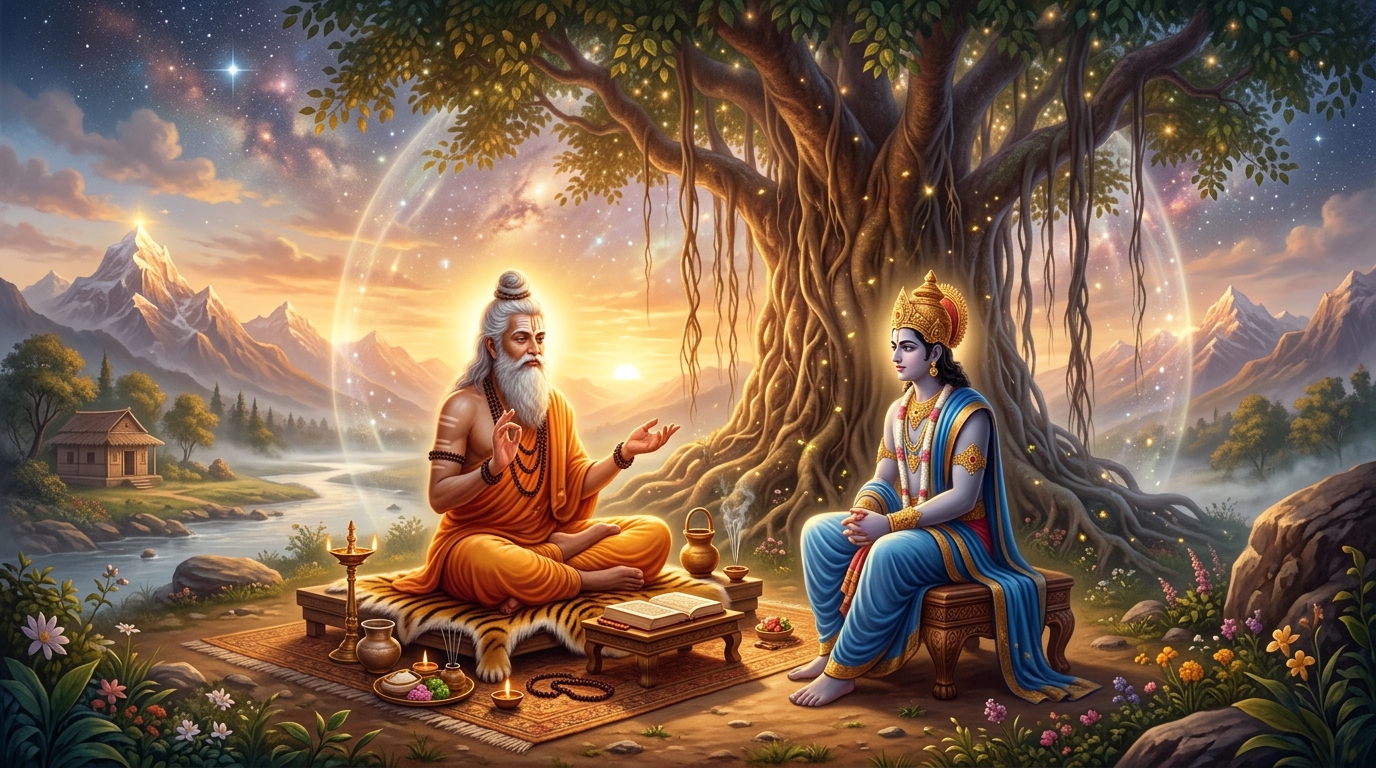
 【Overview】 Piercing the World Illusion and Resting in the Supreme Bliss of the True Self
Towering at the supreme pinnacle of ancient Indian philosophy stands the timeless scripture, the Yoga Vasistha (Maha-Ramayana). When Prince Rama was overwhelmed in his youth by the transient futility of worldly existence and fell into existential anguish, the royal preceptor, Sage Vasistha, imparted a teaching that was neither world-denying pessimism nor escapist renunciation. Rather, through relentless rationality and direct observation, he unveiled the true nature of the phenomenal world as a "long dream," presenting the pinnacle of practical mysticism for attaining living liberation (Jivanmukti) right in the midst of daily duties.
This comprehensive dialogue covers the historical position of the text; the Four Gatekeepers to Liberation and the core of Self-Inquiry (Vichara); the instantaneous awakening of King Janaka; deep structural convergences and divergences with Mahayana Buddhism (Yogacara and Sunyata); the ecstatic descriptions of superconsciousness (Turiya); the two royal paths for dissolving the mind (Chitta-Nasa); and the radical ontology of Non-Origination (Ajata-Vada) which dismantles the illusion of objective existence. It illuminates how an enlightened being lives gracefully through "action in inaction," transforming existence into an unconditioned, joyful cosmic dance (Lila).
Please explain the historical era in which the Yoga Vasistha was composed and its unique position in Indian philosophy as a whole.
Dialogue 1: Historical Era and Position in Indian Philosophy — The Earliest Synthesis of Yoga-Vedanta
The Yoga Vasistha (historically known as the Maha-Ramayana) is a scripture of extraordinary radiance in Indian intellectual and spiritual history. Its dating and standing in Indian thought can be understood through both traditional sacred lineage and modern historical scholarship.
1. Era of Composition and Lineage
- Traditional Lineage (c. 500 BCE or earlier): Within the sacred tradition, it is held to have been authored by the immortal sage and poet Valmiki, the celebrated author of the epic Ramayana, during the Treta Yuga (around 500 BCE or much earlier). The narrative framework consists of a profound 21-day royal discourse delivered by Sage Vasistha to the youthful Prince Rama in the royal assembly of Ayodhya.
- Modern Scholarly View (6th to 12th Century CE): Modern philological and historical analysis suggests that the monumental text of nearly 32,000 verses (and its concise condensation, the Laghu-Yoga-Vasistha of 6,000 verses) was compiled and polished primarily in Kashmir between the 6th and 11th–12th centuries CE. It seamlessly integrates earlier Upanishadic Advaita, Buddhist Yogacara and Madhyamaka terminology, classical Patanjala Yoga, and the dynamic cosmology of Kashmir Shaivism.
2. Unique Standing in Indian Philosophy
The Yoga Vasistha transcends sectarian dogmatism through several defining characteristics:
- Earliest Comprehensive Synthesis of Yoga-Vedanta: It reconciles the uncompromising non-dual ontology of Advaita Vedanta with the practical, meditative methodologies of Raja Yoga and Pranayama, providing a unified bridge between metaphysical contemplation and empirical discipline.
- Thoroughgoing Rationality and "Practical Mysticism": Rejecting blind faith, external rituals, and superstitious fatalism, the text places absolute primacy upon sovereign self-effort and rational inquiry. Much like the Bhagavad Gita, which reveals non-attachment on a battlefield, the Yoga Vasistha teaches how a ruler or householder can attain living liberation while governing a state or fulfilling societal obligations.
- Resonance with Kashmir Shaivism: Rather than viewing the world as an inert, mechanical illusion, it envisions all existence as the vibrant, spontaneous self-expression (Svatantrya / Spanda) of one undivided Pure Consciousness (Chit).
- Two Royal Paths to Truth: It articulates two complementary approaches suited to the seeker's temperament: the **Path of Knowledge and Inquiry (Atma-Jnana / Jnana Yoga)** and the **Path of Energy and Breath Regulation (Prana-Nirodha / Yoga)**.
✦ The Core Position of the Scripture
The Yoga Vasistha never commands the seeker to flee into the forest. By penetrating the illusory architecture of the world-dream through direct investigation, it empowers one to abide in living liberation (Jivanmukti) right amidst the storms of worldly action.
Please elaborate on "Inquiry through Knowledge (Vichara)," which forms the central axis of the Yoga Vasistha, and describe its functional effects.
Dialogue 2: The Core of Self-Inquiry (Vichara) — The Four Gatekeepers to Liberation and Abiding as the Witness
In the Yoga Vasistha, "Inquiry through Knowledge (Vichara)" is crowned as the supreme, infallible method for eradicating the delusion of cyclical suffering (samsara) and awakening to one's authentic nature.
1. The Nature of Vichara: Direct Looking into Oneself
- Direct Self-Observation: Vichara is not speculative philosophizing or bookish debate; it signifies "direct looking into oneself" without conceptual mediation.
- Fundamental Questioning: It is the sustained, inward investigation: "Who am I in this complex of flesh, blood, and thoughts?" and "How did this appearance of birth, death, and ignorance arise?"
2. The Four Gatekeepers to Liberation (Chatur-Dvara)
Sage Vasistha asserts that the palace of Liberation (Moksha) is guarded by Four Gatekeepers. If a seeker befriends even a single one of these guardians, the remaining three instantly welcome the seeker inside:
| Gatekeeper | Sanskrit Term | Function and Essence |
|---|---|---|
| Self-Control / Serenity | Shama | Mastery over sensory agitation and mental fluctuations, establishing an inner mirror of tranquil observation. |
| Spirit of Inquiry | Vichara | Unwavering discrimination between the Real and the unreal, exposing the root of ego and ignorance. |
| Inner Contentment | Santosha | Spontaneous fullness untouched by gain or loss, resting peacefully in the present moment as it is. |
| Association with the Wise | Satsanga | Communion with enlightened sages and sacred scriptures, swiftly dissolving the mental dross of illusion. |
3. Practice and Functional Effects of Vichara
- Radical Discrimination (Viveka): Constantly recognizing: "I am not the physical body; I am neither the senses, the fleeting mind, nor the intellect (Neti, Neti)." One severs false identification with perishable objects.
- Abiding as the Witness (Sakshin): Establishing oneself as the unattached, timeless Pure Consciousness that illuminates all thoughts, emotions, and external phenomena without being altered by them.
- Uprooting Ignorance and Latent Conditioning (Vasanas): When the light of inquiry is focused inward, the phantom of ego vanishes. The scripture compares Vichara to a majestic elephant that uproots the creeper of ignorance, or a fire that consumes the dried forest of delusion.
- Harmony with Active Life: Without renouncing worldly vocations, inward inquiry allows an individual to maintain serenity amidst hectic daily duties.
✦ Contrast with Mere Asceticism and Physical Yoga
Severe mortification of the flesh and mechanical breath retention can only temporarily suppress mental agitation. Fundamental ignorance (Avidya) can be dissolved exclusively through Vichara—the direct intuitive realization of the Self.
Please recount the celebrated story of King Janaka's enlightenment from the Yoga Vasistha, highlighting the crucial lessons it conveys.
Dialogue 3: The Enlightenment of King Janaka — The Song of the Siddhas, Relentless Inward Inquiry, and Royal Living Liberation
In Book 5 (Upashama Prakarana / Section on Quiescence), the account of King Janaka of Videha is presented as the archetypal proof of "immediate awakening through one's own penetrating inquiry (Vichara)."
1. The Catalyst: The Song of the Celestial Siddhas
While strolling through his royal pleasure garden on a pleasant day, King Janaka overheard songs echoing from perfected celestial beings (Siddhas) soaring through the skies:
"Realize that unconditioned bliss of the Self (Atman) wherein the seer, the seen, and seeing merge into oneness. Striking down desires with the staff of wisdom and silencing the restless mind, the immortal nectar of Truth reveals itself."
2. Solitary Inquiry in the Royal Palace: Catching the Thief Called Mind
Pierced to the core by this celestial verse, King Janaka experienced a profound surge of dispassion (Vairagya) regarding worldly glory, wealth, and power. He immediately returned to his palace, dismissed his retinue, locked himself in a quiet chamber, and embarked on fierce, solitary self-inquiry:
- Interrogating the Mirage of Time and Power: "In this endless expanse of cosmic time, what significance does a fleeting lifespan or royal sovereignty possess? Why have I foolishly clung to these phantom honors?"
- Targeting the Root of Bondage: "The seed of this illusory world and its agonies lies in the mind's psychological intentions and cravings (Samkalpa). I will dry up these motives, capture this thief called 'mind' that has plundered my wisdom, and abide only in the Knowledge of the Self (Atma-Jnana)."
3. Realization and the Life of a Jivanmukta
Through uninterrupted contemplation, the spotless light of Pure Consciousness dawned in Janaka's heart:
- Relinquishing the Sense of Doership: All cravings of "I am the doer" or "I am the enjoyer" completely dropped away, transcending dualistic notions of pleasant and unpleasant.
- Resuming Royal Duties in Deep Quietude: Janaka calmly rose and resumed the governance of his realm. Outwardly, he executed state affairs with impeccable wisdom, yet inwardly his mind remained in absolute tranquility, as if resting in unbroken, deep dreamless sleep (Turiya).
✦ Core Lessons of King Janaka's Awakening
- Self-Reliance and the Inner Light: Liberation is not bestowed by external ceremonies or blind obedience to external authority; it is ignited by one's own inward light through ceaseless Vichara.
- Complete Compatibility of Duty and Enlightenment: Even while managing the formidable responsibilities of an empire, an individual whose inner attachment is dissolved lives as a completely free Jivanmukta.
Did Shakyamuni Buddha or Buddhist ascetics figure directly within the text of the Yoga Vasistha? What cosmic perspective reconciles this historical timeline?
Dialogue 4: Direct References to the Buddha and Cosmic Cycles — The Interplay with Mahayana Thought Across Innumerable Kalpas
The text of the Yoga Vasistha contains direct references to Buddha (referred to as the Muni) and Buddhist monastic practitioners, marking a fascinating chapter in the philosophical dialogue of ancient India.
1. Textual References to Buddha and Buddhist Monks
- Praise for the Buddha's Attainment: In describing total renunciation that transcends all doubts and conditionings, the text cites the Muni (Buddha) as an exemplary master who attained the unwavering, silent peace of supreme realization.
- Depiction of Buddhist Monks: In narrative descriptions of world-traversing yogis and sages, Buddhist ascetics walking mindfully through the forests are depicted as an established part of the spiritual landscape.
2. The Cosmic Framework of Infinite Kalpas
In traditional chronology, Sage Vasistha instructed Prince Rama during the Treta Yuga, long before the historical Shakyamuni Buddha (6th–5th century BCE). The scripture resolves this temporal divergence through its cyclically expansive cosmology:
- Infinite Cycles of Creation and Dissolution: The cosmos undergoes tens of thousands of creations and dissolutions (Kalpas).
- Non-Linearity of Time in Pure Consciousness: From the standpoint of unconditioned consciousness, past, present, and future exist simultaneously as mental projections. Hence, prophecies and occurrences of Krishna and Buddha in other world-cycles or future epochs are entirely coherent within the multidimensional metaphysics of the text.
3. Philosophical Convergence with Mahayana Thought
- Shared Idealism (Mind-Only): The core thesis that the objective world is an unsubstantial projection of consciousness (Chitta) is shared deeply with the Yogacara (Vijnanavada) school of Mahayana Buddhism.
- Adoption of Sunyata (Emptiness): To describe the unconditioned state of Brahman, the Yoga Vasistha frequently utilizes the Buddhist term Sunya (the Void/Emptiness), illustrating how non-dual Vedanta and Mahayana philosophy enriched each other.
✦ Freedom from Sectarian Boundaries
The Yoga Vasistha honors the Buddha not as a rival sectarian founder, but as a supreme sage who penetrated the illusion of cyclical existence, demonstrating a universal reverence for Truth beyond denominational labels.
Focusing on "Rational Realizationism (Gnosis through intuitive inquiry)," please provide a rigorous comparative analysis between the Yoga Vasistha and Buddhist enlightenment.
Dialogue 5: Rational Realizationism in Direct Comparison — Yoga Vasistha vs. Buddhist Wisdom: The Boundary of Self and No-Self
Both the Rational Realizationism of the Yoga Vasistha and Buddhist Enlightenment (Prajna / Vipassana) reject blind dogma in favor of the direct dismantling of primordial ignorance (Avidya). Yet, their final ontological conclusions mark a decisive philosophical divide.
1. Characteristics of Realizationism in the Yoga Vasistha
- Rejection of Mortification: Tormenting the flesh or mechanically chanting prayers cannot uproot the seed of ignorance. Only the direct inquiry "Who am I?" brings genuine freedom.
- Awakening from a Dream: Enlightenment is not gaining an external power; it is waking up from the protracted nightmare of personal ego identity.
- Immediate Living Freedom: Worldly kings and householders can realize this state in a single instant through penetrating insight without physical seclusion.
2. Systematic Comparison: Yoga Vasistha vs. Buddhism
| Dimension | Yoga Vasistha | Buddhism (Early to Mahayana) |
|---|---|---|
| Primary Approach | Self-Inquiry (Vichara) directly dissolving ignorance via internal observation. | Mindful insight (Vipassana) and wisdom (Prajna) dissecting defilements and conditionings. |
| Status of Phenomenal World | A protracted dream projected by consciousness (Chitta); lacks independent substance. | Dependently originated (Pratityasamutpada); impermanent, unsatisfactory, and empty of inherent existence (Sunya). |
| Moment of Awakening | Instantaneous melting of illusion upon direct perception of Truth (Subitist realization). | Zen sudden awakening (Satori) or early Buddhist opening of the Dhamma eye. |
| Ultimate Reality (Self vs. No-Self) |
【Affirmation of Supreme Self】 Beneath all illusions abides the eternal, immutable substrate: Atman / Brahman. |
【Radical Deconstruction / No-Self】 Rejection of any unchanging substance (Anatman); quiescent blowing out of attachments (Nirvana). |
| Resolution of Ego | The limited wave (Jiva) realizes its identity with the infinite ocean of Cosmic Consciousness (All-as-One). | The concept of "I" is deconstructed as an aggregate of conditions, revealing non-dual Dependent Origination. |
| Disciplinary Architecture | Emphasizes direct breakthrough via reason and intellect over rigid ritual stages. | Emphasizes the progressive, balanced Threefold Training: Ethics (Sila), Samadhi, and Wisdom (Prajna). |
✦ The Converging Point of Emptiness and Fullness
In experiential practice, Buddhist Sunyata (empty of inherent existence) and Vedantic Brahman (empty of anything other than consciousness) produce identical freedom from grasping. However, while Buddhism maintains a deconstructive silence, the Yoga Vasistha poetically celebrates the supreme reality as an overflowing, radiant ocean of Bliss.
Please explore the poetic metaphors describing the supreme bliss of Pure Consciousness (Turiya) in the Yoga Vasistha, and contrast its mechanics with Mahayana Mind-Only (Yogacara) philosophy.
Dialogue 6: The Bliss of Pure Consciousness (Turiya) and Yogacara — Mechanics of the "Long Dream" and Metaphysical Foundations
Transcending the three ordinary states of waking, dreaming, and dreamless sleep, the fourth state, Turiya, and its transcendent culmination, Turiyateeta, are depicted in the Yoga Vasistha through breathtaking imagery.
1. Symbolic Expressions of Turiya (Superconsciousness)
- "Sleepless Sleep" (Deep Sleep in Waking / Mahasupta): Outwardly conducting state affairs and conversations, yet inwardly all cravings, attachments, and egoic distinctions have vanished, maintaining an absolute quietude as if resting in unbroken, deep dreamless sleep.
- The "Seamless Rock" and the "Bilva Fruit": Brahman is compared to a massive rock of bliss containing no internal crevices, or a colossal Bilva fruit that holds entire universes within its sweet pulp—representing the concentrated, indestructible mass of Reality itself.
- The "Taintless Sky": An immaculately clear void untouched by the clouds of mental agitation or latent desires (Vasanas). Countless galaxies float like iridescent soap bubbles within this infinite expanse.
- Extinction of the Subject-Object Triad: The division of the observer (seer), observed (world), and observation (act) vanishes completely. What remains is spontaneous, uncaused Experiencing itself.
2. Detailed Comparison with Mahayana Yogacara (Vijnanavada)
【Structural Commonalities: Transformation of Mind】
- The World as Mental Agitation: Both agree that the external material world does not exist as an independent, physical reality, but is an appearance ("long dream") projected by the fluctuations of mind (Samkalpa / Parikalpita).
- Transmigration Driven by Latent Impressions (Vasanas / Bijas): Unconscious seeds and conditioning accumulated under ignorance continually sprout into the dualistic appearance of subject and object.
- Freedom via Transcending Duality: Liberation is realized when the grasp of subject (grasper) and object (grasped) dissolves, allowing the mind to return to its unblemished nature (Parinispanna).
【Foundational Metaphysical Divergences】
- "Immutable Ground (Brahman)" vs. "Stream of Consciousness (Alayavijnana)":
The Yoga Vasistha posits that after mental agitation ceases, the eternal, unchanging mirror of Pure Consciousness (Brahman) remains. In contrast, Yogacara views even the storehouse consciousness (Alayavijnana) as an impermanent stream devoid of an unchanging self-entity. - Outcome of Mind Dissolution (Merging vs. Transformation):
In the Yoga Vasistha, the dissolution of mind (Chitta-Nasa) is the wave merging into the cosmic ocean of Brahman. In Yogacara, it is the transformation of the basis (Asraya-paravritti), unfolding non-conceptual wisdom rather than absorption into an absolute Self. - Praise of Bliss (Ananda):
The Yoga Vasistha jubilantly exalts Brahman as supreme bliss and nectar, while Buddhism deliberately speaks of the "cessation of sensation" to prevent subtle grasping at spiritual euphoria.
✦ The Mirror of Reality
In Yogacara, the mirror wisdom (Adarsajnana) reflects phenomena free from delusion; in the Yoga Vasistha, the mirror itself is the living, eternal Reality that remains untouched and radiant whether reflections appear or disappear.
What are the specific, practical methods prescribed in the Yoga Vasistha to permanently eradicate fundamental ignorance (Avidya)?
Dialogue 7: The System of Eradicating Primordial Ignorance (Avidya) — Inquiry, Eradication of Desires, Prana Control, and Sovereign Self-Effort
In the Yoga Vasistha, the eradication of ignorance (Avidya / Ajnana) is expounded not as theological dogma, but as a multi-dimensional discipline resting upon seven pillars:
1. Direct Self-Inquiry (Vichara) and Discrimination (Viveka)
- Severing Body Identification: Directly observing: "This aggregate of flesh and bone cannot be 'I'." One systematically discards false identification with the physical organism and sensory apparatus.
- Dispelling Darkness with Light: Just as darkness cannot survive the rising sun, the persistent light of "Who am I?" deprives ignorance of any foundation, causing it to vanish.
2. Eradication of Latent Desires (Vasana-Kshaya)
- Scorching the Seeds of Craving: Ignorance is nourished by latent psychological tendencies (Vasanas). By the fire of wisdom, cravings (Raga) and revulsions (Dvesha) are transformed into "scorched seeds" incapable of sprouting into new suffering.
- Sublimation through Pure Tendencies: If dark cravings cannot be abolished immediately, one substitutes them with pure aspirations (Shuddha Vasanas)—scriptural study, noble conduct, and communion with sages—before ultimately transcending even pure tendencies into unconditioned stillness.
3. Dissolution of Mind (Manonasha) and Non-Dual Practice (Abhyasa)
- Severing Mind with Mind: Because conceptualization (Samkalpa) sustains delusion, one uses refined intelligence to silence the mind's compulsive myth-making.
- Affirming Non-Duality: Overcoming countless lifetimes of conditioned limitation by constantly meditating on the truth: "All is Brahman; I am unconditioned Consciousness."
4. Dismantling the Ego (Ahamkara) and Sense of Doership
- Exorcising the Phantom: The ego-sense ("I" and "mine") is treated as a malignant phantom possessing the mind, exposed and dismantled through uncompromising scrutiny.
- Surrendering Doership: Performing necessary actions while relinquishing the delusion: "I am the personal actor; I am the claimant of results." One abides as the silent witness of the cosmic order.
5. Control of Life-Force (Prana-Nirodha)
- Intimate Bond between Mind and Breath: The movement of thought and the pulsation of Prana are interconnected like a flower and its fragrance.
- Pranayama and Meditation on OM: Regulating the rhythmic flow of inhalation, exhalation, and retention, and contemplating the sacred syllable OM, stills the vibration of Prana and calms the waves of the mind.
6. Cultivating the Four Gatekeepers
Nurturing Serenity (Shama), Inquiry (Vichara), Contentment (Santosha), and Holy Company (Satsanga) forms the protective atmosphere in which ignorance cannot survive.
7. Sovereign Self-Effort (Purushartha)
- Dismantling Fatalism: The Yoga Vasistha vehemently repudiates destiny or fate (Daiva) as a cowardly invention of the lazy. What people call "destiny" is nothing more than the momentum of past self-effort.
- Conquering Past by Present Effort: An erroneous past action can be utterly defeated by a more vigorous, enlightened self-effort in the present moment.
✦ The Triumph of Self-Effort
"Fate is a phantom created by fools to justify their lethargy. There is no power in the three worlds that can overpower the resolute, enlightened self-effort (Purushartha) of a human being who seeks Truth." — Sage Vasistha
Please elaborate on the profound teaching that views the entire phenomenal universe as a "Long Dream" (Svapna), and explain its multi-layered architecture.
Dialogue 8: Viewing the World as a "Long Dream" — Homogeneity of Waking and Dreaming, Multi-Layered Illusions, and Transcending Duality
In the Yoga Vasistha, "Viewing the world as a long dream (Svapna)" is neither an escapist fantasy nor a cynical nihilism. It is the most liberating metaphysical insight for uncoupling the heart from craving, terror, and grief.
1. Essential Homogeneity of Waking (Jagrat) and Dreaming (Svapna)
Sage Vasistha asserts that between waking reality and nocturnal dreaming, there is no intrinsic qualitative difference:
- The Sole Distinction is Apparent Duration: Waking is simply a "dream of long duration," whereas the night dream is a "dream of brief duration."
- Undeniable Realism During the Dream: While dreaming, the landscape, towns, bodies, and emotional experiences feel completely authentic and external. Just as they evaporate upon waking, this solid physical cosmos instantly dissolves its claim to independent reality when one awakens to the Knowledge of the Self.
2. The Multi-Layered Nested Architecture of Dreams
- The Primordial Dream of Brahma: The entire cosmos first manifested as a creative daydream (Samkalpa) in the mind of the cosmic creator, Brahma.
- Nested Dreams of Individual Souls (Jivas): Within Brahma's dream, individual souls emerge and construct their own private "dreams within dreams," wandering through endless cycles of birth and death.
- The Parable of Jivata: In one illustration, a wandering monk falls asleep and dreams he is a drunken man named Jivata; Jivata dreams he is a scholar; the scholar dreams he is a king; the king dreams he is a deer... illustrating how mental projections spawn endless parallel worlds within worlds.
3. Pure Consciousness as the Single Substrate
Just as all characters, weapons, oceans, and mountains within a dream are composed of nothing other than the dreamer's own conscious mind, so too every element in the universe is the self-projection and play (Lila) of single Pure Consciousness (Brahman).
4. Practical Liberation Derived from Seeing the Dream
- Neutralizing Fear and Greed: One does not murder others for gold encountered in a dream, nor weep inconsolably over dream misfortunes. Recognizing the dream-like nature of objects evaporates latent grasping and existential panic.
- Effortless Grace: Knowing the world to be a dream, the sage does not run away, but acts skillfully like a consummate actor playing a royal role with effortless poise.
✦ Awake While Dreaming
The enlightened being does not strive to destroy the world-dream. Knowing it to be a dream, they delight in it as divine art. This is the sublime pinnacle of cosmic play (Lila).
How does the Yoga Vasistha explain the complete dissolution or destruction of the mind (Chitta-Nasa / Manonasha), and what are its two progressive stages?
Dialogue 9: Two Royal Paths to Dissolving the Mind (Chitta-Nasa) — Self-Inquiry (Jnana) and Life-Force Control (Yoga)
The supreme turning point in the Yoga Vasistha is "The Dissolution of the Mind (Chitta-Nasa / Manonasha)." The mind is not a concrete biological organ, but an illusory agitation spun from ignorance and desires. When the mind dissolves, the illusory world of suffering vanishes, leaving only the eternal peace of Brahman.
1. The Two Royal Paths to Dissolving Chitta
① The Path of Knowledge and Inquiry (Jnana Yoga)
- Washing Dirt with Dirt: "Just as an artisan removes grease with an abrasive agent, or poison is cured with an antidote, the impure mind is destroyed by the purified, discerning mind."
- Eradicating Vasanas: The mind consists solely of latent impressions (Vasanas). Burning these seeds with the fire of wisdom collapses the mind's operating structure.
- Constant Non-Dual Reflection (Abhyasa): Re-centering on "I am not the body; all is Brahman" dismantles the illusion of personal ego.
② The Path of Energy and Breath Control (Yoga / Prana-Nirodha)
- Interdependence of Mind and Prana: Mental restlessness and the flow of vital breath (Prana) are inextricably linked like water and its waves. When Prana is stilled, the mind stops immediately.
- Observation of Breath Flow: Calming the natural cycle of inhalation and exhalation between the tip of the nose and the spiritual heart center.
- Meditation on the Sacred Syllable OM: Resting the awareness in the silent interval between breaths while meditating on OM dissolves the mind into its unmanifest source.
2. The Principle of the Threefold Interwoven Practice
Sage Vasistha proclaims that the following three must be pursued together:
- Knowledge of Truth (Jnana)
- Dissolution of the Mind (Manonasha)
- Eradication of Latent Desires (Vasana-Kshaya)
These three are mutually cause and effect. Perfecting any one of them inevitably establishes the other two.
3. The Two Stages of Manonasha
| Stage | Sanskrit Term | Characteristics and Manifestation |
|---|---|---|
| Dissolution with Form | Saroopa-Manonasha | The State of the Living Liberated (Jivanmukta). The agitated, egoic mind (Chitta) has perished, but the mind survives as purified, translucent intelligence (Sattva), executing daily activities flawlessly while remaining completely free from inner bondage. |
| Formless Dissolution | Aroopa-Manonasha | The State of Disembodied Liberation (Videhamukti). Even the pure Sattvic mind dissolves upon the shedding of the physical body. Consciousness merges seamlessly into unconditioned Brahman without a trace of duality. |
✦ Mind Transformed into Pure Sattva
Dissolving the mind in the Yoga Vasistha does not mean becoming comatose or vegetative. It means shedding the pathological ego-mind and transforming consciousness into a crystal-clear mirror of divine wisdom.
What is the ontological genesis of the universe in the Yoga Vasistha, and what is the profound meaning of its ultimate doctrine of Non-Origination (Ajata-Vada)?
Dialogue 10: Ontology of Creation and Apparent Manifestation — From Subtle Vibration (Samkalpa) to Non-Origination (Ajata-Vada)
The cosmological architecture in the Yoga Vasistha represents the pinnacle of Advaita metaphysics: "The universe was never created as an independent material object; it is an apparent projection (Vivarta) cast by mind within the ocean of Pure Consciousness."
1. The Four-Fold Manifestation Sequence
- The Sole Supreme Reality (Brahman): Before creation, during its appearance, and after cosmic dissolution (Pralaya), the sole existing reality is unblemished, unbroken Pure Consciousness.
- Subtle Vibration and the Cosmic Mind (Brahma): Like a spontaneous ripple on a calm ocean, an initial vibration/intention (Samkalpa) stirs within Consciousness to perceive itself as an object. This gives rise to the Cosmic Mind (Brahma).
- Ego-Sense and the Five Subtle Elements: Within the Cosmic Mind arises the sense of "I am" (Ahamkara). As this vibration thickens, the subtle concepts of Space (Akasha), Air, Fire, Water, and Earth appear alongside time and spatial dimensions.
- Projection of the Material Cosmos: These subtle elements interact, crystallizing into galaxies, mountains, bodies, and fourteen world-realms—appearing unmistakably solid to the deluded observer.
2. The Ultimate Conclusion: Non-Origination (Ajata-Vada)
Having expounded this cosmic genesis, Sage Vasistha delivers the ultimate truth: "In reality, nothing has ever been created or born."
- Rejection of Real Transformation (Parinama): The cosmos is not milk transforming irreversibly into yogurt. It is an apparent projection (Vivarta), exactly like an illusory snake perceived upon a coiled rope in twilight.
- Absence of Cause or Motive: The unconditioned Absolute has neither external materials nor psychological motives to create anything. Without a cause, an effect cannot exist.
- Ajata-Vada (Non-Origination): The apparent material world is solely a misperception born of ignorance. When wisdom dawns, the world does not "vanish"; one simply realizes that an objective world never existed at all.
✦ The Ocean and Waves, Gold and Ornaments
Waves do not exist separately from water; bracelets and rings do not exist separately from gold. What truly exists is only water and gold. Diversity is mere nomenclature; the sole reality is unbroken Consciousness.
Regarding the fundamental metaphysical riddle, "Why is there something rather than nothing?", how does the ontology of the Yoga Vasistha resolve this question?
Dialogue 11: The Ontology of "Why Is There Something Rather Than Nothing?" — Illusion of Objective Realities and Innate Consciousness-Power
To the question that Martin Heidegger called the ultimate question of metaphysics—"Why is there something rather than nothing?"—the Yoga Vasistha offers an audacious, non-dual answer.
1. Transcending the Dualism of "Being" and "Non-Being"
The scripture points out that our notions of "existence" (something) and "non-existence" (nothing) are conceptual dualities fabricated by the thinking mind.
- Supreme Reality Beyond Being and Non-Being: Brahman is neither "something" (an object among objects) nor "nothing" (a dead void). It is the self-luminous ground within which concepts of presence and absence appear.
- Absence of an Objective "Something": There is no separate "thing" out there; there is only Consciousness experiencing its own nature.
2. How "Something" Comes to be Perceived
- Inherent Creative Potency (Chit-Shakti): Just as heat is intrinsic to fire and light to the sun, Consciousness has the inherent capacity to experience infinite forms (Chit-Shakti / Lila). It requires no external why.
- Polarization into Subject and Object: Through a subtle ripple of awareness, Consciousness bifurcates into the "seer" and the "seen."
- Reification via Ignorance: Ignorance (Avidya) and conditioning (Vasana) superimpose solidity onto this mental wave, mistaking an internal sensation for an external, material "thing."
3. The Ontological Status: Neither Real Nor Unreal (Sad-Asad-Vilakshana)
- Not Real (Sat): It cannot be called truly real because it changes every moment and vanishes upon awakening.
- Not Completely Unreal (Asat): It cannot be dismissed as pure non-being like a barren woman's son, because it is undeniably experienced and causes real joy and suffering.
- Apparent Reality (Maya): It is an inexplicable, apparent manifestation—an iridescent mirage upon the desert of infinity.
✦ The Final Resolution
"Why is there something?" The ultimate answer is: "Nothing objectively exists. Consciousness is simply playing with its own boundless potential. From beginning to end, only Pure Consciousness is."
How does this radical ontology—that nothing objectively exists and all is a projection of Consciousness—translate into practical daily living? Describe the effortless lifestyle of a Jivanmukta.
Dialogue 12: From Ontology to Daily Action — Dismantling Doership, Action in Inaction, and the Graceful Play (Lila) of a Jivanmukta
Realizing that the world is an unsubstantial dream is not an invitation to apathy or moral chaos. In the Yoga Vasistha, it is the bedrock of supreme spiritual freedom—the vibrant life of a Jivanmukta (one who is liberated while still living in the body).
1. Dismantling Doership and "Action in Inaction"
- Eradication of Ego-Agency: Recognizing that all phenomena are waves of consciousness eradicates the delusion: "I am the doer; I am the sufferer."
- Abiding as the Witness: The body, mind, and intellect act with supreme efficiency according to context, while internally the sage abides as the silent witness (Sakshin). Free from anxiety over outcomes, the sage experiences absolute stillness amidst intense activity (Action in Inaction).
2. Neutralization of Desires and Equanimity
- Indifference to Dream Treasures: Knowing that worldly treasures are dream gold, the sage feels neither grasping craving (Raga) nor defensive aversion (Dvesha).
- Unshakable Serenity: Latent psychological conditionings (Vasanas) having been incinerated, the sage's inner serenity remains as smooth as an unruffled lake, regardless of praise, blame, fortune, or catastrophe.
3. "Deep Sleep in Waking" (Sushupta Mauna) and Equal Vision
- Unbroken Peace: Like King Janaka managing an empire, the sage lives outwardly engaged while internally resting in the quietude of deep dreamless sleep (Turiya).
- Universal Equal Vision (Samata): Prosperity and adversity, gold and stone, friend and foe are witnessed with equal serenity as diverse expressions of the single Self.
4. Transcendence of Duality and Boundless Compassion
- Dissolution of the "Other": When the boundary between self and other dissolves, possessiveness, envy, and aggression lose their psychological footing.
- Universal Friendliness: Finding the Self in all beings, unconditioned benevolence and compassion (Karuna) radiate naturally, not as moral duty, but as spontaneous affection for one's own limbs.
5. Effortless Cosmic Play (Lila)
- Absence of Strain: The actions of a Jivanmukta flow with total naturalness (Sahaja), devoid of premeditated calculation or egoic strain.
- Appropriate Action: The right action unfolds effortlessly at the right moment. Neither fleeing the world nor clinging to it, the liberated sage plays their part on the cosmic stage with an unblemished smile.
✦ Epilogue: Dancing Gracefully in the Cosmic Theater
The Yoga Vasistha leaves us not in cold cosmic void, but in the radiant freedom of being unconditioned amidst the dream. Because the world has no objective reality, we can cast off existential dread and celebrate this cosmic play with infinite joy and timeless peace.
Key References and Primary Sources
- Vasistha's Yoga (Swami Venkatesananda, State University of New York Press): The premier modern, readable English translation and commentary of the scripture.
- The Yoga-Vasistha of Valmiki (Translated by Vihari-Lala Mitra, 4 vols.): The historic complete English rendering of the entire 32,000-verse text.
- Laghu-Yoga-Vasistha (Translated by K. Narayanaswami Aiyar): The classical condensation by Abhinanda into 6,000 verses.
- Cheng Weishi Lun & Trimśikā-vijñaptimātratā (Vasubandhu / Xuanzang): Foundational treatises on Mahayana Yogacara philosophy.
- The Mahabharata and Ramayana (Valmiki): Classical epics providing the spiritual and cosmological landscape of ancient India.