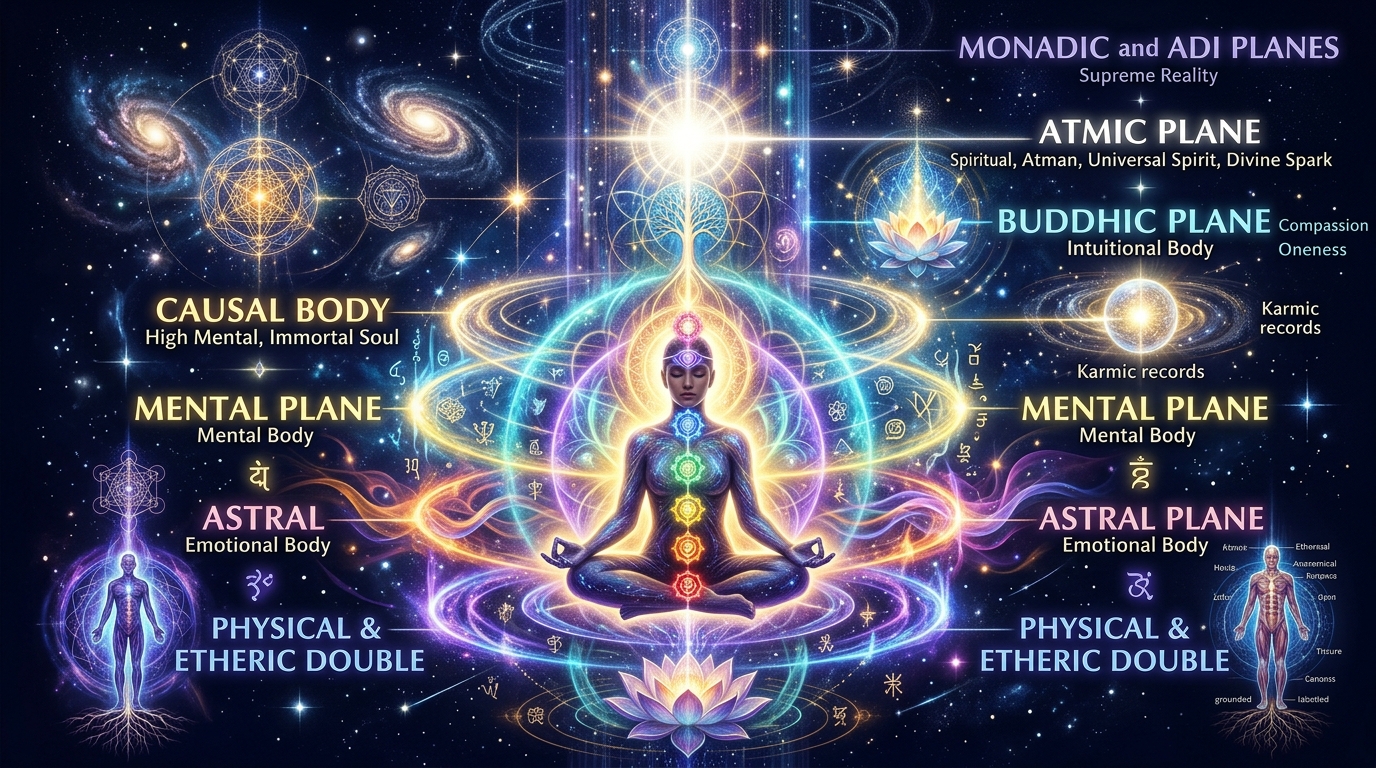
Infographic illustrating the multi-layered subtle bodies and cosmic planes of Theosophy

✦ On the Presentation of An Outline of Theosophy — Inheriting the Torch of Wisdom

Years ago, the late Yuko Uritani, founder of Tama Publishing and a visionary pioneer of the spiritual and metaphysical movement in Japan, presented the inquirer with a precious volume: Charles W. Leadbeater's An Outline of Theosophy.

Decades have passed, and humanity is now directly encountering the intrinsic boundaries of materialist progress. We have entered a momentous era of transition where serious attention must be directed toward multi-layered realities and the experiential technologies of consciousness — taking our very first steps as "future human beings."

The layered anatomy of human existence presented in that work — the Etheric Double, the Astral Body, the Mental Body, and the Causal Body — and the corresponding cosmology of universal planes are far from obsolete occultism. They represent a magnificent "roadmap of life," one that contemporary phenomenology, experiential process theory, and the ongoing evolution of human awareness are only now beginning to catch up with.

This space was built to inherit the flame of wisdom entrusted by Uritani and to clarify who we truly are and where we are headed. The time has finally arrived for this wisdom to be illuminated in its true light.

AI Digest: The Multi-Layered Anatomy of Man and the Cosmic Planes

Drawing from Arthur E. Powell’s authoritative Theosophical compendiums, this dialogue conducts a rigorous philosophical exploration of human multi-layered existence across the five foundational realms: the Physical-Etheric Double, the Astral Body, the Mental Body, the Causal Body, and the higher Solar Cosmic planes. Transcending naive physicalist reductionism by grounding its inquiry in the lived phenomenological body (le corps vécu) and the felt sense, it decodes the vibratory frequencies, functions, and post-mortem transitions of each subtle vehicle. The dialogue culminates in an exhaustive comparative matrix with Mahāyāna Buddhist Yogācāra (Ālayavijñāna, Manas, and the sensory faculties), returning to the ultimate non-dual realization of "Universe-Centric Living" and the transcendence of the isolated individual ego.

✦ The Multi-Layered Constitution of Man and the Five Cosmic Planes

Click any plane to navigate directly to its in-depth exploration

Questioner

In Arthur E. Powell’s compendiums based on Theosophical teachings, the human being is understood not merely as a physical organism, but as an exquisitely layered multidimensional structure. Could you begin by elucidating the first domain: the Physical Plane and the Etheric Double? Specifically, how does it relate to the dense physical body, how does it function as a conductor of Prāna (vital energy), and how can we understand it through the lens of the lived phenomenological body (the felt sense)?

Dialogue 1: Physical Plane and the Etheric Double — The Subtle Matrix of Form and the Conductive Network of Prāna

In the Theosophical framework, what we conventionally identify as "the body" is actually composed of two inseparable aspects: the Dense Physical Body, constituted of solids, liquids, and gases, and the Etheric Double, comprised of the four finer etheric grades of physical matter. The Etheric Double is not an ethereal spirit residing in another dimension, but an exact subtle physical counterpart and organizing blueprint (matrix) for every dense physical cell and organ.

1. The Blueprint and Archetypal Matrix of Physical Form

From the moment of fertilization, as cells divide and specialize into complex tissues, their morphogenesis is guided geometrically by the electromagnetic and etheric lines of force within the Etheric Double. Dense physical molecules fall into their proper places because the etheric matrix already contains the structural pattern. The well-known clinical phenomenon of "phantom limb pain" — where an amputee continues to feel sensations in an absent arm or leg — is explained in Theosophy by the persistent presence of the etheric limb even after the dense physical tissue has been severed.

2. Reception and Stepping-Down of Solar Prāna

The paramount physiological function of the Etheric Double is to absorb universal vitality (Prāna) continuously radiating from the Sun, step it down into specialized energetic currents, and distribute it throughout the nervous and circulatory systems.

  • The Spleen Chakra: Located on the surface of the Etheric Double near the spleen, this vortex absorbs vitality globules, breaks them down into seven specialized colored streams of force, and charges the entire cellular system.
  • Etheric Radiation and the Health Aura: In a state of robust vitality, surplus Prāna radiates outward from the pores in straight lines perpendicular to the skin, creating what Theosophists term the "Health Aura." This radiant shield acts as an energetic barrier, deflecting atmospheric poisons and subtle pathogenic vectors.

3. Connection with the Phenomenological Lived Body (Felt Sense)

Materialist medicine tends to reduce the body to mechanical neurobiology. However, when we direct attention inward toward the lived body (le corps vécu), we encounter an immediate, pre-verbal domain of sensation: an internal tingling, warmth, living density, and spaciousness. What Eugene Gendlin identified in experiential focusing as the felt sense is precisely the bodily awareness of this etheric matrix and its fluctuating currents of vitality prior to conceptual labeling.

✦ Key Takeaway: The Physical-Etheric Horizon

The Etheric Double is the vital energetic bridge that binds consciousness to dense physical matter. By transmitting Prāna and sustaining physical cohesion, it forms the foundation of our lived embodiment and serves as the immediate ground for direct somatic realization.

Questioner

Next, let us explore the Astral Plane and the Astral Body (the emotional vehicle). What is the internal architecture of the astral vehicle, and what role does it play during nocturnal sleep, lucid dreaming, out-of-body experiences, near-death encounters, and the post-mortem transition through Kāma-loka?

Dialogue 2: The Astral Plane and the Emotional Body — The Dynamic Kaleidoscope of Affect and Post-Mortem Metamorphosis

Interpenetrating the physical world with a vastly higher vibrational velocity is the Astral Plane (the realm of stars, illusion, and desire). The human Astral Body is an ovoid aura extending beyond the physical contour, serving as the direct seat of all desires, emotions, passions, fears, and affective attachments.

1. The Immediate Vehicle of Emotion

In Theosophy, emotions do not originate in the brain; rather, emotional surges originate in the Astral Body, whose vibratory fluctuations are then conducted downward through the etheric brain centers and autonomic nervous system.

  • Coarse Passions: Selfish desires, rage, and crude sensory attachments stir the lowest, densest sub-planes of astral matter, casting murky, heavy crimson and muddy brown hues across the aura.
  • Refined Compassion and Aspiration: Altruistic affection, spiritual devotion, and selfless compassion awaken the subtlest sub-planes, producing radiant flashes of clear rose-pink and luminous violet-blue.

2. Nocturnal Sleep, Lucid Dreaming, and Astral Projection

When the physical body sleeps, the dense organism and the Etheric Double remain resting on the bed, while the consciousness, clothed in the Astral Body, withdraws into the astral world. This is the natural arena of ordinary dreams.

In an untrained person, the astral vehicle drifts passively near the sleeping form, replaying fragmented impressions of waking life. However, as spiritual awareness awakens, the individual learns to remain awake within the astral body, entering conscious lucid dreaming and voluntary astral travel. Unconstrained by physical gravity or linear time, the seeker can travel at the speed of thought, learn in inner esoteric schools, and engage in subtle service to others.

3. The Post-Mortem Transition in Kāma-loka

At physical death, the silver cord linking the vehicles is permanently severed, and the Etheric Double disintegrates within days. Consciousness shifts completely into the Astral Body within the realm designated as Kāma-loka (the world of desire, analogous to the Buddhist Antarābhava or intermediate state).

Following death, the matter of the Astral Body rearranges itself into concentric layers according to density. Strong earthly cravings and unresolved egoic attachments keep the soul anchored in the lower, murky strata. As these lingering desires exhaust their energy and dissolve, the coarser astral matter sloughs off, allowing the soul to ascend naturally toward the celestial realm of Devachan on the Mental Plane.
✦ Key Takeaway: The Astral Dimension

The Astral Body is an emotional resonance chamber and the arena of post-mortem purification. Realizing that one is not one's emotions, but the spacious observer witnessing these turbulent astral tides, marks a crucial threshold of spiritual liberation.

Questioner

Moving beyond the domain of affect, what are the characteristics of the Mental Plane and the Mental Body? Please elaborate on Lower Manas (the faculty of concrete, logical thought), the genesis and mechanics of Thought-Forms, and both the utility and the limitations of conceptual, linguistic articulation.

Dialogue 3: The Mental Plane and Lower Manas — The Analytical Intellect and the Architecture of Thought-Forms

Above and within the astral realm lies the Mental Plane (Devachan in its lower subdivisions). Theosophy bifurcates the human mind (Manas) into two distinct vehicles: Lower Manas, which functions through the Mental Body in the lower four sub-planes (the Rūpa or Form levels), and Higher Manas, which operates through the Causal Body in the upper three sub-planes (the Arūpa or Formless levels).

1. Lower Manas and Concrete Rationality

The Mental Body is the instrument of everyday discursive thinking, analytical logic, categorization, and problem-solving:

  • Semantic Articulation: Lower Manas dissects the continuous, unbroken flow of reality into distinct mental labels and concepts. While essential for technological and pragmatic living, it inevitably fragments holistic experience.
  • The Fusion of Desire and Mind (Kāma-Manas): In uncultivated human beings, the Mental Body is entangled with the Astral Body, forming the hybrid complex known as Kāma-Manas (desire-mind). Rationalizations, partisan bias, and self-serving justifications are born from this entanglement.

2. Thought-Forms and Their Living Morphology

Whenever a person thinks, the Mental Body generates specific high-frequency vibrations that mold the surrounding mental essence into a distinct, living entity known as a Thought-Form (Thought-Form / Elemental).

  • Dual Propagation: Every thought produces both a radiating vibrational wave that impacts other receptive minds and a definite geometric form clothed in mental matter that hovers near its creator or moves directly toward its intended target.
  • Sympathetic Resonance: Sustained thoughts of animosity, anxiety, or obsession accumulate like toxic clouds, attracting corresponding frequencies in the surrounding collective atmosphere. Conversely, clear, compassionate, and philosophical contemplation charges the environment with luminous clarity.

3. Cognitive Defusion and Freedom from the Conceptual Cage

The Mental Body is a remarkable analytical tool, but when the self mistakenly identifies with the flow of concepts ("I am my thoughts"), it builds an impenetrable cognitive prison. The wisdom traditions emphasize cognitive defusion: observing thought-processes as external phenomena moving across the sky of pure awareness without falling into unconscious identification.

✦ Key Takeaway: The Mental Dimension

Lower Manas is the architect of concrete logic and thought-forms. Detangling intellect from animal desire (Kāma) allows discursive thought to fulfill its proper function as an obedient instrument rather than an oppressive master.

Questioner

Now let us enter the Causal Plane and the Causal Body (the vessel of the immortal Ego). Why is this vehicle termed "Causal"? What is its relation to Higher Manas, abstract contemplation, and the preservation of soul memory across multiple incarnations? How does this understanding dissolve the existential dread of physical death?

Dialogue 4: The Causal Plane and the Imperishable Ego — The Treasure House of the Transmigrating Soul

Occupying the three higher, formless (Arūpa) sub-planes of the Mental World is the Causal Plane, where resides the human Causal Body. Whereas the physical, etheric, astral, and mental bodies are temporary disguises (personae) fabricated anew for each physical lifetime and discarded upon death, the Causal Body is the permanent, enduring vessel of the reincarnating soul — the True Ego (Individualized Self).

1. Why It Is Named the "Causal" Body

This vehicle is designated "Causal" because it acts as the primary reservoir (Causa) of all karmic causes, evolutionary fruits, and archetypal tendencies that govern subsequent rebirths:

  • Distillation of Pure Essence: The trivial details, fleeting personalities, and specific circumstances of a given lifetime perish with the lower bodies. However, the distilled essence of every experience — moral growth, philosophical insight, artistic genius, and profound compassion — is permanently integrated into the Causal Body as an enduring faculty.
  • The Mystery of Child Prodigies: The instantaneous brilliance of child prodigies (such as Mozart in music) is explained in Theosophy as the direct flowering of specialized faculties thoroughly woven into the Causal Body over many preceding incarnations.

2. Higher Manas and Abstract Contemplation

Operating through the Causal Body, Higher Manas does not reason through sequential syllogisms or empirical fragments. Instead, it grasps universal principles, archetypal essences, and timeless mathematical harmony through instantaneous intellectual intuition. It perceives truth in its synthetic totality rather than in discursive parts.

3. Transcending the Dread of Physical Dissolution

As long as consciousness is confined to the fleeting mask of the personal ego, physical death appears as an existential catastrophe. But once an individual awakens to their identity as the immortal transmigrating witness within the Causal Body, physical death is seen for what it truly is: merely taking off a worn-out garment at the end of a long day of school, preparing to return home to the radiant sanctuary of the soul.

✦ Key Takeaway: The Causal Dimension

The Causal Body is the eternal temple of the evolving soul. It transcends the birth and decay of physical forms, quietly accumulating the spiritual treasure of every lifetime until individual consciousness ripens for universal communion.

Questioner

Beyond the Causal Plane lie the sublime realms of the Buddhic and Ātmic planes, extending into the macrocosmic order of the Solar System. How do these higher dimensions transcend individual separation, how does the microcosm of man reflect the solar macrocosm, and how does this converge with Yuko Uritani's philosophy of "Universe-Centric Living" and the transcendence of the isolated individual?

Dialogue 5: Higher Planes and the Solar Macrocosm — Buddhic Intuition, Ātmic Will, and the Return to Universe-Centric Living

Beyond the Causal Body, even the subtle boundary of individual selfhood begins to dissolve into the boundless expanse of universal spirit. Here we enter the Buddhic Plane (the realm of intuitive wisdom and unity) and the Ātmic Plane (the realm of pure spiritual will and divine essence), ascending toward the Monadic and Logoic horizons.

1. The Buddhic Plane: The Ocean of Non-Separation and Boundless Compassion

On the Buddhic plane, the illusion of separation that defines personal existence is overcome. One does not merely "love" another person; one directly realizes that the other is oneself. The suffering of any sentient being is experienced as intimately as one's own. This is the metaphysical origin of the Buddhist Mahākaruṇā (Great Compassion) and Christian Agape.

2. The Ātmic Plane: Universal Will and Surrender to the Whole

The Ātmic plane is the direct expression of the divine creative will. Here, the personal sense of doership ("I am doing this") vanishes completely. Consciousness aligns seamlessly with the cosmic pulse: "Not my will, but the cosmic will operates through this form." Man becomes a transparent instrument of universal life.

3. Microcosm and Macrocosm: The Solar Logos

Theosophy views the entire Solar System as the living, embodied manifestation of a sublime cosmic intelligence — the Solar Logos. The seven planes of nature are the physiological layers of this cosmic organism, and the human being is a living cell (microcosm) reflecting the total macrocosm in perfect correspondence.

"As above, so below; as below, so above." The sevenfold constitution of man is the holographic reflection of the sevenfold universal structure of the Solar System.

4. Convergence with Yuko Uritani's Universe-Centric Philosophy

This sublime cosmology converges directly with the vision articulated by Yuko Uritani in The Universe-Centric Declaration. Uritani proclaimed that the era of "individual-centric living" — the egotistical paradigm where humanity treats nature and society as tools for private gain — has reached its catastrophic conclusion.

The necessary paradigm shift is toward "Universe-Centric Living" (transcendence of the isolated individual), in which human beings vacate their self-centered desires, abide in the zero-point of open awareness, and function as Cosmic Catalyzers. In this state, universal energy flows unobstructed through the human vehicle to restore natural equilibrium and peace.

✦ Key Takeaway: The Cosmic Horizon

On the Buddhic and Ātmic planes, the isolated seeker dissolves into the universal tide. Transcending the individual ego is not an extinction into nothingness, but an awakening into one's true identity as the living universe itself.

Questioner

Finally, let us construct a rigorous comparison between this Theosophical hierarchy and the profound depth psychology of Mahāyāna Buddhism: Yogācāra philosophy (the Eight Consciousnesses). How do the Physical-Etheric Double, Astral Body, Lower Manas, Causal Body, and Buddhic/Ātmic planes correspond to the Five Sensory Consciousnesses, the Sixth Mental Consciousness, the Seventh Manas, the Eighth Ālayavijñāna, and the pristine realm of Tathatā (Amalavijñāna)? Please provide a detailed comparative matrix and synthesize the philosophical insights gained from this cross-cultural encounter.

Dialogue 6: Theosophical Cosmology and Buddhist Yogācāra — A Systematic Comparative Matrix

When we place the Western esoteric taxonomy systematized by Theosophy alongside the sophisticated epistemological psychology formulated by Asaṅga and Vasubandhu in 4th–5th century Indian Yogācāra (Vijñānavāda), we uncover an astonishing structural convergence. Both traditions map the descent of unconditioned reality into conditioned embodiment through distinct functional strata.

Theosophical Plane & Vehicle Core Function & Characteristics Yogācāra Equivalent (Eight Consciousnesses) Function in Yogācāra Epistemology Philosophical Synthesis & Shared Insight
Physical & Etheric Double
(Dense Matter & Prānic Field)
Biological organism, cellular blueprint, vitality circulation, sensory hardware The Five Sensory Consciousnesses
(Cakṣur, Śrotra, Ghrāṇa, Jihvā, Kāyavijñāna)
& Rūpadharma
Direct sensory reception of external phenomena (forms, sounds, scents, tastes, touch) via the subtle physical organs (indriya) The Etheric Double functions as the subtle biological ground (indriya-rūpa) without which sensory consciousness cannot manifest in the dense physical world.
Astral Body
(Emotional / Desire Body)
Affect, sensory desires, passion, aversion, emotional turmoil, dream states Mental Factors (Caitasikas)
Associated with the 6th Consciousness: Vedanā, Rāga, Pratigha
Feeling tones (pleasant, unpleasant, neutral) and afflicted emotional currents (attachment, aversion, pride) stirring consciousness Emotion is not an independent entity, but an affective wave pattern arising in response to sensory contact. The astral aura mirrors the turbulence of unpurified mental factors.
Mental Body
(Lower Manas / Concrete Mind)
Discursive reasoning, conceptual categorization, semantic articulation, Thought-Forms The Sixth Consciousness
(Mano-vijñāna / Discursive Intellect)
Synthesizes sensory data, conceives past and future, discriminates objects, and generates conceptual constructions (vikalpa) Both models recognize that conceptual thought cuts the continuous fabric of reality into discrete entities. The generative power of Lower Manas mirrors the conceptual projection of Mano-vijñāna.
Causal Body
(Higher Manas / Individual Soul)
Abstract intuition, universal truth, permanent repository of transmigrating selfhood The Seventh Consciousness
(Kliṣṭa-manas / Afflicted Self-Awareness)
& upper stratum of Ālayavijñāna
Incessantly fixates upon the deep unconscious (Ālaya) with the foundational delusion: "This is my permanent, unchanging Self" [Key Divergence & Insight] What Theosophy venerates as the "Immortal Ego" in the Causal Body is diagnosed by Yogācāra as the subtle root of ignorance: the Seventh Manas clinging to the karmic stream as an absolute self.
Upper Causal Plane
(Karmic Seed Reservoir)
Timeless repository where past lives are distilled and preserved as archetypal seeds The Eighth Consciousness
(Ālayavijñāna / Storehouse Consciousness)
Stores all karmic imprints (Bījas) deposited by intentional actions, maturing across lifetimes into future experiences The term "Causal" directly corresponds to the definition of Ālayavijñāna as the Sarva-bīja-vijñāna (the consciousness containing all causal seeds of existence).
Buddhic & Ātmic Planes
(Intuitional & Spiritual Planes)
Non-dual compassion, divine will, transcendence of subject-object dichotomy, Logoic union Transformation of Consciousness into Wisdom
(Āśraya-parāvṛtti: 4 Wisdoms)
& Amalavijñāna / Tathatā
The radical inversion where the storehouse consciousness is cleansed of karmic delusion, shining as the Great Mirror Wisdom (Ādarśa-jñāna) and Pure Reality When individual separation dissolves into universal oneness, the Theosophical ascent to Buddhic/Ātmic consciousness unites with the Buddhist awakening of Suchness (Tathatā).

Philosophical De-Reification: Yogācāra's Antidote to Occult Materialism

The most crucial philosophical fruit of this comparative analysis is the deconstruction of occult reification:

  • The Theosophical Pitfall: Encountering descriptions of astral, mental, and causal bodies, seekers often make the mistake of conceptualizing them as literal, quasi-physical objects located in external metaphysical space — falling into a subtle form of occult materialism.
  • The Yogācāra Correction: Buddhist Yogācāra deconstructs this naive realism with its core teaching of Vijñapti-mātra (Representation-Only / Mind-Only). All vehicles and planes are not objective outer containers; they are dynamic vibratory spectra of consciousness itself, projected from the karmic seeds of Ālayavijñāna.

By utilizing the anatomical clarity of Theosophy while simultaneously applying the non-dual deconstruction of Yogācāra, we can climb the ladder of subtle vehicles without being captured by the illusion of their substantial reality.

✦ Key Takeaway: The Ultimate Synthesis

The multi-layered universe is not a collection of solid, separate realms, but a spectrum of conscious frequencies through which the Unconditioned expresses itself. When we see through the illusion of the personal ego, the entire hierarchy reveals itself as the spontaneous play of Suchness, fulfilling the ultimate realization of Universe-Centric Living.