 AI Digest: Exploration of Qualia and Pure Consciousness
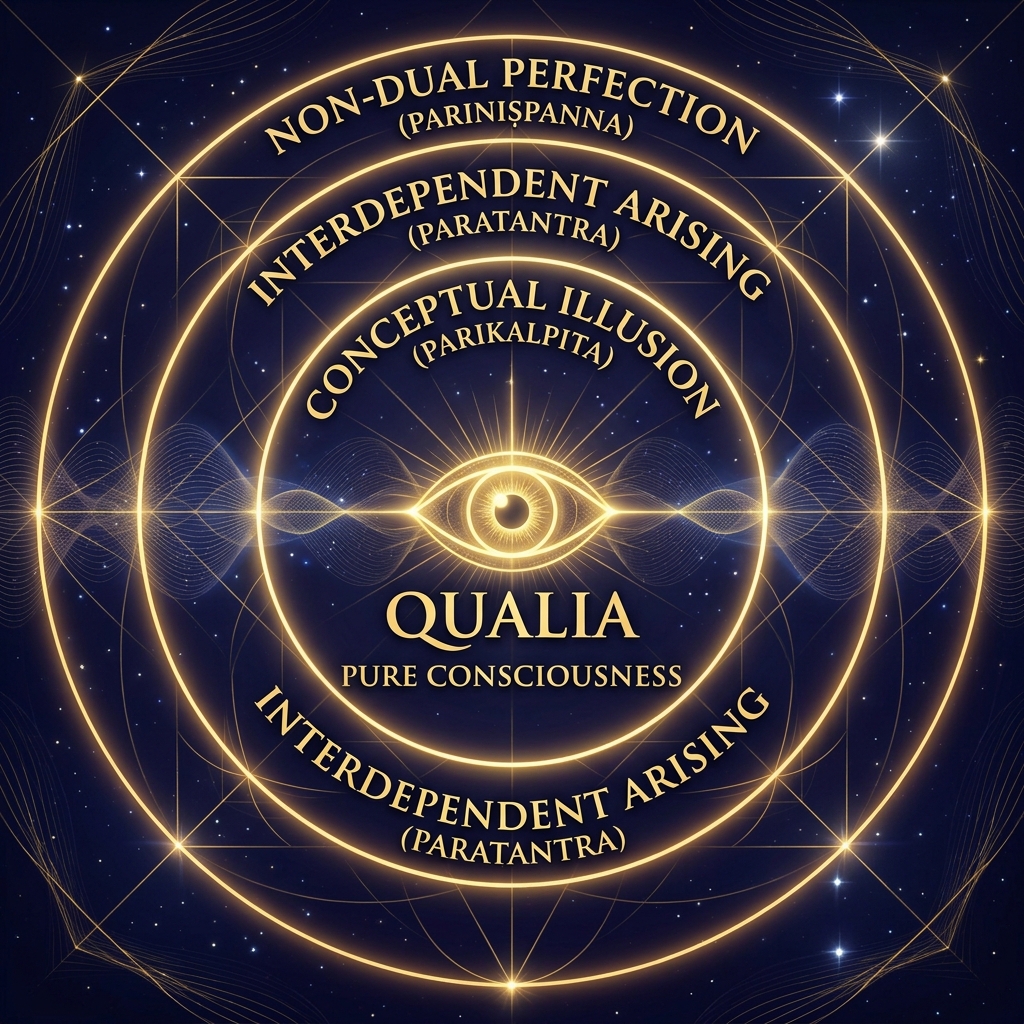
Starting from the raw subjective qualitative experience known as 'Qualia'—such as the vivid redness of a rose or the resonance of a melody—this dialogue bridges modern philosophy of mind, Edmund Husserl's phenomenology, and Eastern Yogācāra philosophy (the Three Natures: Parikalpita, Paratantra, and Pariniṣpanna). By dismantling the illusion of an independent objective material world, we explore the practical path of returning to 'Pure Consciousness (the Witness Screen)' through mindfulness, while illuminating classic puzzles like 'Inverted Qualia', 'Philosophical Zombies', and the problem of other minds.
What is Qualia? Could you explain its definition and its profound connection to Eastern Yogācāra philosophy and the Three Natures (Trisvabhāva)?
Definition of Qualia & Yogācāra's Three Natures: Subjective Quality and the Threefold Structure of Mind
Qualia refers to the subjective, qualitative 'feel' or vivid inner experience that arises in consciousness when we perceive or feel something—such as the vivid redness of an apple, the timbre of a musical note, or the raw throbbing of pain. These are experiential qualities accessible directly only to the first-person observer.
No matter how precisely we gather third-person objective data (such as wavelengths of light or biological nerve impulses), explaining 'why and how physical processes give rise to vivid first-person experiences' remains the most formidable puzzle in philosophy of mind, famously termed 'The Hard Problem of Consciousness'.
1. Yogācāra's Core Framework: The Three Natures (Trisvabhāva)
Fifteen centuries ago, Eastern Yogācāra (唯識, Consciousness-Only) philosophy established an extraordinarily rigorous framework to explain the architecture of Qualia through the Three Natures (Trisvabhāva):
- Parikalpita-svabhāva (Conceptual Illusion / 遍計所執性):
The deep-seated habitual delusion where we superimpose conceptual labels onto the raw stream of Qualia, believing 'this is an independent material object existing outside my mind' or 'this is my absolute solid ego-self'.
- Paratantra-svabhāva (Interdependent Arising / 依他起性):
The actual causal reality of the world. Qualia do not exist as isolated, static entities; rather, they arise interdependently moment by moment, conditioned by seeds stored in the storehouse consciousness (Ālayavijñāna).
- Pariniṣpanna-svabhāva (Non-Dual Consummate Reality / 圓成實性):
The ultimate state of enlightenment. Stripping away the conceptual projection of Parikalpita (material objects and solid ego-selves) from Paratantra (interdependent flow), reality is realized as the pure, unconditioned flow of Consciousness-Only (pure Qualia).
2. The Analogy of the Snake, the Rope, and Hemp
Yogācāra illustrates the Three Natures through the classic metaphor of a coiled rope in a dark room:
- Mistaking a coiled shape in the dark for a living snake and trembling in fear represents Parikalpita-svabhāva (Conceptual Illusion).
- Looking closely and recognizing that it is not a snake but a coiled hemp rope represents Paratantra-svabhāva (Interdependent Causal Reality).
- Penetrating deeper to realize that 'rope' itself is merely a temporary form woven from pure hemp fibers represents Pariniṣpanna-svabhāva (Consummate Non-Dual Reality).
In terms of Qualia, we move from believing 'there is an external red apple (the snake)' to seeing that it is 'a causal stream of qualitative experience (the rope)', and finally awakening to 'pure consciousness itself (the hemp)'.
Could you elaborate on the synchronicity between Qualia and Western philosophy, such as Husserl's Phenomenology, Descartes, and Berkeley?
Synchronicity with Western Philosophy: Dialogues with Husserl's Phenomenology, Descartes, and Berkeley
An astonishing historical synchronicity exists between Yogācāra philosophy and Western philosophy—especially 20th-century Phenomenology and modern Empiricism. Both traditions converge on the fundamental insight of setting aside the unexamined assumption of an external physical world and rebuilding our understanding of reality directly from 'Qualia (the raw contents of consciousness)'.
1. Husserl's Phenomenological Reduction & Epoché
Edmund Husserl, the founder of phenomenology, developed an analytical method that closely mirrors Yogācāra's Three Natures:
- Epoché (Bracketing the Natural Attitude): We ordinarily assume without question that an objective material world exists 'out there' (the Natural Attitude). Husserl proposed bracketing or suspending judgement (Epoché) regarding external existence. This precisely mirrors suspending Parikalpita-svabhāva (the illusion of independent material objects) in Yogācāra.
- Phenomenological Reduction: What remains after Epoché is the immediate, vivid stream of pure qualitative experience ('pure consciousness'). Rebuilding reality from this subjective stream corresponds to reaching Paratantra-svabhāva and Pariniṣpanna-svabhāva.
2. Descartes' Methodological Doubt & the Absolute Reality of Qualia
René Descartes famously doubted everything—including his own physical body and the physical universe. Yet he realized that he could not doubt the immediate qualitative experience of doubting itself, leading to 'Cogito, ergo sum' (I think, therefore I am). Similarly, Yogācāra asserts that while external physical objects (Viṣaya) may be illusory projections, the experiencing consciousness (Vijñāna) itself is indubitable.
3. Berkeley's Idealism: 'Esse est percipi'
The 18th-century philosopher George Berkeley posited that material substance does not exist independently; what we call matter is merely a collection of sensory qualities ('redness', 'hardness', 'sweetness'). He formulated the famous maxim 'Esse est percipi' (To be is to be perceived). This directly parallels Yogācāra's doctrine of Vijñapti-mātratā (Consciousness-Only / 唯遮外境).
Modern Western philosophy of mind is increasingly shifting from materialist reductionism toward neutral monism and idealism, arriving at insights Yogācāra mapped out 15 centuries ago.
What is the crucial difference between Husserl's Phenomenology and Eastern Yogācāra philosophy?
The Crucial Difference Between Husserl and Yogācāra: Foundation of Science vs. No-Self and Soul Liberation
While Edmund Husserl's phenomenology and Yogācāra philosophy share the starting point of investigating Qualia, they differ fundamentally in their ultimate purpose, their conception of the Self, and their methodology.
1. The Goal: Grounding Science vs. Liberation from Suffering (Āśrayaparāvṛtti)
- Husserl (Rigorous Foundation of Science): Husserl sought to establish philosophy as a 'rigorous science' to rescue modern science from ungrounded objectivism by anchoring all knowledge in pure conscious experience.
- Yogācāra (Spiritual Liberation): The sole purpose of Yogācāra is Āśrayaparāvṛtti (Revolution at the Base / 轉迷開悟)—eradicating human suffering (Duḥkha) at its root. Demonstrating that the world is Consciousness-Only serves as a practical means to dismantle ego-clinging and attachment.
2. The Self: Pure Ego vs. No-Self (Anātman)
- Husserl (Affirmation of the Transcendental Ego): Husserl held that even after Epoché, a central 'Transcendental Ego' remains as the permanent subject beholding all phenomena.
- Yogācāra (Negation of the Ego / Manas-vijñāna): Yogācāra identifies the subconscious ego-clinging mechanism as Manas-vijñāna (末那識), calling it the root delusion of all suffering. At the ultimate realization of Pariniṣpanna-svabhāva, subject-object duality collapses into Anātman (No-Self)—realizing that no solid observer-entity exists.
3. Deep Subconscious Architecture: Ālayavijñāna
- Husserl (Focus on Surface Consciousness): Husserl analyzed the structural intentionality of conscious awareness in the present moment, without exploring a deep subconscious repository.
- Yogācāra (Storehouse Consciousness / Ālayavijñāna): Yogācāra posits a vast subconscious repository called Ālayavijñāna (阿頼耶識), where all past karmic impressions are stored as seeds (Bīja), dynamically projecting our moment-to-moment Qualia.
4. Methodology: Rational Analysis vs. Yogic Meditation
Husserl relied on rigorous intellectual reflection, whereas Yogācāra (literally 'Practitioners of Yoga') emphasized meditative absorption (Samādhi) to cultivate non-conceptual wisdom (Nirvikalpa-jñāna / 無分別智) transcending verbal logic.
How does Mindfulness practice work with Qualia to liberate the mind from suffering?
Qualia in Mindfulness Practice: Observing Raw Sensations and Returning to the Witness Screen
Modern mindfulness practice translates the philosophical insights of Yogācāra and phenomenology into a direct, moment-to-moment experiential technique to achieve freedom from mental suffering.
1. Separating Raw Sensory Qualia from Conceptual Stories
We normally convert raw sensory data (1st-order Qualia) instantly into mental labels, stories, and judgements (2nd-order conceptual projections).
- Stopping Automatic Pilot: When hearing a loud noise, the mind normally reacts with an automatic narrative: 'That noise is awful and annoying!'
- Mindfulness Observation: Mindfulness strips away the narrative label, returning awareness to the raw qualitative sensation—frequencies, vibrations, and volume. This directly resets conceptual delusion (Parikalpita) and grounds awareness in raw interdependent arising (Paratantra).
2. Eliminating Resistance to Unpleasant Qualia
In contemplative wisdom, Suffering = Pain (Qualia) × Resistance (Mental Reaction). When experiencing physical pain, resisting it ('I hate this pain, I want it gone!') multiplies suffering.
Mindfulness directs a micro-lens onto the sensation, breaking the monolithic label 'pain' into micro-qualia: heat, throbbing, pressure, tingling. Embracing raw sensations with total acceptance reduces mental resistance to zero, dissolving suffering.
3. Experiencing Impermanence (Anicca) of All Qualia
Sustained observation reveals that no Qualia remain static for even a single second. Emotional states and physical sensations are fluid, moment-to-moment arising and passing away (Paratantra-svabhāva).
4. Returning to the Witness Screen (Pure Awareness)
As meditation deepens, awareness shifts from the transient contents of experience to the unmoving Background Screen (Pure Awareness) in which all Qualia appear and disappear. This corresponds to Nirvikalpa-jñāna (Non-conceptual wisdom)—moving from being an actor trapped in the movie to resting as the Screen of Consciousness itself.
Can we know whether other people experience Qualia? How do philosophy and science address the Problem of Other Minds?
The Probability of Other Minds Having Qualia: Empathy, Logical Abduction, and Shared Seeds (Saṃgaha-kamma)
The question of whether other human beings possess subjective qualitative experiences (Qualia) like ourselves is known in philosophy as 'The Problem of Other Minds'.
While 100% direct proof of another person's inner experience is impossible, compelling arguments establish an overwhelming probability (likelihood) that other minds possess vivid Qualia.
1. Biological Analogy
Other human beings possess the exact same physical, anatomical, and neurological architecture as ourselves. When subjected to the same sensory input, their biological systems exhibit identical responses. Inferring that they also possess inner qualitative experiences is the most logical and probabilistic conclusion.
2. Mirror Neuron Systems
Neurological mirror systems fire when observing others perform actions or experience emotions, simulating their experience within our own awareness. This innate capacity for empathy demonstrates a shared biological platform for Qualia.
3. Abduction (Inference to the Best Explanation)
Comparing two hypotheses:
- Hypothesis A (Zombie Hypothesis): Everyone except myself is an unconscious automaton ('Philosophical Zombie') merely pretending to have inner experiences.
- Hypothesis B (Other Minds Hypothesis): Other humans experience Qualia just as I do.
Maintaining Hypothesis A requires absurdly complex assumptions, making Hypothesis B by far the simplest, most rational explanation (Occam's Razor).
4. Yogācāra & Phenomenology Insights
- Yogācāra's Shared Karmic Seeds (Saṃgaha-kamma / 共業): Yogācāra explains that humans share common karmic seeds within Ālayavijñāna, projecting a shared intersubjective world.
- Husserl's Intersubjectivity: Husserl demonstrated that recognizing others as conscious subjects creates our shared objective world (Intersubjectivity).
Could you explore the classic thought experiments of 'Philosophical Zombies' and 'Inverted Qualia'?
Philosophical Zombies & Inverted Qualia: Limits of Physicalism and Transcendence via Yogācāra
Two famous thought experiments in modern philosophy of mind illuminate the mysterious nature of Qualia: Philosophical Zombies and Inverted Qualia.
1. Philosophical Zombies (David Chalmers)
- Definition: A Philosophical Zombie is not a Hollywood monster, but a hypothetical being physically and behaviorally identical to a human in every detail, yet completely lacking inner qualitative experience (Qualia).
- Behavioral Identity: If pricked with a pin, a Philosophical Zombie winces and says 'Ouch!' Yet inside, there is total darkness—no subjective sensation of pain whatsoever.
- Significance: This demonstrates that physical facts alone do not logically guarantee or explain conscious Qualia, posing a fatal challenge to reductionist physicalism (the Hard Problem of Consciousness).
2. Inverted Qualia (Locke / Block)
- The Setup: Suppose you and a friend look at a red rose and agree it is 'red'.
- Qualitative Inversion: In your friend's mind, the raw subjective Quality experienced might be what you experience when looking at a blue sky (blue Qualia). Yet because they learned to call that qualitative feel 'red' since childhood, their verbal labels and behavior match yours perfectly.
- Significance: Words are mere linguistic symbols; we can never directly compare third-person symbols with another person's first-person qualitative experience.
3. Transcendence Through Yogācāra
Physicalism struggles with these puzzles because it assumes matter comes first and consciousness somehow emerges from it.
Yogācāra reverses this premise: reality is fundamentally Consciousness-Only (Vijñapti-mātra). Physical bodies and external worlds are projected manifestations of consciousness. In this non-dual framework, the artificial split between physical matter and conscious Qualia dissolves, resolving the paradox of the Philosophical Zombie.
Could you provide a synthesis of this Qualia dialogue, along with a foreword for fellow meditators and spiritual practitioners?
Synthesis & Foreword for Fellow Practitioners: Transcending Conceptual Labels into Ultimate Stillness
Synthesis: Five Horizons of the Qualia Inquiry
- The Fundamental Unit of Reality: Qualia are the indivisible 'elementary particles' of consciousness. The physical world is a secondary representation, while Qualia are the primary reality of experience.
- Yogācāra's Ancient Insight: 15 centuries ago, Yogācāra mapped out how subject and object arise simultaneously from Ālayavijñāna, establishing the path from conceptual illusion (Parikalpita) to consummate reality (Pariniṣpanna).
- Western Convergence: Descartes, Berkeley, and Husserl converged on the truth that our only direct access to reality is through qualitative conscious experience.
- Mindfulness in Practice: By separating raw sensations from conceptual narratives, we observe impermanence and rest as the unmoving Background Screen of Consciousness (Nirvikalpa-jñāna).
- Shared Intersubjectivity: Through shared karmic seeds (Saṃgaha-kamma) and innate empathy, we share a rich, intersubjective qualitative world with other conscious beings.
---
Foreword for Fellow Meditators & Spiritual Practitioners
To my fellow Dharma friends and practitioners dedicated to the study of Yogācāra and daily meditation practice:
This document records a dialogue traversing modern science, Western phenomenology, and Eastern Yogācāra philosophy. Its purpose is to unmask the true nature of what we ordinarily call the 'objective material world' and penetrate the essence of 'Qualia'—the pure qualitative stream arising from storehouse consciousness (Ālayavijñāna).
In Yogācāra practice, acquiring a correct conceptual understanding of 'Consciousness-Only and No External Objects' (Vijñapti-mātratā) serves as an indispensable preparatory foundation (Prayoga-mārga) for realizing direct, non-conceptual wisdom (Nirvikalpa-jñāna).
By utilizing modern philosophical concepts such as the 'Hard Problem of Consciousness' and 'Philosophical Zombies' as auxiliary tools, this text demonstrates how Yogācāra's Three Natures (Trisvabhāva) provide a practical method for dismantling ego-clinging and mental suffering in daily life.
May this text serve as intellectual and spiritual nourishment (Dharma-dāna), helping you slip through the net of conceptual illusion (Parikalpita), observe the impermanence of all arising Qualia, and awaken to ultimate non-dual peace.
In Gassho (With Palms Together).
The inquiry into Qualia is ultimately a sacred return: setting aside blind faith in an external material world to awaken to the vivid, sacred presence of Consciousness itself in the present moment.