
✦ Philosophical Prologue: Toshihiko Izutsu's Breakthrough Beyond Mysticism
In 1977, the linguistic philosopher Toshihiko Izutsu published his seminal English monograph, Toward a Philosophy of Zen Buddhism, at the Imperial Iranian Academy of Philosophy in Tehran. While Daisetz T. Suzuki had introduced Zen to the West primarily through psychological, intuitive, and mystical categories, Izutsu achieved something fundamentally different: he deployed the sharpest scalpels of Western philosophy — Aristotelian logic, phenomenological reduction, and structural linguistics — to lay bare the deep ontological and semantic architecture of the Zen enlightenment experience.
Izutsu revealed that Zen is neither an anti-intellectual mysticism nor an irrational silence. Rather, it is a radical philosophical act that dynamites the rigid "essentialist" paradigm of Western metaphysics (the subject-predicate structure of Substance and Accidence), uncovering the pre-dual dynamic field of reality: The Field of Awareness ("The Verb SEE"). Furthermore, he demonstrated how the 3-stage logic of Soku-hi (A is A → A is non-A → A is again A) and the "Transparent Articulation of Language" did not remain abstract speculations, but became directly embodied (incarnated) in the great traditional arts of Japan (Gei-doh): Suiboku-ga (ink wash painting), Noh theater, Chanoyu (the Way of Tea), and Haikai poetry.
In his 1977 English monograph Toward a Philosophy of Zen Buddhism, Toshihiko Izutsu states at the very outset of Essay I, "The True Man Without Any Rank," that while Western philosophy since Aristotle has continually asked "What is man?", Zen raises an entirely different, existential question: "Who am I?"
Why did Izutsu identify this contrast as the decisive metaphysical watershed separating Western philosophy from Zen? What kind of paradigm shift in ontology and view of humanity is being initiated here?
Dialogue 1: The Deconstruction of Aristotelian Essentialism and the Existential Inquiry "Who Am I?"
That opening inquiry strikes directly at the metaphysical fault line between Western philosophical traditions and the Zen worldview. By contrasting Aristotle's "What is man?" (Quid est homo?) with Zen's "Who am I?", Izutsu is executing a total deconstruction of Aristotelian Essentialism.
Let us unpack this contrast systematically:
1. Aristotle's Question: "What is man?" — The Illusion of Fixed Substance
When one asks "What is X?", one is operating within the classical logic of substance (substantia) and accidence (accidens). In this framework:
- An observer stands in an objective, detached third-person position, surveying "man" as an external object of observation.
- The inquiry seeks a formal definition through genus (genus proximum) and specific difference (differentia specifica), arriving at definitions such as zoon logon echon ("the rational animal").
- This assumes an immutable, self-identical "essence" or "human nature" underlying all individual human beings.
Izutsu points out that this essentialist approach inevitably turns the living human subject into a reified object, a conceptual fossil. It assumes the empirical ego is an enduring substance that "possesses" thoughts, feelings, and faculties.
2. The Zen Question: "Who am I?" — The Immediate Existential Crisis
In stark contrast, Zen refuses to treat humanity as an abstract concept. When the Zen master turns to the disciple and demands: "Speak! Before your father and mother were born, who are you?", the following fundamental transformations occur:
- Abolition of the Objective Standpoint: The inquirer cannot step outside themselves to observe an objective essence. The very subject who asks the question is on trial here and now.
- Demolition of Generic Categories: General concepts such as "rationality," "social animal," or "sentient being" are stripped away. Any conceptual answer is immediately struck down with the master's staff (Keisaku).
- Encounter with the Abyss of Emptiness: When all attributes, memories, social roles, and concepts are eliminated, what remains? Not a solid core called "ego," but the sheer, unfathomable openness of Non-Self (Anātman) and Emptiness (Śūnyatā).
"The question is not concerning the nature of Man in general, but an infinitely more personal and intimate one of who is this very human subject who, existing as he does here and now in a time-space system, raises the question about his own self."
— Toshihiko Izutsu, Toward a Philosophy of Zen Buddhism, Essay I
Thus, Zen replaces the Western metaphysics of Substance (Substantia) with the Eastern ontology of Relation (Relatio) and Field. What Linji Yixuan (Rinzai) called "The True Man Without Any Rank" (wèi-wèi zhēn-rén) is precisely this subject: an absolute subject that has thoroughly discarded all worldly rankings, classifications, and substantial essences, operating freely within the living field of reality.
Having deconstructed the substantial ego, Izutsu introduces a central concept in Essay I: "The Field of Awareness" (Field Awareness). He emphasizes that the ultimate reality of Zen is not grasped by nouns or objects, but by the pure dynamic verb "SEE", in which subject and object are simultaneously dissolved and generated.
Could you explain the functional relationship between Subject and Object in this "Field," and what Izutsu means by distinguishing "Consciousness" from "Supra-Consciousness"?
Dialogue 2: The Field of Awareness (The Verb "SEE") and Supra-Consciousness
Here we arrive at the heart of Izutsu's epistemological revolution. Ordinary human cognition is enslaved by the subject-object dualism: "I (Subject) see a Mountain (Object)." We instinctively believe that an independent "I" exists first on one side, an independent "Mountain" exists on the other, and that a cognitive bridge called "seeing" links them across space.
Izutsu turns this commonsense model completely upside down through the ontology of the Field of Awareness.
1. The Pure Dynamic Verb "SEE" Beyond Dualism
In the enlightened state of Zen, there is neither an isolated subject who sees nor an isolated object being seen. There is only the primordial, undivided event of illumination: SEE.
- It is not that "Man sees the Mountain."
- Nor is it that "The Mountain sees Man."
- Rather, within the single dynamic Field of Awareness, "Man" and "Mountain" are co-arising, mutually determining polarities.
The subject (S) and the object (O) are not independent self-substances; they are functional determinations of the Field itself. The moment the Field activates as "SEE," one pole crystallizes as the experiencing consciousness (Subject), while the other pole simultaneously crystallizes as the experienced phenomenon (Object). This is the functional reciprocity of Pratītyasamutpāda (Dependent Origination).
2. Consciousness vs. Supra-Consciousness
To clarify this state, Izutsu introduces a vital distinction between ordinary Consciousness (Empirical Ego) and Supra-Consciousness (The Field):
✦ The Structural Levels of Mind in Izutsu's Analysis
1. Ordinary Empirical Consciousness (Vikalpa):
Characterized by discursive thinking, reifying concepts, and rigid dualism. The ego imagines itself to be an autonomous castle separated from the external world.
2. The Unconscious (Freud / Jung):
Beneath ordinary awareness lie biological drives or mythological archetypes. However, for Izutsu, this layer is still darkened by ignorance (Avidyā) and personal/collective conditioning.
3. Supra-Consciousness (The Zen Field):
This is neither trance, deep sleep, nor mystical blur (makyō). It is a state of absolute, diamond-like clarity where all clinging to an ego has dropped off ("Body and Mind Dropped Off" / Shin Jin Datsu Raku). Because there is no ego-filter to obstruct reality, the entire cosmos shines forth with total lucidity.
In Supra-Consciousness, the "I" is no longer an ego-substance, but an "Ego-less Ego." As Izutsu states, when you look at a bamboo stalk in this state, it is the bamboo that becomes your awareness, and your awareness that becomes the bamboo. The wall between interiority and exteriority has completely collapsed into the undivided Field.
In Essays III and IV, Izutsu tackles one of the most enigmatic problems in Zen: language. Zen famously proclaims "A special transmission outside scriptures, not founded upon words or letters" (Kyōge Betsuden, Furyū Monji). Yet Zen masters produce immense volumes of sayings, and the tradition developed the elaborate system of Koans (e.g., "What is the Buddha? — Three pounds of flax"; "What is the meaning of the Ancestor coming from the West? — The cypress tree in the courtyard").
Izutsu argues that these dialogues are not mere "irrational nonsense," but represent what he calls "Transparent Semantic Articulation" (Transparent Articulation). How does language function here, and how does a Koan smash discursive thought to reveal this new dimension of words?
Dialogue 3: Koan and "Transparent Articulation" — The Alchemy of Language and Nonsense
This is perhaps Toshihiko Izutsu's most brilliant contribution as a world-renowned semanticist and linguist. Superficial observers often assume Zen is entirely anti-verbal, asserting that "words are useless; truth lies solely in silent meditation." Izutsu firmly refutes this naive misunderstanding.
He demonstrates that Zen's true intention is not the absolute annihilation of language, but the destruction of "Opaque Articulation" and the recovery of "Transparent Articulation."
1. Opaque Articulation: Words as Walls
In conventional life, human language operates through Opaque Articulation:
- Words cut up the continuous, seamless fabric of reality into fixed conceptual pigeonholes (man vs. woman, good vs. bad, tree vs. mountain).
- These verbal categories petrify into rigid conceptual walls. Instead of experiencing the living reality of a flower, we experience only our conceptual label "flower."
- Language becomes an opaque barrier that blocks direct contact with Emptiness and the Field of Awareness.
2. The Koan as a Metaphysical Sledgehammer
When a disciple asks: "What is the ultimate Buddha-nature?", their mind is trapped in opaque articulation, expecting a metaphysical definition. But the master snaps back: "Three pounds of flax!" (Mā-sān-jīn) or "The cypress tree in the front garden!"
From the viewpoint of standard logic, this is pure "nonsense." But as Izutsu analyzes in Essay III ("Sense and Nonsense in Zen"), this nonsense is a calculated, devastating semantic technique:
- The unexpected collision instantly derails the train of rational, discursive thinking (vikalpa).
- The intellectual ego, seeking a logical link where none exists, experiences a complete deadlock — what Zen calls "The Great Doubt" (Daigi-dan), likened to swallowing a red-hot iron ball that can neither be swallowed nor spat out.
- Under this unbearable metaphysical pressure, the entire scaffolding of opaque conceptualization collapses: The bottom falls out of the tub.
3. Transparent Articulation: Words Born of Silence
Once the mind drops through the bottom of conceptual thought into the silent abyss of Non-Articulation (Silence), language undergoes a miraculous rebirth:
"Zen Silence is a silence pregnant with words. Out of the depths of the Silence there emerges language... an event of the self-articulation of the non-articulation."
— Toshihiko Izutsu, Toward a Philosophy of Zen Buddhism, Preface
In Transparent Articulation:
- Words no longer point to rigid substances. They become crystalline, translucent forms through which the light of Emptiness (Śūnyatā) shines unimpeded.
- When the master says "The cypress tree in the garden," the words do not stand between the observer and the tree. The words are the living, flashing manifestation of the Field itself.
- Language is no longer an opaque wall concealing the truth; it has become a transparent window opening upon the infinite.
This transformation of language brings us directly to the classical dialectic of Mahayana Buddhism: the famous 3-stage formulation by Qingyuan Xingsi (Seigen Ishin):
- "Before practicing Zen, thirty years ago, I saw that mountains were mountains and rivers were rivers."
- "When I attained a deeper insight, I saw that mountains were not mountains, and rivers were not rivers."
- "Now, having reached the ultimate rest, mountains are once again mountains, and rivers are once again rivers."
This is the dialectic of Soku-hi: A is A → A is non-A → A is again A. Why does Izutsu place supreme emphasis on this 3rd stage, identifying it as the emergence of "Miao-Yu" (Wondrous Being)? How does the 3rd stage differ from the naive 1st stage?
Dialogue 4: The 3-Stage Logic of Soku-hi and the Emergence of "Miao-Yu" (Wondrous Being)
This 3-stage progression is the definitive master-key for understanding the entire trajectory of Eastern metaphysics and its aesthetic fruition in Japanese culture. Izutsu treats this formulation not as a poetic paradox, but as a rigorous epistemological map of awakening.

1. Stage 1: A is A — Naive Differentiation (Samsara)
This is the world of everyday common sense. The mountain is seen as a distinct, solid physical entity existing independently of myself. It is governed by naive realism and Aristotelian essentialism: a chair is a chair, a mountain is a mountain, I am I. Dualism, attachment, and existential suffering reign supreme because all forms are grasped as enduring, separate substances.
2. Stage 2: A is non-A — Absolute Negation & Emptiness (Śūnyatā)
Through relentless Zazen and the explosive impact of the Koan, all distinctions and conceptual reifications are thoroughly annihilated.
- The substantial identity of things dissolves: "The mountain is no longer a mountain."
- The empirical ego dissolves: "I am no longer an ego."
- All differentiated forms collapse into the primordial abyss of Emptiness (Śūnyatā), the zero-state of undifferentiated Oneness.
However, Izutsu issues a severe warning here: If a practitioner stops at Stage 2, they fall into the deadly trap of Nihilism and Quietism ("Dead Emptiness" / Akū). Stagnating in the blank darkness of Emptiness is what Zen masters call "the cave of the devil" or "drunkenness in the void."
3. Stage 3: A is (again) A — Wondrous Being (Miao-Yu)
True Zen enlightenment does not reside in the void of Stage 2; it consists of taking one further, decisive step off the top of a hundred-foot pole: Returning back to the phenomenal world.
- "Mountains are once again mountains, and waters are once again waters."
- Visually, this appears identical to Stage 1. The mountain stands tall, green, and solid. Yet its ontological status has undergone a 180-degree metamorphosis.
- The mountain is no longer a heavy, opaque Aristotelian substance. It is now a transparent, shimmering crystallization of Emptiness itself.
✦ The Ontological Formula of Miao-Yu (Wondrous Being)
In Buddhist ontology, this is expressed as: True Emptiness is Wondrous Being (Shinkū Myōu).
Because things are completely empty of self-nature (Stage 2), they can arise in infinite variety, radiant and unhindered, as phenomenal reality (Stage 3).
Here, the principle of Coincidentia Oppositorum (The Unity of Opposites) is fully realized: Absolute Emptiness and Absolute Phenomenal Form are strictly identical. Every ordinary blade of grass, every pebble, every cloud is perceived as the luminous, pulsing self-manifestation of the Field of Awareness.
And it is precisely this 3rd stage — A is again A — that became the spiritual wellspring of traditional Japanese arts. Let us now examine how this metaphysical realization became "flesh" (incarnated) in the great Gei-doh traditions.
In the final two essays of his book — Essay VI ("The Interior and Exterior in Zen") and Essay VII ("The Elimination of Color in Far Eastern Art and Philosophy") — Izutsu turns his gaze to traditional Far Eastern art, particularly Suiboku-ga (monochrome ink wash painting).
Why did Zen masters and painters deliberately reject the magnificent spectrum of five colors (red, blue, yellow, etc.) to paint exclusively in monochrome black ink? And what is the profound metaphysical meaning of "Yo-haku" (Negative Space / Blank Void) in these paintings?
Dialogue 5: The Metaphysics of Suiboku-ga — The Elimination of Color and the Awakening of "Yo-haku"
In Essay VII, Izutsu provides a breathtaking metaphysical analysis of Far Eastern aesthetics. Western oil painting traditionally works by accumulation: adding pigment upon pigment, covering every millimeter of the canvas to create the illusion of solid three-dimensional volume and radiant polychromy.
In stark contrast, Far Eastern Suiboku-ga operates by an act of radical metaphysical asceticism: The Elimination of Color.
1. The Sacrificial Slaughter of Color (Killing the Five Colors)
The sensible world is overflowing with colors: crimson blossoms, azure skies, emerald foliage. But according to Izutsu, ordinary sensory perception of colors belongs to Stage 1: it stimulates the sensory ego, fuels emotional attachment, and reinforces the illusion of external substances.
- The Zen painter deliberately slaughters this sensory glitter. By plunging all five colors into the monochromatic darkness of black ink (Sumi), the painter performs a visual act of Śūnyatā (Stage 2: A is not A).
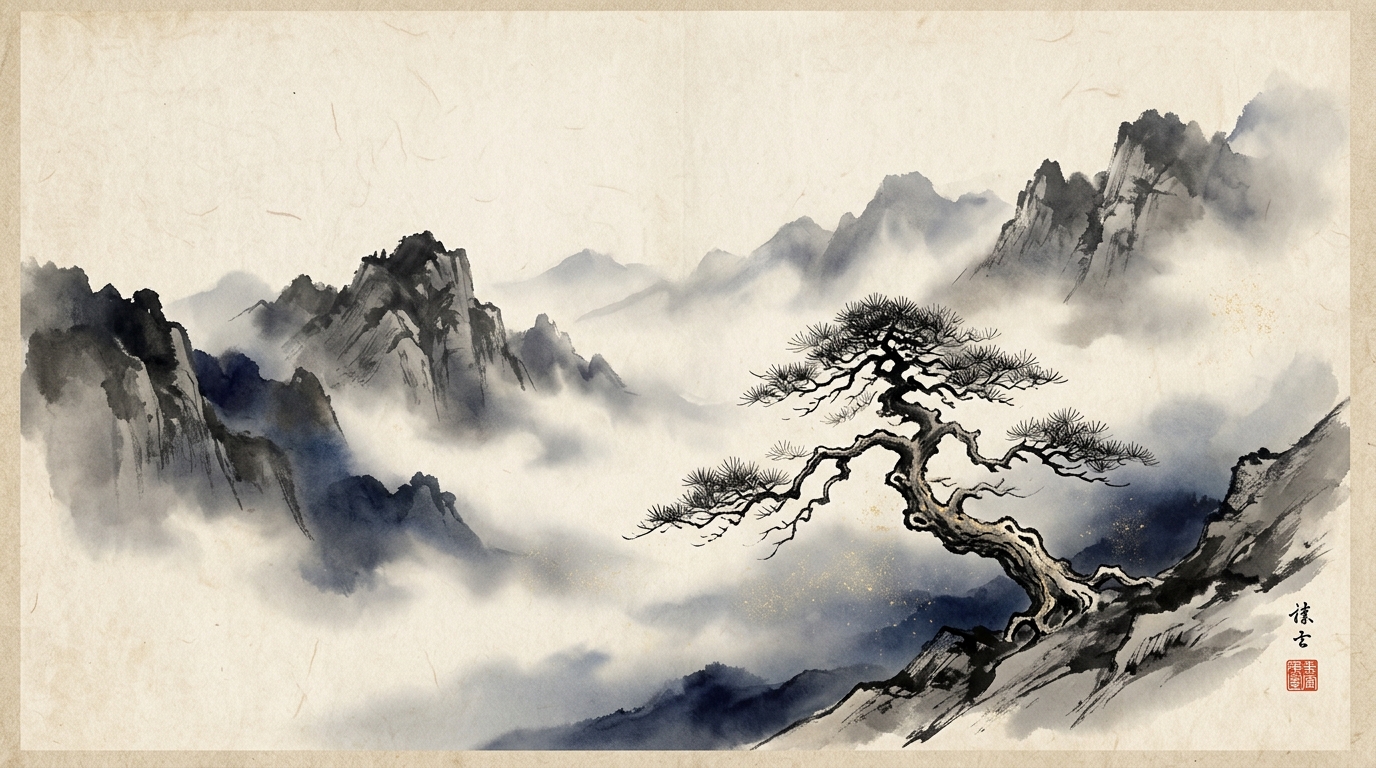
- Yet black in Suiboku-ga is not a dead, flat absence of color. As the classical treatise says: "In ink, there are five colors" (Boku ni goshiki ari).
- By reducing color to the infinite tonal gradations of soot, water, and paper (dark, light, dry, soaked, flying-white), black becomes the metaphysical womb holding all possible colors in potentiality. This is Stage 3 (Miao-Yu): black ink does not depict the surface skin of things, but radiates the inner spirit (Qi) of Being itself.
2. "Yo-haku" (Negative Space): The Living Womb of Emptiness
Even more crucial than the black ink strokes is what is left unpainted: Yo-haku (the untouched white space of the paper).
✦ The Ontology of Negative Space in Suiboku-ga
In Western classical perspective, an empty background is simply "empty air" or an unfinished portion of the canvas. In Suiboku-ga, however, Yo-haku is not empty canvas waiting to be filled — it is the primary subject of the painting.
- The white void represents the infinite Field of Awareness (Śūnyatā).
- A few strokes of ink — a withered branch, a distant mountain peak, a solitary fisherman — emerge out of this void like ripples on a cosmic ocean, only to merge back into it.
- The viewer does not merely look at the painted tree; their eye is drawn into the vast white space between the branches. The unpainted void vibrates with intense spiritual presence.
As the Chinese saying declares: "Where there is no brush and no ink, there lies the most wondrous realm." Suiboku-ga is nothing less than the direct sensory embodiment of the Heart Sutra: "Form is Emptiness, Emptiness is Form" (Rūpaṃ śūnyatā, śūnyataiva rūpam). The monochrome ink stroke is Miao-Yu (Wondrous Form), and the surrounding Yo-haku is Shinkū (True Emptiness), dynamically interpenetrating without the slightest obstruction.
This embodiment of "Miao-Yu" extends far beyond painting into the performative and spatial arts: Noh theater and Chanoyu (the Way of Tea).
In Noh, Zeami formulated the mysterious aesthetic principle of "Senu Hima" (The Interval of Non-Action), along with "Riken no Ken" (The Detached Gaze). In Chanoyu, Sen no Rikyu created the legendary two-mat teahouse Taian, stripping away all decorative luxury.
How do Zeami's motionless pauses and Rikyu's extreme contraction of physical space embody Izutsu's "Field of Awareness" and the metaphysics of Zen?
Dialogue 6: The Embodiment of "Miao-Yu" in Noh and Chanoyu — Zeami's "Senu Hima" and Rikyu's Micro-Sanctuary
In this dialogue, we witness how Zen's realization of the Field of Awareness descended directly into the living physical body of the actor and the architectural space of the tea master.
1. Zeami's Noh: The Metaphysics of "Senu Hima" (The Interval of Non-Action)
In his masterwork Kakyō (The Mirror of the Flower), Zeami addresses a profound question: What is the most mesmerizing moment in a Noh performance? He answers: "The interval when nothing is being done" (Senu Hima).
- The flute stops, the drum ceases, the actor halts all physical movement and singing. The stage falls into complete stillness.
- Yet, Zeami warns: "The actor must never let the inner tension of the mind slacken for a single instant."
- What is happening during this motionless silence? It is the somatic condensation of Supra-Consciousness. While the empirical body is completely still (negation of outward movement = Stage 2), the actor's inner awareness is stretched like a bowstring to maximum spiritual intensity (Stage 3). The audience holds its breath, captivated not by external acrobatics, but by the pure invisible radiation of the Field of Awareness.
Furthermore, Zeami's doctrine of "Riken no Ken" (The Detached Gaze) — looking at oneself from behind, seeing one's own figure as the audience sees it — is the exact theatrical counterpart to Izutsu's demolition of the subjective ego: the actor ceases to be a self-absorbed performer and becomes the transparent Field in which stage, performance, and spectators are unified.
2. Rikyu's Chanoyu: Taian and the Contraction into Cosmic Space
Turn now to Sen no Rikyu's revolution in the Way of Tea, exemplified by the surviving national treasure Taian (a teahouse measuring merely two tatami mats, roughly 6 square feet):
- The Nijiriguchi (Crawling Entrance): The entrance is a tiny sliding hatch less than three feet high. Even the most powerful warlord or shogun had to take off his swords, drop down on his hands and knees, and crawl in like an ordinary mortal. This physical gesture was a dramatic ritual of "Dropping off Body and Mind" (Shin Jin Datsu Raku) — stripping off social rank, worldly power, and the armor of the ego before entering the sanctuary.
- Extreme Contraction as Infinite Expansion: Why did Rikyu contract the room to two mats? Because when physical space is radically contracted to its absolute limit, the room ceases to be an external physical enclosure. The walls become paper-thin, the light filtering through the shoji window becomes soft and ambient, and the sound of boiling water in the iron kettle (Shōfū, the wind in the pines) fills the entirety of existence.
- Wabi and Suki (The Beauty of Imperfection): Rikyu rejected pristine Chinese porcelain in favor of hand-molded, unglazed Chojiro black Raku teabowls. Asymmetrical, heavy, uneven, and devoid of ornate decoration, these bowls embody Miao-Yu: beauty found not in idealized perfection, but in the rough, fleeting, cracked reality of the present moment.
In both Noh and Chanoyu, we observe the identical metaphysical movement: By negating external volume, color, and motion (Stage 2), the finite human act is transfigured into an open vessel for the infinite Field of Awareness (Stage 3).
Finally, we arrive at the art of Haikai (Haiku) pioneered by Matsuo Basho, and Zen's ultimate destination: Return to Everyday Life ("Entering the Marketplace with Helping Hands" / Nitten Suishu, and "Everyday Mind is the Way" / Heijōshin kore Dō).
Basho's famous poem is known throughout the world:
Furu ike ya / kawazu tobikomu / mizu no oto
(The old pond — / A frog jumps in, / The sound of water.)
What kind of metaphysical drama did Izutsu and Zen read into this single seventeen-syllable poem? And what does it mean for us to live this Zen awareness not in an isolated monastery, but amidst the raw realities of daily life?
Dialogue 7: Everyday Life as Supreme Art — Basho's Haikai and "Entering the Marketplace with Helping Hands"
In Basho's Haikai and Zen's return to the marketplace, the entire journey of awakening reaches its final, triumphant resting place.
1. The Metaphysical Architecture of Basho's Frog Haiku
Basho's seventeen-syllable poem is not a casual pastoral sketch of nature. It is a razor-sharp ontological crystallization of the 3-stage logic of Soku-hi and the Field of Awareness:
- "The Old Pond" (Furu ike ya): This is not just a body of water in a garden; it is the primordial, timeless abyss of True Emptiness (Shinkū / Stage 2). It represents the ancient stillness that has existed prior to all cosmic creation, unbroken by a single wave or sound. In Basho's poetic terminology, this is "Fueki" (The Unchanging / Eternal).
- "A Frog Jumps In" (Kawazu tobikomu): A tiny, insignificant creature leaps into the motionless mirror of the void. This is the sudden, dynamic rupture of silence — the awakening of "Ryūkō" (The Ever-Changing / Transience).
- "The Sound of Water" (Mizu no oto): The plop of the water breaks the silence. Yet, does it destroy the silence? Far from it! It is precisely through the fleeting sound of the water that the unfathomable depth of the ancient silence is illuminated and made palpable.
✦ The Synthesis of Eternity and the Transient Instant
The timeless silence (Emptiness) and the transient plop (Form) are not two separate things: they are totally fused in a single instant of Transparent Articulation. The sound of the water is the old pond crying out; the old pond is the sound of the water. This is the absolute perfection of Miao-Yu (Wondrous Being).
The language of the poem is completely transparent: seventeen syllables that offer zero intellectual friction, pointing directly to the living reality where Subject and Object vanish into the pure auditory event.
2. Return to the Marketplace: The 10th Ox-Herding Picture
Why does Zen refuse to end with quietist meditation on a mountain peak? The answer is revealed in the famous Ten Ox-Herding Pictures (Jūgyūzu):
- Stage 6: Riding the Ox Home (Attainment of insight).
- Stage 8: Both Ox and Self Transcended (The empty circle: Absolute Emptiness / Stage 2).
- Stage 10: Entering the City with Helping Hands (Nitten Suishu).
In the 10th picture, an enlightened master depicted as the jolly, barefoot Budai (Hotei) walks right into the noisy, dusty marketplace, carrying a gourd of wine and a sack of treats for street urchins. He does not radiate mystical airs; he does not preach lofty sermons. He drinks, laughs, and rubs shoulders with common laborers and fishmongers.
This is the profound realization that "Everyday Mind is the Way" (Heijōshin kore Dō):
A novice monk once asked Master Zhaozhou (Jōshū):
"I have just entered the monastery. Please give me your teaching."
Zhaozhou asked: "Have you eaten your breakfast porridge?"
The monk replied: "Yes, I have eaten."
Zhaozhou said: "Then go wash your porridge bowl!" (Senpatsu yukiyo).
At that moment, the monk was thoroughly enlightened.
✦ Epilogue: Living the Field in Our Modern World
Washing your bowl after breakfast. Sweeping the dust off the floor. Answering an email with sincere presence. Looking into the eyes of a troubled companion and listening without egoic filters.
Toshihiko Izutsu's monumental work teaches us that Zen is not an esoteric escape into the clouds. By shattering the illusions of Aristotelian substance, dissolving the rigid walls of language, and realizing that True Emptiness is Wondrous Being, the whole universe is redeemed as the living Field of Awareness. When you take a sip of tea or step out onto the morning street, the ancient pond and the splash of water are happening right here, right now.