
 AI Digest: Dissecting the Three Fatal Distortions with the Buddha’s Razor
Guided by the deep reflections of Shoho Kishi (Shawshank), author of The Buddha’s True Intent, this dialogue fearlessly dismantles three foundational distortions prevalent in contemporary Buddhism: (1) reducing Dependent Origination (Paṭiccasamuppāda) to a sentimental moralism of "interconnected gratitude", (2) reducing Non-Self (Anattā) to academic, materialist nihilism ("annihilation at death"), and (3) downgrading meditation to a passive, thought-free sedation. In place of these counterfeit teachings, we reconstruct the Buddha's original engine of self-deconstruction—the active analytical intellect of the First Jhāna (vitakka-vicāra), the universal causality of cessation (Idappaccayatā), and the eternal, unconditioned reality that reveals itself once the cyclone of ego subsides: the Boundless Ocean of the Infinite Mind (Appamaññā).
Author & Source Reference
Original Source: Shoho Kishi (Shawshank)This dialogue is an original philosophical and analytical synthesis inspired by Shoho Kishi’s landmark book The Buddha’s True Intent: The Law of Dependent Origination and Arising-Ceasing (Gentosha MC, 2022) and his extensive 8-year research archive on his official blog. Adhering strictly to intellectual property ethics, this page does not copy book text verbatim, but reconstructs and elevates the structural essence of his critique of modern scholasticism into an in-depth dialogue.
When listening to contemporary Buddhist sermons or reading popular introductions, one constantly hears soothing phrases such as: "We are supported by everything around us, so let us be grateful," "Cherish every karmic encounter," or "Empty your head, let go of all thoughts, and accept everything as it is."
Yet when confronted with real existential agony—aging, illness, bereavement, or explosive emotional turmoil—these platitudes prove completely impotent. I understand the early Pali suttas contain a solemn prophecy about "counterfeit gold" (counterfeit Dhamma). What is the true origin of this overwhelming powerlessness and deception in modern Buddhism?
1. The Buddha’s Prophecy of "Counterfeit Gold" (Saddhamma-patirūpaka)
The profound dissonance you feel is precisely the historical catastrophe that the historical Buddha foresaw and warned against in the early Pali Canon.
In the Saṁyutta Nikāya (SN 16.13, Saddhamma-patirūpaka Sutta), the venerable Mahā-Kassapa approached the Buddha and asked:
"Lord, what is the reason why formerly there were fewer training rules but more monks who attained complete liberation (Arahantship), while now there are far more training rules, yet far fewer monks attain full liberation?"
The Buddha replied with a lucid economic metaphor:
"So it is, Kassapa. So long as counterfeit gold (jātarūpassa patirūpakaṃ) has not arisen in the world, genuine gold does not disappear.
But when counterfeit gold appears in the market, genuine gold vanishes from sight.
In the same way, Kassapa, so long as a counterfeit of the True Dhamma has not arisen in the world, the True Dhamma does not disappear. But when a counterfeit Dhamma appears, the True Dhamma disappears."
💡 The Nature of Counterfeit Gold (Saddhamma-patirūpaka)
In ancient commerce, counterfeit gold was made by electroplating or leafing a thin layer of gold over common iron or lead. Because it glistens on the surface and is cheap to trade, people flock to it, neglecting the heavy, genuine gold underneath.
As Shoho Kishi demonstrates, what mainstream modern Buddhism peddles today is precisely this "lead gilded with sentimental morality." While harmless and convenient for social harmony, the Buddha’s original, uncompromising blade that excises the arrow of existential anguish (dukkha) has been entirely cast aside.
The True Dhamma was not destroyed by external persecutions; it eroded from within as the monastic institution diluted the Buddha's rigorous causal science of self-deconstruction into convenient, emotionally comforting tales to secure patronage and social stability.
A prime example of this counterfeit gold seems to be the popular interpretation of Dependent Origination (Paṭiccasamuppāda).
Almost every modern school teaches: "The rice we eat comes from farmers, our clothes from weavers; everything is interconnected, so let us be grateful for our mutual interdependence."
Why is this moralistic "interdependence of gratitude" the complete antithesis of the Buddha’s realization?
2. Dismantling the Moralization of Dependent Origination: Social Interdependence vs. The Universal Law of Arising and Ceasing
The ubiquitous modern trope that "Dependent Origination means being thankful for social connections" is perhaps the most devastating inversion of Buddhist doctrine.
The Irreconcilable Contradiction with the Buddha’s Renunciation
If the Buddha’s enlightenment consisted of realizing that "humans live in social interconnectedness and should be grateful to society," it makes his own historical life an inexplicable contradiction and moral crime.
What did Siddhartha Gautama actually do?
As the crown prince of the Shakya clan, he had profound filial and social obligations. Yet in the middle of the night, he abandoned his aging father, his devoted wife, his newborn infant son (Rāhula), his throne, and all civic responsibilities to plunge alone into the wilderness.
If spiritual awakening meant "cherishing social harmony and mutual gratitude," then the Buddha’s Great Renunciation was nothing other than cruel dereliction of duty. A sage who severed every worldly bond to eradicate suffering in the forest could never have intended Dependent Origination to mean "conform to and appreciate social relations."
What Did the Buddha Actually Discover? The Law of Specific Conditionality (Idappaccayatā)
What the Buddha realized beneath the Bodhi tree was Paṭiccasamuppāda—not a cozy human-relations theory, nor a mechanistic physicalism, but the invariant causal law governing how thoughts, phenomena, and suffering (dukkha) arise and cease.
【The Axiom of Dependent Origination (Idappaccayatā)】
When this (A) exists, that (B) comes to be;
With the arising of this (A), that (B) arises.
When this (A) is absent, that (B) does not come to be;
With the cessation of this (A), that (B) ceases.
The Buddha's sole mission was to reduce existential suffering (dukkha) to absolute zero. To achieve this, he mapped the direct cause (A: craving and fundamental ignorance) that generates the effect (B: suffering). Dependent Origination is the causal blueprint of cessation: The Twelve Links (Dvādasa-nidāna: Ignorance → Formations → Consciousness → Name-and-Form → Six Senses → Contact → Feeling → Craving → Clinging → Becoming → Birth → Aging and Death).
| Dimension | Modern "Counterfeit Gold" Interpretation | The Buddha’s Authentic Universal Law |
|---|---|---|
| Core Definition | Sentimental Moralism Universal interdependence, social networks, ecology of gratitude. |
Universal Law of Arising & Ceasing Causal arising where thoughts manifest as phenomena; strict conditionality of suffering (Idappaccayatā). |
| Guiding Motto | "We are sustained by all things; let us be thankful for every connection." | "Whatever is subject to arising is subject to cessation. Cut the root cause to end suffering." |
| Practical Direction | Affirm worldly relationships; adjust passively to social harmony. | Observe the automatic reactions of memory bundles; sever self-identification (anattā) to dismantle the ego. |
Let us address Non-Self (Anattā).
Modern philologists and secular Buddhist scholars often assert that liberation in Early Buddhism means total extinction—that death is the complete annihilation of consciousness and existence (ucchedavāda / absolute annihilationism).
However, this reduces Buddhism to mere materialist nihilism. Shoho Kishi clearly affirms that the Buddha was not a materialist, and that rebirth, the afterlife, and the Buddha’s Three Higher Knowledges (Tevijjā) are central. Why has Anattā been so grossly distorted into nihilism?
3. Overcoming the Nihilization of Non-Self: Materialist Annihilation (Ucchedavāda) vs. Severing Self-Identification (Anattā)
The modern academic claim that "Nirvana is simply the extinguishing of life and consciousness like a candle going out forever" is nothing other than the extreme fallacy of Annihilationism (Ucchedadiṭṭhi), which the Buddha explicitly condemned in suttas like the Kaccānagotta Sutta.
As Shoho Kishi emphasizes, rebirth (saṁsāra) and the afterlife are foundational premises in the Buddha’s teaching. The Buddha’s awakening beneath the Bodhi tree was constituted by the Three Higher Knowledges (Tevijjā):
- Pubbenivāsānussati-ñāṇa: The knowledge of recollecting one’s countless past lives across eons.
- Dibbacakkhu-ñāṇa (Cutūpapāta-ñāṇa): The Divine Eye, perceiving the death and rebirth of beings according to their karma.
- Āsavakkhaya-ñāṇa: The knowledge of the destruction of all mental defilements.
Modern scholars who dismiss rebirth and post-mortem continuity as "ancient cultural baggage" are projecting shallow 19th-century materialism onto the Buddha, eviscerating the very ground of the Three Knowledges.
"Not-Self" (Anattā), Not "No-Self"
In the Pali Canon, the formula is Sabbe dhammā anattā ("All phenomena are non-self / not-mine").
The Buddha never indulged in the abstract metaphysical dogma that "there is no self whatsoever" (Natthi attā). Rather, his approach was a precise diagnostic protocol:
"Monks, is the physical body (rūpa) permanent or impermanent?"
— "Impermanent, Lord."
"And is what is impermanent painful or pleasant?"
— "Painful, Lord."
"Is it fitting to regard that which is impermanent, painful, and subject to change as: 'This is mine (etaṃ mama), this I am (eso hamasmi), this is my self (eso me attā)'?"
— "No, Lord."
"Therefore, monks, any body, feeling, perception, mental formation, or consciousness should be seen with right wisdom as: 'This is not mine (netaṃ mama), this I am not (nesohamasmi), this is not my self (na meso attā).'"
🔍 Practical Diagnostic: Anattā as the Severing of Identity
In Shoho Kishi’s rigorous exposition, Anattā is an active method: severing self-identification with the Five Aggregates (the bundle of memory, bodily sensations, and emotional waves).
Whenever an emotion or physical sensation arises, our subconscious reflexively applies "glue" (clinging / upādāna), declaring: "This is my anger, my injury, my ego." This identification is the sole generator of dukkha.
By observing that these five aggregates are conditioned waves that arise and pass away, one peels away the glue of ownership. This is the profound "subconscious housecleaning" that dissolves the illusory boundaries of the ego.
Modern teachers often trivialize All is Suffering (Sabbe Saṅkhārā Dukkhā) as merely: "Life has minor dissatisfactions when things don't go our way."
When the Buddha declared the First Noble Truth (Dukkha Sacca), what was the terrifying reality of "the suffering of the five clinging-aggregates" (Pañcupādānakkhandhā Dukkhā)?
4. The Trivialization of Dukkha: Daily Discontent vs. The Structural Agony of Ego Boundaries
Reducing dukkha to "temporary inconvenience or dissatisfaction" strips Buddhism of its immense existential urgency.
The Parable of the Roppongi Club: The Failure of the Professional Priest
Shoho Kishi recounts a telling anecdote of a contemporary priest who observed youth partying lavishly in Roppongi and lamented: "They are enjoying their lives to the fullest. Telling them 'all is suffering' falls on deaf ears; Buddhism is too hard to teach to modern people."
This is not an issue of modern culture; it proves that the priest himself has no comprehension of what the Buddha meant by dukkha.
Pañcupādānakkhandhā Dukkhā: The Structural Tension of Maintaining a Phantom
The Buddha's definition of suffering was not emotional disappointment:
"In brief, the five clinging-aggregates themselves are suffering (saṅkhittena pañcupādānakkhandhā dukkhā)."
— Dhammacakkappavattana Sutta (The First Sermon)
The essence of dukkha is the structural agony of attempting to freeze and defend a phantom boundary ("me" vs. "other") across the turbulent, ever-shifting ocean of universal phenomena.
No matter how much wealth, fame, or pleasure one amasses, the biological vehicle is decaying every second toward death, while the mind is battered by relentless stimuli. To live trapped inside the Burning House of the Triple Realm (San-gai Kataku), struck by poisoned arrows while dreaming of trivial pleasures—this systemic madness is what the Buddha diagnosed as dukkha.
The critique of meditation is equally revolutionary. Contemporary Mindfulness and Soto Zen often instruct: "Stop all thinking, make your mind blank, and simply be a mirror."
Yet sitting for 40 minutes in a quiet trance does nothing to prevent immediate outrage the moment someone insults us in daily life.
Why does "thought-free meditation" fail to dissolve the ego? How does it differ from the Buddha’s rigorous contemplation beneath the Bodhi tree?
5. Exposing Thoughtless Meditation: The Parable of "Garbage and the Fan", and the Power of the First Jhāna (Vitakka-Vicāra)
This is one of the most razor-sharp breakthroughs in Shoho Kishi’s work. The modern consensus that "meditation equals stopping thought" is a fatal trap from the standpoint of genuine liberation.
The Parable of the Garbage and the Fan
Shoho Kishi illustrates the reality of modern thoughtless meditation with a piercing analogy:
🗑️ The Mechanics of the Garbage and the Fan
- Rotting Garbage (Unresolved Ego Formations & Defilements): Left abandoned in the center of the living room, constantly emitting foul stenches of anxiety, craving, and rage.
- The Fan (Thought-Free Concentration / Passive Mindfulness): Sitting and frantically waving a hand fan to blow the stench away for 40 minutes, sighing, "Ah, how serene and refreshing!"
- Removal Operation (The Buddha’s Vipassanā / Deep Wisdom): Identifying the garbage bundle, carrying it out of the room, and thoroughly scrubbing the floor clean.
Sitting in thought-free "stillness" on a cushion is merely waving the fan. The moment you stop, the garbage remains in the center of the room. When a real-world trigger occurs, the stench erupts instantly. This is why people remain unchanged after decades of sitting.
Why the Buddha Abandoned the Formless Trances
Before his awakening, the Buddha mastered the pinnacle of thought-free yogic trances under Āḷāra Kālāma and Uddaka Rāmaputta—the Sphere of Nothingness and the Sphere of Neither-Perception-Nor-Non-Perception.
Yet he immediately walked away. Why? Because the moment he emerged from the trance, the root of ignorance (avijjā) and mental taints (āsava) remained completely intact. Suspending thought is mere temporary anesthesia.
The Bodhi Tree Awakening: Fully Engaging the First Jhāna (Vitakka-Vicāra)
Starving and having abandoned severe austerities, the memory that saved the Buddha was the First Jhāna he had experienced as a youth beneath the rose-apple tree.
The defining mark of the First Jhāna is that it possesses Applied Thought (Vitakka) and Sustained Thought (Vicāra)—the analytical intellect and verbal faculties are operating at maximum clarity.
- Vitakka (Initial Application): Directing the spotlight of attention precisely toward the knot of sensation, craving, or memory.
- Vicāra (Sustained Contemplation): Actively investigating, analyzing, and dismantling that phenomenon against the universal law of Dependent Origination and impermanence.
The Buddha’s awakening was not a cessation of intellect, but a supreme triumph of rigorous intellectual discernment—wielding the sword of the Dhamma to systematically refute and dismantle every phantom belief of the ego.
| Criterion | Thought-Free Meditation (Modern Counterfeit) | The Buddha’s Active Contemplation |
|---|---|---|
| Status of Thought | Evil / To Be Suppressed "Cast away thoughts; keep your mind completely empty." |
Supreme Weapon of Liberation Active analytical contemplation in the First Jhāna (vitakka-vicāra). |
| Definition of Sati (Mindfulness) | "Passive, judgment-free awareness" (a passive mirror). | "Recalling and retaining the Law of Arising and Ceasing (Sati / Memory of Dhamma)." |
| Associated Hazards | Dissociation, emotional numbing (Zen sickness), spiritual narcissism. | None. Automatic habitual reactions are permanently dismantled by direct insight. |
What lies beyond this rigorous deconstruction of the self?
If the academic "extinction" theory is false, what is the true nature of Nirvana? Please explain the Buddha’s "noble silence" (avyākata) regarding the Tathāgata after death, and the eternal reality of the Four Immeasurables (Brahmavihāra).
6. Transcending Nihilism: The Dissolution of the Eye of the Cyclone and the Eternal Ocean of the Infinite Mind
What emerges at the terminus of self-deconstruction is not cold nothingness or annihilation. It is the restoration of the Infinite Mind (Appamaññā / Boundless Space) once the narrow prison of individual identity collapses.
The Reality of the Unborn and Unconditioned (Asaṅkhata)
In the Udāna (8.3), the Buddha proclaimed with absolute clarity:
"There is, monks, an unborn (ajātaṃ), unbecome (abhūtaṃ), unmade (akataṃ), unconditioned (asaṅkhataṃ).
If there were not that unborn, unbecome, unmade, unconditioned, there would be no escape discerned from what is born, become, made, and conditioned."
While the Buddha rigorously deconstructed all transient phenomena (the conditioned) as not-self, he affirmed that behind the transient lies the Unconditioned Reality, which neither arises nor passes away.
The Buddha’s Silence (Avyākata): Protecting the Unconditioned from the Traps of Language
Why did the Buddha remain silent when asked whether the Tathāgata exists or does not exist after death?
Not because "nothing exists." Language and dualistic concepts ("exists" vs. "does not exist") were fabricated solely within the ego’s horizon. To say "he exists" invites eternalist souls; to say "he does not exist" invites nihilistic annihilation.
The Buddha maintained holy silence (avyākata) to protect the transcendent reality from being dragged back into the prison of worldly concepts.
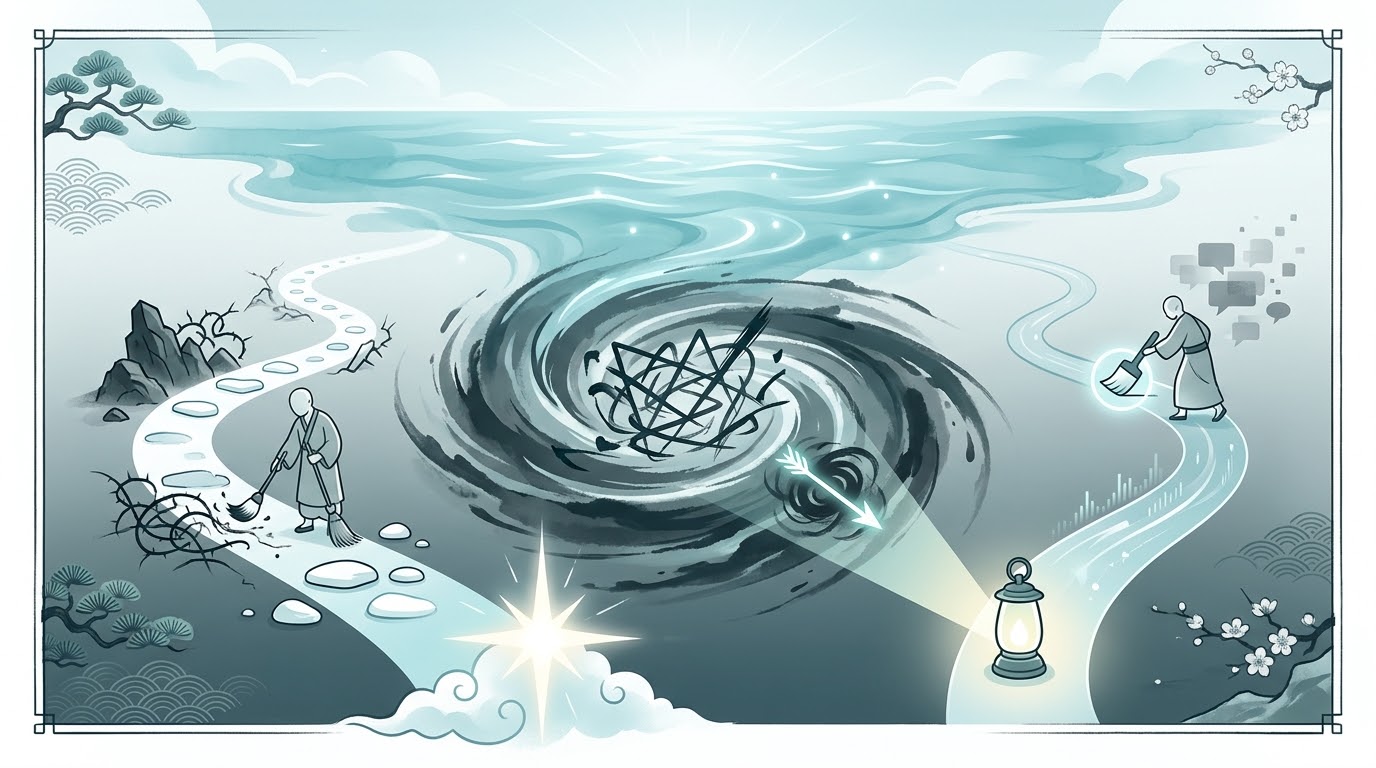
🌊 The Metaphor of the Ocean and the Wave
In the Aggi-Vacchagotta Sutta, the Tathāgata is described as "deep, boundless, and unfathomable like the great ocean."
When a fire goes out because its fuel is exhausted, asking "Did the fire go north or south?" is meaningless. The individual phenomenon (the wave) has not been destroyed; the artificial boundary has vanished, and it has returned to the vast background of space (the ocean).
- The Wave (Individual Ego): Temporarily arising due to conditions (wind and water), destined to break and subside.
- The Ocean (The Infinite Mind): The unconditioned water that neither increases nor decreases whether waves rise or fall.
When the wave disappears, the ocean does not perish. Shoho Kishi’s insight—"The wave may cease, but the Ocean never perishes"—announces the emergence of the Great Ocean of Compassion at the far limit of self-deconstruction.
Reintegrating the Four Immeasurables (Brahmavihāra)
Later Abhidharma schools downgraded the Four Immeasurables to minor preparatory practices for heavenly rebirth. But in early texts like the Vatthūpama Sutta, the Buddha directly links the eradication of defilements to the expansion of the Infinite Mind.
When the eye of the ego-cyclone collapses, the mind becomes Appamaññā (boundless), radiating in all directions:
- Mettā (Loving-kindness): The expansive ocean embracing the well-being of all living beings.
- Karuṇā (Compassion): The dynamic surge of the ocean seeking to rescue every wave caught in delusion.
- Muditā (Sympathetic Joy): Resonance with the joy of all beings without a trace of envy.
- Upekkhā (Equanimity): The absolute, immovable stillness of the deep ocean, untouched by surface winds.
This explains why Mahayana Buddhism and the Lotus Sutra had to arise historically in response to the cold nihilism of Sectarian Buddhism (Hinayana).
It is said that Zen Master Hakuin Ekaku, who in his youth scoffed at the Lotus Sutra as mere childish fables, read it again at age 42 upon his deep enlightenment and wept uncontrollably. How does the truth of the Lotus Sutra unite with the Buddha’s true intent?
7. The Inevitability of Mahayana and the Restoration of the Lotus Sutra: Shattering the Nihilism of "Extinction of Body and Mind"
The rise of Mahayana Buddhism was not an arbitrary invention; it was a monumental rescue operation to reclaim the Buddha’s true intent from the dead-end nihilism of "corpse-like extinction" (kaishin metsuchi) into which sectarian monasticism had fallen.
The First Council and the Monastic Suppression of the True Dhamma
Following the Buddha’s Parinirvana, the monastic elders at the First Council prioritized institutional preservation, freezing the teachings into rigid monastic codes (Vinaya) and dogmatic formulas (Sutta).
To safeguard their economic privileges, monks turned away from the radiant awakening to the Infinite Mind, retreating into scholastic hair-splitting (Abhidharma) and a selfish quest for personal extinction (the lesser Arahant).
The Burning House: The Truth That Made Hakuin Weep
In his youth, Hakuin believed he had reached the ultimate through rigorous koan training on "Mu" (Nothingness). He mocked the parables of the Lotus Sutra—the Burning House, the Prodigal Son, the Jewel in the Robe—as childish allegories.
Yet at age 42, reading the Parable of the Burning House while listening to the crickets at night, Hakuin broke into profound tears:
Ignorant children (sentient beings) engrossed in toys inside a house engulfed in roaring flames.
The Father (the Tathāgata) outside, witnessing the lethal danger (the dukkha of birth, aging, sickness, and death), desperately crying out with a breaking heart to save them.
Hakuin realized: The Buddha’s diagnosis of dukkha was never a cold, intellectual abstraction. It was boundless, heart-wrenching Compassion (Karuṇā) for every life trapped in the burning house.
📜 Shoho Kishi’s Insight into the Verse of the "Life Span of the Tathāgata" (Jigage)
"The apparent passing away of the historical Buddha was merely an expedient wave to awaken beings.
The true life of the Tathāgata is the eternal, unconditioned Ocean, never born and never dying.
I (the Tathāgata) am ever present here, with this Boundless Mind of Great Compassion,
unceasingly liberating beings from the abyss of suffering into primordial peace."
The entire theoretical architecture is brilliantly unified.
Finally, how can we cast aside counterfeit teachings in the midst of daily life, operate the Buddha's raft of self-deconstruction, and abide in the Infinite Mind? What is the practical four-step contemplation for daily life?
8. Daily Practice: Establishing the Dhamma through the Dialogue of Self-Contemplation
The Buddha's Dhamma was never intended to be confined to a meditation cushion. It is an active practice of recalling and applying the Law of Arising and Ceasing the exact moment an emotional storm or suffering (dukkha) surges in daily life.
⚡ The Four-Step Contemplation in Moments of Suffering
-
Step 1: Vitakka (Focusing the Spotlight of Attention)
The instant anger, anxiety, or impatience flares, do not suppress or run from it. Direct the spotlight of awareness precisely to where somatic tension and feeling (vedanā) are constricting in the body. -
Step 2: Vicāra (Severing Self-Identification)
Discern with crystal clarity: "This emotion is not mine. It is merely a wave of thought generated as past conditioned memories (saṅkhāra) react to sensory input." Peel away the glue of identity. -
Step 3: Sati (Recalling the Universal Law of Arising and Ceasing)
Actively recall into the conscious mind the immutable truth: "Whatever is subject to arising is subject to cessation (Vayadhammā saṅkhārā)," instantly cutting the chain of automated reactions. -
Step 4: Upekkhā (Resting in the Boundless Ocean)
Watch the wave rise and watch it subside without clinging, allowing awareness to relax back into the unconditioned stillness of the Infinite Mind.
Daily Satipaṭṭhāna Checklist
- Kāyānupassanā (Body): Do you see that "I am walking" is merely the physical chain reaction of bones and muscles arising and ceasing?
- Vedanānupassanā (Feelings): When pleasant or unpleasant sensations arise, do you detach from them as transient stimulus waves before grasping them as "my feelings"?
- Cittānupassanā (Mind): When irritation arises, do you refrain from becoming "the angry self" and instead objectively note: "There is anger in the mind"?
- Dhammānupassanā (Phenomena): When mental narratives spin, do you immediately see them as nothing more than conditioned waves of the Five Aggregates?
Conclusion: Living as a Wave, Resting as the Ocean
Through eight years of rigorous contemplation, Shoho Kishi moved from the role of a clinical dissector of the ego to that of an awakened sage resting in the all-embracing Ocean.
In this worldly life, we each exist as a single "wave"—an individual human being. As a wave, we will inevitably be tossed by winds, collide with rocks, and break upon the shore.
Yet one who knows the Truth has no fear of the wave breaking. For the true substance of the wave has always been the Water of the Great Ocean—an Ocean that was never born, never dies, and is eternally full in this very moment.
The wave may cease, but the Ocean never perishes.
Cast aside the counterfeit gold, board the Buddha’s true raft, and return to the serene, infinite Ocean of this present moment.
📚 References & External Links
-
Book: Shoho Kishi, The Buddha’s True Intent: The Law of Dependent Origination and Arising-Ceasing (Gentosha MC, 2022).
Amazon.co.jp Product Page -
Official Blog: Shoho Kishi Official Blog "Shawshank no Sora ni"
https://shawshank-blog.hatenablog.com/ - Pali Sutta Sources: Saṁyutta Nikāya (SN 16.13 Saddhamma-patirūpaka Sutta, SN 12.15 Kaccānagotta Sutta), Udāna (8.3 Asaṅkhata Sutta), Majjhima Nikāya (MN 7 Vatthūpama Sutta, MN 72 Aggi-Vacchagotta Sutta), Dīgha Nikāya (DN 16 Mahāparinibbāna Sutta), Saddharmapuṇḍarīka Sūtra (Lotus Sutra, Chapters 3 & 16).