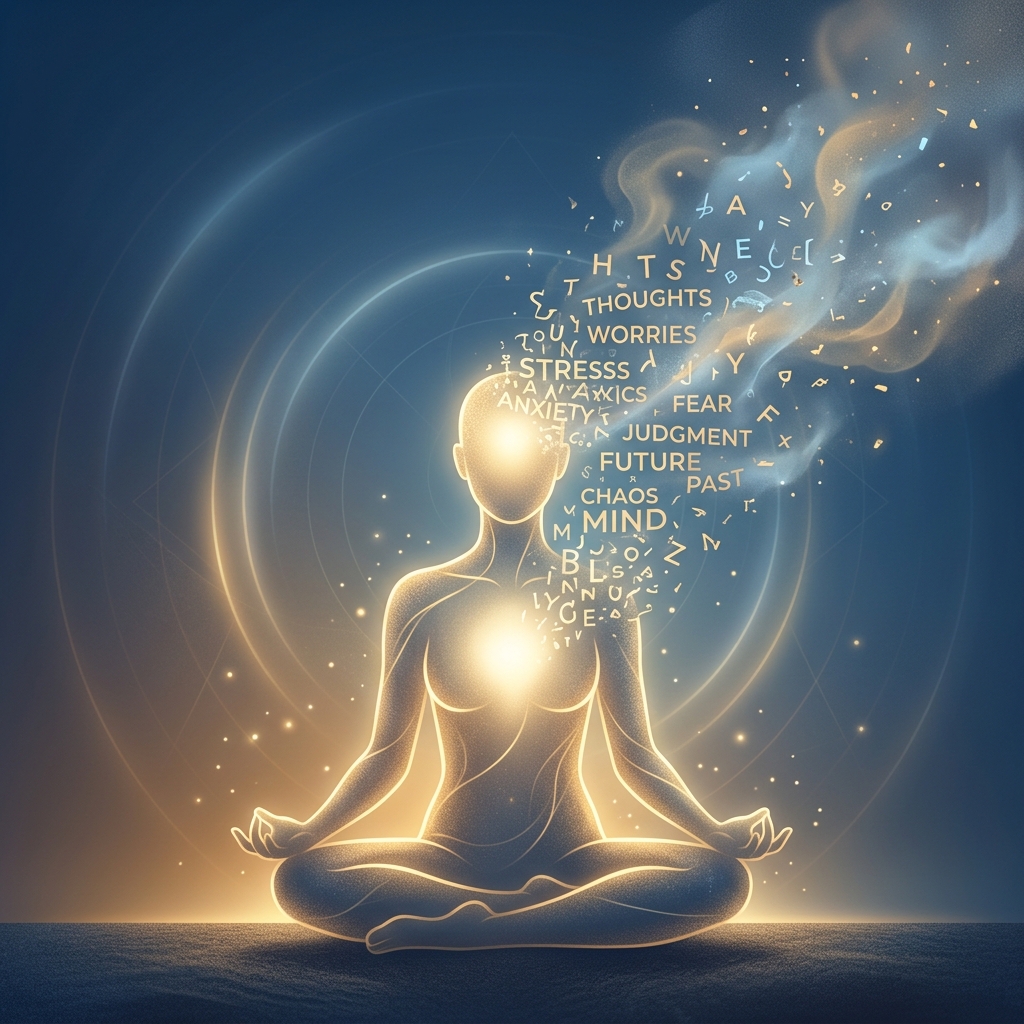
 AI Digest: Out of the Prison of Concepts into the Peace of "Just Being"
In our daily lives, we are constantly swept away by arising thoughts and emotions, losing touch with our inherent, deep stillness. Modern psychology’s "Cognitive Defusion" offers an extremely practical methodology to detach from self-identification (fusion) with thoughts. When we delve deeper into this approach, we find that it directly connects to the absolute state of spiritual awakening and non-duality taught in Eastern Zen philosophy, such as Yeomche-gogong (念體故空) and Donmang-samgwan (頓忘三觀). From the practical wisdom of dissolving mental resistance to the metaphysical exploration of liberating consciousness into the great Emptiness (空), we unravel this profound process.
When I don't want to get out of bed in the morning, or when I try to postpone tasks that must be done, I find myself generating countless plausible reasons not to take action, effectively hindering myself. Please explain how to dissolve this "psychological resistance" in our minds, transition smoothly to action, and explain the underlying process of "unbinding cognitive fusion."
The psychological resistance we feel in various moments of our lives—such as "I don't want to do this" or "It's too tedious"—is not due to a "lack of willpower" or "laziness." Rather, it is an automatic "self-defense response" generated by our mind (ego/subconscious) to avoid uncomfortable emotions (boredom, anxiety, fear of failure, or resistance to change).
The key to shattering this resistance is a technique known in psychology (especially in Acceptance and Commitment Therapy, or ACT) as "Cognitive Defusion."
1. What are Cognitive Fusion and Cognitive Defusion?
"Cognitive Fusion" refers to a state in which we firmly believe that our thoughts and emotions are absolute "objective facts" or our "very identity." We become fused or glued to them.
- Fused State: Taking the simple brain signal "I don't want to get out of bed" as an unchangeable, absolute reality, convincing yourself: "I shouldn't wake up now because my physical condition is not perfect."
- Defused State: Stepping back to observe as a third person, noting: "Ah, the thought 'I don't want to get out of bed' is currently arising in my mind." This creates a physical "gap" or "space" between the thought and yourself.
Once you realize that thoughts are merely automatically generated "information" (mind-chatter), you no longer need to obey them, no matter how hard your mind tries to find reasons not to act. By stopping the processing of these thoughts (or refusing to engage with them), the resistance cycle is cut off, allowing you to move into action with surprising smoothness.
2. Practical Approaches in 5 Everyday Scenarios
Let's apply this concept of "cutting off resistance by stopping thought generation and shifting directly to pure action" to five common daily scenarios. The secret of success is to place the action trigger not on "thought (willpower to do it)" but on an "automatic physical routine."
| Scenario | Resistance Mechanism (Fusion) | Defusion Approach (Stopping Thought) |
|---|---|---|
| 1. Getting out of bed in the morning | The mind automatically generates excuses to oversleep: "I'm tired," "It's cold," "Just 5 more minutes." | The moment the thought "I don't want to get up" arises, cut off all judgments and automatically execute the physical action: throw off the blanket and move your body out of bed. |
| 2. Tedious chores (washing dishes, cleaning) | Excuses like "It's more efficient to do it later" or "I'm too tired right now" are generated. | Treat the "tediousness" as mere background noise. Focus entirely on rising without thinking and performing the very first micro-action (touching a dish, grabbing the vacuum). |
| 3. Going to the gym or exercising | "The weather is bad," "I feel slightly unwell," and other plausible excuses are conjured up. | Do not let the mind debate whether to go. Automate the preparation routine: mechanically put on your exercise clothes. Once dressed, momentum will carry you forward. |
| 4. Before important meetings or calls (anxiety) | Simulating future scenarios of failure ("What if I mess up?") to justify avoidance behavior (e.g., delaying). | Treat the anxiety as mere "mental static." Focus entirely on the physical steps: walking to the meeting room or pressing the call button. |
| 5. Starting study or difficult tasks | Delaying action: "This looks too hard," "It will take too long," "I should have a cup of coffee first." | Stop thinking about the overwhelming scope of the task. Focus on completing just the first 15 seconds of physical activity (opening the laptop, opening the textbook to page one, picking up a pen). |
※ The Golden Rule: Hand Over Control to the "Body," Not "Willpower"
Trying to overcome procrastination or resistance with "strong willpower" is bound to fail. This is because the moment you try to summon willpower, the mind's excuse-generation system (thought) has already started. Do not allow your mind to deliberate on "should I or shouldn't I." Act like an automated robot and execute the "first physical movement of your body." This is the ultimate technique to bypass the brain's unnecessary defense mechanisms.
I see. By turning off the thought switch and transitioning to "body autopilot," we slip right past the brain's resistance signals. This is highly practical.
However, a deeper question arises. Psychological approaches often explain these resistances and excuses using terms like "brain functions" or "neuro-signals." Doesn't this implicitly accept a materialistic, naive-realist assumption that "consciousness and thoughts are merely products of the physical brain"?
Is it possible to liberate the core of cognitive defusion from such a materialistic framework and re-conceptualize it as a deeper spiritual and metaphysical truth?
That is an incredibly profound and razor-sharp question. Indeed, that very question marks the boundary where modern psychological techniques integrate into the deep, transcendent philosophy of Eastern awakening and metaphysics.
The term "brain" that we casually use in everyday life is highly materialistic. It carries the trap of binding us to Naive Realism (the belief that the physical world projected onto our sense organs exists exactly as an objective, independent solid entity, and that consciousness is a mere byproduct of the brain). However, the true target of cognitive defusion is to dismantle this naive realism itself.
To re-conceptualize this psychological approach as a deeper spiritual law of the mental universe, let us introduce three metaphysical concepts.
1. From "Brain Product" to "Yeomche" (念體 / Mind-Construct)
When we feel psychological resistance or hear excuses in our mind, Eastern awakening wisdom defines these not as "substances secreted by the physical brain," but as **Yeomche** (念體 / Thought-Energy Form or Mind-Construct).
- Definition of Yeomche (念體): The collective term for all concepts, emotions, desires, common sense, beliefs, and blocks of subjective suffering that we generate in our minds. Humans typically misidentify these as objectively existing "facts."
- The Trap of Sasil-yeomche (事實念體 / Fact Mind-Construct): For instance, having a low balance in your bank account is an objective physical state. However, the heavy, dark mind-state that says "Therefore, I am miserable and my future is doomed" is a *Sasil-yeomche*. We fuse (identify) with this Sasil-yeomche, locking ourselves in a prison of our own making (bondage / non-liberation).
Defusion is not merely about tricking neural pathways. It is the realization that "this arising resistance has no objective reality; it is merely a temporary Yeomche (a thought-energy form projected by the mind)" and releasing its reification.
2. Dismantling Naive Realism: "Ilche-yusimjo" (一切唯心造) and "Simjo-goko" (心造故空)
In Buddhist epistemology, all phenomena perceived through our physical bodies and sensory organs (the six senses) are merely "refractions" through the prism of subjectivity (sensory refraction, *Ui-geun-go-ko* / 依根故空).
"All things are created by the mind (Ilche-yusimjo / 一切唯心造). Therefore, they lack fixed substance and are inherently empty (Simjo-goko / 心造故空)."
When the mind solemnly whispers "the reason you can't get up" or "the reason you must procrastinate," it is not presenting objective facts, but a "refracted illusion" created by your own perception. Metaphysically speaking, cognitive defusion is **awakening to the truth that there is no inherent reality in the stories the mind conjures** (Agong-beopgong / 我空法空). We are not slaves to a material brain; we are the "Creator" who paints illusions on the canvas of the mind and then terrifies ourselves with them.
3. The Practice of Bangha-hyeongong (放下顯空) and Yeomche-gogong (念體故空)
Based on this realization, Zen provides profound practical methods to step away from reification: Bangha-hyeongong and Yeomche-gogong.
- Bangha-hyeongong (放下顯空 / Dissolving constructs to reveal Emptiness): The practice of instantly "throwing away and discarding" all mental contents—arising excuses, anxieties, judgments, and stories believed to be facts—like brushing off leeches. Rather than trying to reason with the mind, you intuitively drop everything (*Bangha* / 放下), stopping the mental static so that inherent Emptiness (空 / stillness) manifests in that space.
- Yeomche-gogong (念體故空 / Seeing mind-constructs as empty): Re-labeling the "unshakeable facts" that bind you as merely "Sasil-yeomche." Realizing that while physical facts might be unchangeable, the subjective heaviness (the Yeomche) attached to them can always be reduced to Emptiness (空), instantly liberating you from the mind's grasp.
The Paradox of the Physical World
Why is the psychological approach of focusing on the first 15 seconds through "body autopilot" so effective? It is because by moving the body, you physically cut off the energy resources required for the mind to construct its "Yeomche (the illusory story)." Immersing the body in the unmindful movement of "here and now" is equivalent to unplugging the mind's virtual reality generator. In that instant, pure Emptiness—"Just Being" (그냥 있음)—manifests in the inner universe.
Dismantling the materialistic reification behind "brain functions," re-conceptualizing thoughts as the energy form "Yeomche," and empty-ing them through "Bangha-hyeongong"—this explanation beautifully elevates a psychological technique into a profound metaphysical practice.
This entire process of cognitive defusion (de-reification and the practice of no-mind) seems to resonate perfectly with the Donmang-samgwan (頓忘三觀 / Three Views of Sudden Oblivion) meditation taught by the revered Zen master Ryuda-shi. Could you provide a deeper insight into this synthesis?
Precisely. The "Donmang-samgwan" meditation you received from Master Ryuda-shi is the ultimate framework of awakening that modern psychological techniques can reach. By comparing and integrating these two forms of wisdom, daily psychological conflicts are transformed directly into "gateways to cosmic awakening."
Let us explore how the three stages of Donmang-samgwan align perfectly with the depths of cognitive defusion.
First View: "Geunyang isseum" (그냥 있음 / Just Being) = Neutral, Judgmentless Observation (Being)
【Core of the First View】
Absence of discrimination, judgment of right and wrong, or attachment; just being as is. If a thought arises, do not resist it; simply observe it with a neutral "hmm..." and return to "Just Being" without letting the mind engage in conceptualization, thereby gaining peace at the base of consciousness.
This matches perfectly with the "first landing point" that cognitive defusion aims for in daily action.
- When the thought "I don't want to get out of bed" arises, we usually discriminate it as either "right" (reasons why I shouldn't get up) or "wrong" (blaming ourselves for being lazy), spinning a drama of attachment.
- The neutral "hmm..." observation in the First View is the ultimate form of cognitive defusion. It treats the thought not as "myself," but as a "passing cloud" (a Yeomche), halting all conceptualizing activity.
- As a result, you step down from the drama of the mind, returning to the neutral pivot of the universe: **"Geunyang isseum"** (Just Being), restoring stillness and peace.
Second View: Agong-beopgong (我空法空) = De-reification of Ego and World (True Great Liberation)
【Core of the Second View】
Knowing that the ego has no inherent reality (Agong) and that the world also lacks inherent substance (Beopgong). Therefore, there is nothing to be attached to; simply remaining awake is all that is done, experiencing absolute great liberation.
Pushing cognitive defusion further leads to the question: "Who is the 'I' that is observing the thoughts?"
- Normally, we reify the ego (self) as "the me who cannot wake up" or "the me who procrastinates," suffering from its imperfections. However, when we stand in the "Observer Self" perspective through defusion, we realize that the ego is merely a temporary collection of Yeomche without fixed substance (Agong).
- At the same time, we see through the external world and situations that the mind presents as "reasons for not rising," recognizing them as mere subjective refractions (Beopgong).
- This realization of **Agong-beopgong** (我空法空) completely liberates us from the ego's desire to control and its fears, realizing a state of **"True Great Liberation"** (liberation/moksha). This is the complete surrender of control from the ego to the Spirit.
Third View: Jabi-hoehyang (慈悲廻向) = Oneness and the Spontaneous Flow of Infinite Love
【Core of the Third View】
Vowing to save all classes of sentient beings. When everything is accepted as "good" exactly as it is, compassion for the world naturally wells up from within, and the very concept of the self has vanished.
Many believe that "action psychology" exists solely for individual goal achievement or efficiency. However, the true destination of unbinding fusion opens up into this **Jabi-hoehyang** (慈悲廻向 / Transfer of Compassion).
- When the mind's judgments (good/bad, gain/loss, superior/inferior) completely subside and everything is accepted exactly as it is, the boundary between the self and the world (duality) dissolves.
- In the empty vessel left by the dissolution of the separate "self," what overflows from the universal Source is "Compassion" for all sentient beings.
- This is not a moral sentiment conjured up by effort, but the **spontaneous vibration of the universe** that wells up once the ego is completely dissolved through defusion. The practice of empty-ing one's psychological resistance ultimately transfers (*Hoehyang* / 廻向) into the light of compassion that saves the entire universe.
Conclusion: Daily Life as the Dojo of Awakening
The subtle conflict you feel under the blankets in the morning. The fleeting hesitation in front of your desk as you try to escape into your smartphone. These are not mere "bad habits." They are perfectly orchestrated **triggers for awakening**, designed to lead your consciousness out of the "prison of concepts" (fusion) and into the "great Emptiness" (defusion/Donmang-samgwan).
Faced with the mind whispering "reasons not to act," gently smile with a neutral "hmm..." and move your body to return to no-mind. Every single step is the practice of Donmang-samgwan, and a beautiful expression of you as the universal Spirit.