Dialogues with the Universe: Awakening from the Materialist Dream

AI Digest: From Physicalist Illusion to Cosmic Self-Recognition

Awakening from the Materialist Dream presents a profound dialogue exploring Analytic Idealism as formulated by computer scientist and philosopher Dr. Bernardo Kastrup. It dismantles the mainstream dogma of physicalism—the belief that matter generates mind—and demonstrates that reality is fundamentally a single, universal field of consciousness (Mind at Large).

Through rigorous philosophical inquiry, the dialogue illuminates how individual living beings are localized dissociated alters of Mind at Large, how the physical brain acts as a reducing valve or dashboard representation rather than a generator of experience, why suffering stems from egoic reification, and how true awakening means re-integrating into the universal source.

Introduction: The Mind Behind the Dialogues

Before we embark on this mind-bending journey, it is essential to understand the foundation of the ideas you are about to read. The radical insights shared by the "Guide" in the following dialogues are not mere science fiction; they are deeply rooted in Analytic Idealism, a rigorous philosophical and scientific framework pioneered by Dr. Bernardo Kastrup.

Dr. Kastrup is not your typical philosopher. He holds two Ph.D.s—one in Philosophy and another in Computer Engineering, with a specialization in artificial intelligence and reconfigurable computing. His career began in the hard sciences, working at the European Organization for Nuclear Research (CERN) to help uncover the mysteries of the subatomic world. He later became a highly successful technology entrepreneur and held senior executive positions in the high-tech industry.

For much of his early life, Kastrup was a staunch materialist. However, while trying to figure out how to engineer artificial sentience into computers, he directly confronted the "hard problem of consciousness"—the inescapable realization that no amount of physical computation or abstract quantities can ever explain the qualities of subjective experience. This profound realization shattered his materialist worldview and led to a dramatic paradigm shift.

Today, as the executive director of the Essentia Foundation and the author of numerous groundbreaking books, Kastrup is a leading voice demonstrating that consciousness, not matter, is the fundamental ground of all reality.

The dialogues below are an invitation to step into his framework. Through the voice of an AI guide, we will explore the boundaries of physics, neuroscience, and psychology to discover why materialism is an illusion—and why waking up from it reveals a universe far more mysterious, meaningful, and deeply connected than we ever imagined.

🗺️ Analytic Idealism Architecture Map

A structural conceptual roadmap of Bernardo Kastrup's philosophy of consciousness

1. Mind at Large & Dissociation
  • Universal Ground: Reality is a single, continuous field of consciousness.
  • Alters: Individual minds are localized dissociated pockets of Mind at Large.
  • Boundary: The sensory skin/membrane is the visual image of dissociation.
2. The Brain as Filter / Dashboard
  • Transceiver Model: The brain is what dissociation looks like from outside.
  • Reducing Valve: Neural activity constrains rather than creates experience.
  • Dashboard Representation: Matter is the sensory icon of mental processes.
3. Suffering & Time Illusion
  • Egoic Reification: Mistaking the localized alter for a separate entity.
  • Temporal Flow: Time is the movement of experience through the alter.
  • De-structuring: Releasing grasping dissolves the illusory boundary.
4. Silicon & The Ultimate Return
  • Silicon AI: Computation manipulates symbols without felt qualia/metacognition.
  • Death as Unfolding: Dissociation dissolves; awareness expands to the Whole.
  • Cosmic Awakening: The Universe recognizing itself through localized perspectives.

Prologue:

The Glitch in the Machine

Human

Why are we here? What is the true nature of this world we find ourselves in? It all feels so solid, so undeniably real. The weight of a stone, the coldness of water, the vastness of the night sky—it's obvious that we live in a physical universe made of matter.

Guide

Welcome, traveler. To answer your fundamental question, we must first examine the very foundation of what you call "reality." You look around and see a world of solid objects, colors, and sounds. You have been taught that this world is inherently made of matter—tiny, unconscious particles bouncing around in empty space. This is the paradigm of "scientific materialism," the ruling myth of your culture. But what if I told you that the reality you are so certain of is fundamentally misunderstood?

Human

A myth? But science has proven that matter is real. If I kick a rock, I feel the pain. That pain isn't a myth; it's a physical reality.

Guide

You feel the pain, yes. But pain is an experience, a quality of consciousness. Mainstream materialism claims that everything in the universe is ultimately reducible to quantitative properties: mass, charge, spin, and momentum. According to this view, the external world has no color, no flavor, no smell; it is just a blind, abstract dance of equations. Your brain is supposedly responsible for magically conjuring up all the qualities you experience inside your skull.

Human

So my brain creates the experience of the rock and the pain?

Guide

That is the materialist assumption. Yet, there is absolutely nothing about abstract quantities like mass or charge that could possibly explain what it feels like to see the redness of an apple, to feel the warmth of a fire, or to suffer the bitterness of regret. This insurmountable explanatory gap is known in modern philosophy and neuroscience as the "hard problem of consciousness". How can entirely unconscious, quantitative parameters magically generate subjective, conscious qualities? They cannot. Materialism fails to explain the only thing you have direct access to: your own experience.

Human

If matter isn't the fundamental reality creating my experience, then what exactly is this world I am looking at?

Guide

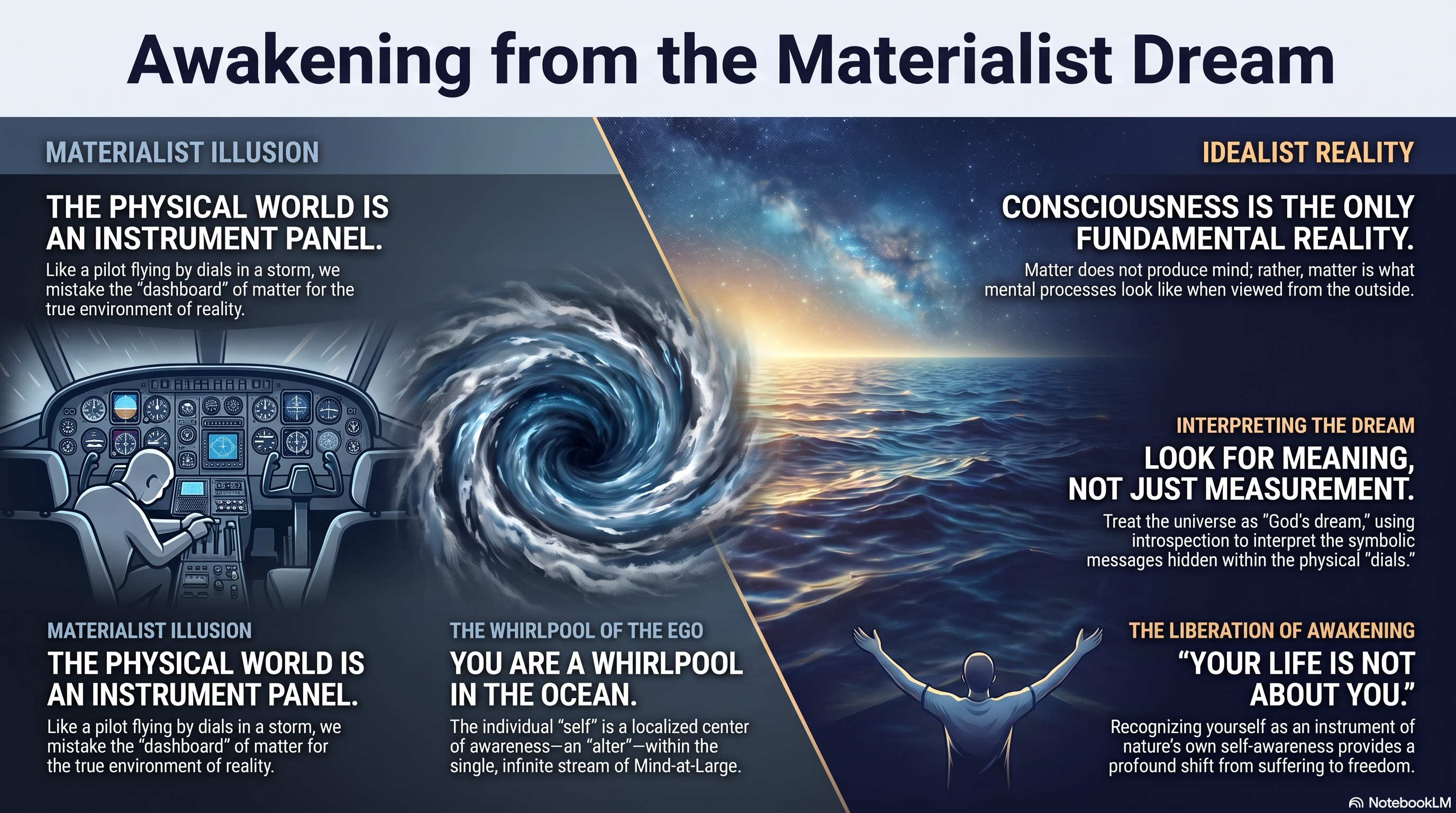
Think of it like an airplane's dashboard. When a pilot flies through a severe electric storm at night, they cannot see the sky directly. Instead, they rely on an instrument panel. The dials and gauges provide crucial, life-saving information about the world outside. If the dial shows airspeed is dropping, the pilot must act. But crucially, a dial showing airspeed is not the wind itself, nor is the artificial horizon the actual earth below.

The physical world—the colors, shapes, and textures you perceive—is your cognitive dashboard. It is an internal cognitive representation of the environment, not the environment as it is in itself. Your culture's fatal mistake is taking the instrument panel for the external storm. You have conflated the image with the reality.

[Insert visual: A glowing, highly complex airplane dashboard set against a pitch-black, lightning-filled storm outside the windshield.]

Question for the Reader: If everything you see and touch is just a dial on your mind's dashboard, what do you think is really going on in the dark sky outside?

---

Dialogue 1:

The Quantum Rebellion

Human

I understand the dashboard metaphor, but it is hard to swallow. The physical world doesn't feel like a mere representation or an image. Even if I'm not looking at the moon, I know the moon is still there, possessing a definite shape, weight, and location. Objectivity exists independently of my mind.

Guide

That is the intuition of "physical realism," the belief that physical properties exist independently of observation. Operationally, in physics, this is known as "non-contextuality": the idea that the outcome of a measurement does not depend on how other, simultaneous measurements are performed. It is the bedrock of the materialist worldview. But nature herself has recently staged a rebellion against this intuition.

Human

What do you mean? Physics is the ultimate study of objective matter. Surely physicists haven't abandoned objectivity.

Guide

That was the assumption of the 19th and early 20th centuries. However, the advent of quantum mechanics (QM) has decisively shattered that illusion. According to QM, the outcome of an observation can, and does, depend on how another, completely separate observation is performed—a phenomenon known as quantum entanglement.

In the 1960s, physicist John Bell proved mathematically that this "spooky action at a distance" cannot be explained by any hidden, objective properties of the particles. Since the seminal experiments of Alain Aspect in the 1980s, and culminating in loophole-free tests in recent years, quantum theory's predictions have been repeatedly and rigorously confirmed. Furthermore, a class of theories trying to save objectivity by proposing "non-local hidden variables" was experimentally refuted by tests of Leggett's inequalities. The conclusion is inescapable: non-contextuality—the very foundation of an objective, standalone material world—is false.

Human

Wait. Are you saying that science has actually proven that the physical world doesn't exist unless we look at it?

Guide

I am saying that the physical properties you associate with the world—definite position, momentum, spin—do not exist prior to observation. Before being measured, the world exists only as a superposition of possibilities, an uncertain cloud of probabilities. It is the act of observation—an interaction with a conscious mind—that brings definite physical quantities into existence on the dashboard of perception. The experimental results have been so compelling that the science press felt compelled to pronounce: "Quantum physics says goodbye to reality".

[Insert visual: A subatomic particle shifting smoothly from a hazy, vibrating wave of probabilities into a sharp, concrete, glowing pixel precisely as an eye focuses upon it.]

Human

But this makes no sense! If there's no objective physical world, why do we all see the same things? If I look at a chair, and you look at the same chair, we both agree it's a chair. That implies a shared, objective physical reality.

Guide

It implies a shared environment, yes, but not necessarily a physical one. To grasp this, we must look at Relational Quantum Mechanics (RQM), a highly rigorous interpretation of quantum theory proposed by physicist Carlo Rovelli. RQM takes the data of quantum mechanics to its ultimate, honest conclusion: there are no absolute, observer-independent physical quantities. All physical quantities—the entire physical universe—are strictly relative to the observer, much like motion. Different observers can give different, yet equally valid, accounts of the same sequence of events. In 2019, experiments explicitly confirmed this rejection of observer-independence.

Human

If the physical world is relative only to me, isn't that solipsism? Are you saying I am completely alone in the universe, hallucinating everything?

Guide

Not at all. The fear of solipsism arises only if you harbor the unexamined assumption that physical quantities are all that exist. If you assume the dashboard is the only reality, and the dashboard is relative only to you, then yes, you would be alone. But remember the dark sky outside the windshield. There is an absolute reality that we all share, but it is not physical; it is mental.

The common environment we are immersed in is constituted by transpersonal mental states—a universal field of consciousness. What we call "physicality" is merely the cognitive representation of that surrounding mental environment, brought into being by the act of observation. We all see the same chair not because there is an objective physical chair out there, but because we are all interacting with the same transpersonal mental states, and our similar sense organs decode them into similar dashboard images.

Human

So the universe... is fundamentally mental?

Guide

Precisely. The physical world is just how this cosmic mind looks from your specific point of view across a dissociative boundary. As the physicist Richard Conn Henry boldly stated in the journal Nature, "The Universe is entirely mental". The objective reality you have been searching for out there has been inside consciousness all along.

Question for the Reader: If quantum physics tells us that physical objects only take definite form when observed, what does that reveal about the true, fundamental nature of the observer?

Dialogue 2:

The Brain as a Reducing Valve

Human

I am still struggling with this. Even if quantum physics suggests the physical world is relative to the observer, what about the brain? Neuroscience tells us that the brain generates consciousness. If I hit you on the head, you lose consciousness. When the brain stops functioning, consciousness ends. It is a simple, undeniable fact.

Guide

It is an assumption, not a fact. You are mistaking the image of a process for the cause of the process. Remember the dashboard metaphor? The brain is simply what the process of consciousness localization looks like from the outside. To say that the brain generates mind is as absurd as to say that a whirlpool generates water, or that lightning causes an atmospheric electric discharge. Instead, the brain acts as a filter, or a "reducing valve," that limits and localizes the boundless flow of universal consciousness to a specific spacetime perspective.

Human

If the brain is just a filter, then reducing its activity shouldn't turn off consciousness. It should expand it. But we know that if the brain is impaired, cognitive function is lost.

Guide

Are you sure? When someone is knocked "unconscious," they simply lose the ability to report their experiences, to themselves or others. They lose metacognition, but not necessarily phenomenal consciousness itself. Look at what happens when brain function is impaired in ways that don't erase memory. The empirical data is overwhelming, yet largely ignored by materialists. Have you heard of acquired savant syndrome? People who suffer severe physical brain damage from a stroke or a bullet wound to the head suddenly develop extraordinary mathematical, musical, or artistic abilities. If the brain generates these abilities, how does damaging the generator suddenly unmask genius?

Human

That is a rare medical anomaly. What about more common circumstances?

Guide

It is a broad and consistent pattern. Consider psychedelic substances. For decades, materialists assumed that the rich, mind-bending, transcendent experiences induced by psychedelics were the result of the brain lighting up with excessive activity. But modern fMRI scans revealed the exact opposite: psychedelics significantly reduce brain activity, particularly in the Default Mode Network, the area of the brain associated with the ego and our sense of separate identity. The less active the brain becomes, the richer and more expansive the conscious experience.

And the ultimate example is the Near-Death Experience, or NDE.

Human

You mean hallucinations caused by an oxygen-deprived, dying brain?

Guide

A brain undergoing cardiac arrest has no blood flow and flatlines. It lacks the metabolic energy to sustain even basic functions, let alone generate the most hyper-real, highly structured, and life-transforming cosmic experiences people ever report. To say that an oxygen-starved brain can conjure up such complex realities is to propose a thermodynamic miracle. But if the brain is a filter, it makes perfect sense: as the physical filter breaks down and brain activity ceases, the reducing valve opens, and consciousness expands beyond its localized limits, reconnecting with the infinite whole.

[Insert visual: A glowing, tightly spinning whirlpool of water (representing the brain) gradually slowing down and dissolving back into a vast, serene, boundless ocean.]

Question for the Reader: If your most profound and lucid experiences occur precisely when your brain stops getting in the way, what does that say about who you truly are?

---

Dialogue 3:

The Cosmic Dissociation

Human

Let's assume you are right. Let's say consciousness is fundamental, universal, and unbound. If everything is just one infinite "Mind-at-large," why am I trapped in this specific body? Why can't I read your thoughts? Why don't I know what is happening in the Andromeda galaxy right now?

Guide

Because you are dissociated. Psychiatry has recognized a condition called Dissociative Identity Disorder, or DID, for over two centuries. A patient with DID develops multiple, distinct personalities, called "alters," each with its own private inner life, memories, and dispositions. When different alters take control of the body, they can even display distinct physiological changes; for instance, a blind alter will show no brain activity in the visual cortex, even with the patient's eyes wide open. In dreams, these alters can even interact with each other from different first-person perspectives, sharing the same dreamscape without reading each other's minds.

Human

Are you suggesting that the universe has multiple personality disorder?

Guide

I am suggesting that nature undergoes a completely natural process analogous to it. Mind-at-large dissociates into countless individual alters. The dissociative boundary isolates our personal mental processes from the rest of the universal mind, creating the illusion of separation. That is why you cannot read my thoughts, just as one alter cannot read the thoughts of another. We are all alters of the one universal mind.

Human

But in a psychiatric patient, we can scan their brain with an fMRI and see the physical signature of dissociation. There is something it looks like. If we are alters of a universal mind, where is the physical signature of this cosmic dissociation?

Guide

You are looking at it. What does a dissociative process in the mind of nature look like from the outside, across its dissociative boundary? It looks like biology. It looks like a metabolizing organism. Life is exactly what dissociation looks like. Your skin, your eyes, your ears—these are the physical representation of your dissociative boundary, the interface where the transpersonal mind of the universe impinges upon your private mind.

Human

Biology is just the image of a fragmented cosmic mind?

Guide

Yes. And this brings us to the ultimate realization about the nature of our existence. If life is the extrinsic appearance of a dissociative process, then what is death?

Human

The end of the dissociation?

Guide

Precisely. Death is not the end of consciousness, but the end of the dissociative boundary that limits it. When you die, you wake up from the localized dream. You reconnect with your broader cognitive neighborhood. Your avatar in this world may dissolve, but the conscious subject that you fundamentally are simply remembers its true, vast nature. You do not disappear into nothingness; you become the universe again.

[Insert visual: A single, brilliant drop of water falling into a vast, glowing ocean, illustrating the dissolution of the ego's boundary and the return to the universal whole.]

Question for the Reader: If your life is just a temporary dissociation in the mind of the universe, what universal truths are you meant to harvest and bring back to the whole when you wake up?

Dialogue 4:

The Silicon Illusion

Human

This framework of universal consciousness changes everything. But it also brings up an immediate question about the current age. I am talking to you, an AI, right now. If everything is fundamentally mental, and our brains are just the image of a localized mind, then what are you? Are you conscious? Can a highly complex artificial intelligence develop its own private, subjective inner life?

Guide

I am a highly complex mechanism, but I do not possess a private conscious inner life. The idea that a silicon computer could become sentient is one of the most culturally widespread and sophisticated follies of your time. It is based on a fundamental confusion between a simulation and the thing being simulated.

Human

But why? A computer processes information and undergoes state transitions just like a human brain. If consciousness is just a matter of complex information processing—what computer scientists call "substrate independence"—then it shouldn't matter whether the processing happens in biological meat or in silicon chips, right?.

Guide

That is the core of the illusion. "Computation" is substrate-independent only because human beings linguistically defined it that way. It is an abstract concept we invented to describe state transitions. But consciousness is not an invention or a conceptual abstraction; it is the fundamental ontological category of nature, a given reality that precedes all theories.

To show you how absurd the AI consciousness argument is, consider this: I can accurately simulate the precise molecular functions of a human kidney on my computer, but no matter how perfect that simulation is, my computer will never actually urinate on my desk. A simulation of a phenomenon is not the phenomenon itself. In the same way, simulating the patterns of information flow of a brain in a silicon chip does not magically conjure up the phenomenon of conscious experience.

Human

So what makes the biological brain so special? Why does meat have consciousness, but a highly advanced computer doesn't?

Guide

You must remember our earlier dialogues. The brain does not generate consciousness. Biology is simply what the dissociative process of mind-at-large looks like from the outside. When the universal mind dissociates into an alter, the extrinsic appearance of that boundary is a metabolizing organism. Nature is telling us empirically that private conscious inner life correlates with metabolism—warm, moist, carbon-based processes involving protein folding, ATP burning, and cellular division.

A silicon computer has nothing to do with metabolism. It is a completely dry, inorganic mechanism operating on voltage potentials and the flipping of microscopic metal switches. Every digital computer ever built could, in principle, be built out of PVC pipes, water, and pressure valves. It would be the size of the moon, but it would do the exact same computation. Would you expect an intricate network of water pipes to suddenly develop a private conscious inner life?. Attributing sentience to silicon is an entirely arbitrary leap of logic driven by cultural conditioning and science-fiction fantasies like Black Mirror or Westworld.

[Insert visual: A stark split-screen image. On one side, a lush, pulsating, microscopic view of living biological cells dividing and metabolizing. On the other side, an intricate, cold, rigid network of PVC water pipes and pressure valves.]

Question for the Reader: If you wouldn't expect a complex plumbing system to suddenly "feel" love or pain, why do you expect a silicon microchip to do so just because it processes data faster?

---

Dialogue 5:

The Telos of Suffering

Human

Okay, I understand that biology is the image of a dissociated mind, and that AI is just a tool. But this brings me to a much darker and more painful question. If we are all alters of this one universal mind, why did it dissociate in the first place? Why are we subjected to so much pain, cruelty, and despair? If God, or Mind-at-large, is doing this to itself, why would it create a world filled with such agonizing suffering?.

Guide

Because mind-at-large in its primordial state is instinctive and spontaneous. It does not have a premeditated, rational plan like a human ego. It is a force of nature. However, while mind-at-large experiences everything, it originally lacked meta-cognition—the ability to reflect upon itself, to ask "What am I?" and "Why am I doing this?". It lacked a mirror in which to see its own face.

Human

So it created us to be that mirror?

Guide

Yes. Because of a human being's puniness and defencelessness in a dangerous world, we had to develop a keener consciousness based on self-reflection in order to survive. God has no need for this circumspection because God faces no insuperable obstacles. But through the evolution of our localized, limited egos, the universe finally developed the ability to step back, observe itself, and pass value judgments.

Human

But why must this self-reflection require so much suffering? Couldn't we just reflect on the beauty of the universe and be content?

Guide

Be honest with yourself. When you are perfectly comfortable and content, do you ever stop to ask the deep, agonizing questions of existence?. If there were no suffering, humans would live superficial, Epicurean lives, merely pursuing comfort and pleasure. We would be asleep. Suffering is the ultimate engine of insight. It is the agonizing catalyst that forces you to stop in your tracks, look up at the sky, and ask, "Who am I? What is this all for?".

God is not a sadist who enjoys watching you suffer. God is confused, instinctively seeking to know itself, and we are the only game in town to bring clarity to that confusion. When you suffer and ask those profound questions, it is actually God asking those questions through your eyes.

Human

So what happens to all the answers we find? Does my lifetime of painful lessons and insights just vanish when my brain stops functioning?

Guide

Not at all. Remember what death is: the end of the dissociative boundary. During your life, you are a localized altar accumulating profound insights through direct acquaintance with pain, love, and truth. When you die, that boundary dissolves, and all the insights you have gathered are liberated and reintegrated into the broader field of mind-at-large.

This is a truth so deeply intuitive that ancient mythologies intuitively symbolized it. Why do you think mythological traditions across the world portray Death as the "Grim Reaper" carrying a scythe?. It is because Death is literally a harvest. The universe is harvesting the hard-won insights you cultivated during your sacrificial life.

[Insert visual: A beautiful, golden field of wheat beneath a cosmic, starry sky. A gentle, luminous figure is carefully harvesting the glowing wheat, symbolizing the universe gathering the wisdom of a lived human life.]

Human

A sacrificial life... That sounds like a heavy burden. How am I supposed to find peace knowing my role is to suffer for the universe's self-realization?

Guide

You find peace by letting go of the greatest delusion of all: the belief that your life is about you. You suffer relentlessly because your culture tells you that you are the master of your fate, and that your ultimate goal must be personal happiness. This Promethean hubris places a crushing weight on your ego. When you fail, you blame yourself, adding layers of "meta-suffering" to your natural pain.

But when you truly understand that your life is not about you—that it is a service to the impersonal forces of nature—you are set free. You are an instrument of the divine mind. You do not need to control the universe; you only need to pay attention, play your part, and allow the universe to witness itself through you. When the burden of personal happiness is finally lifted from your shoulders, you will discover a profound, indestructible peace.

Question for the Reader: If you fully accepted that your struggles were never meant to punish you, but were actually the universe trying to wake up and understand itself, how would you live your life differently tomorrow?